

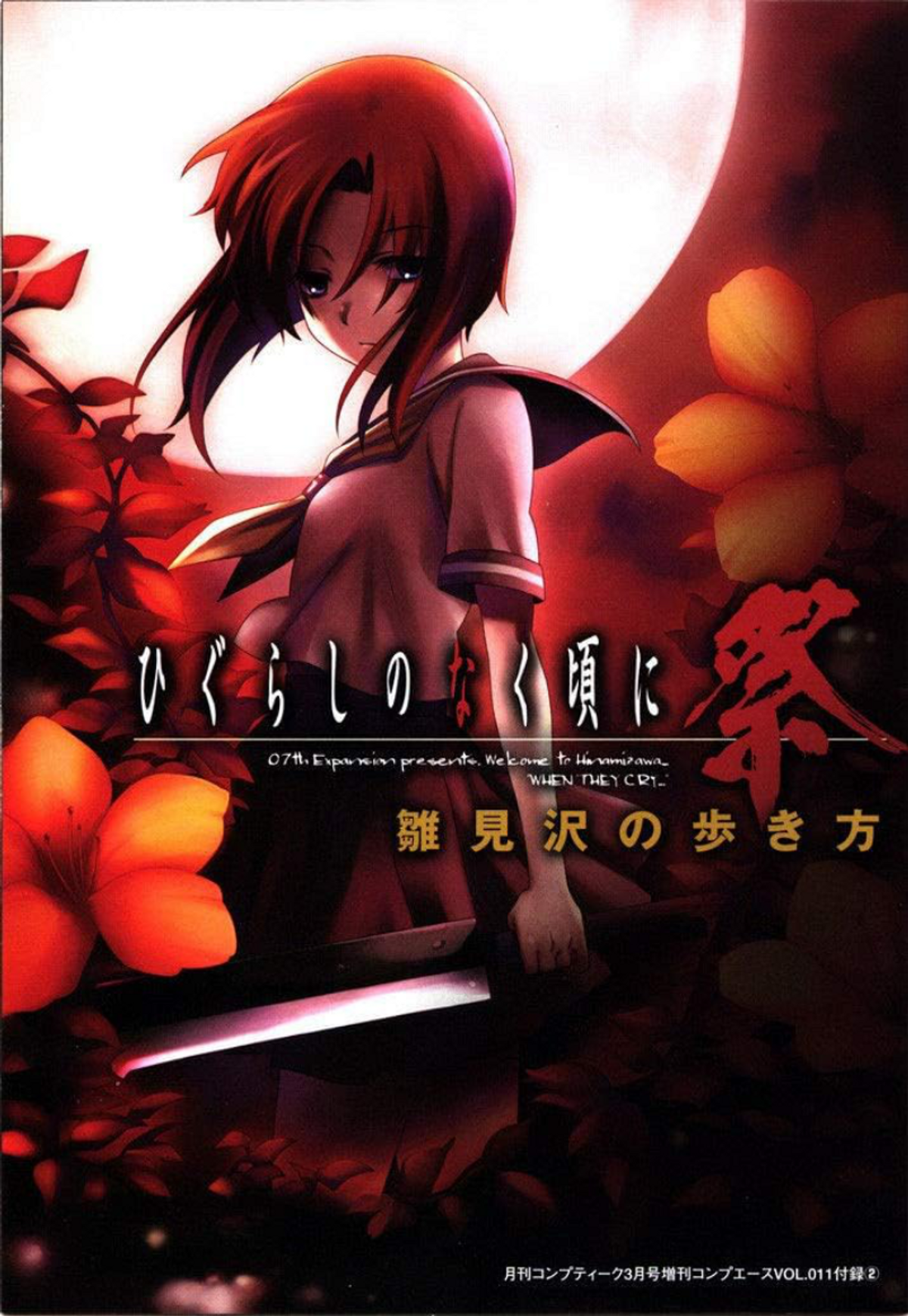
Higurashi: When They Cry (Japanese title: ひぐらしのなく頃に, Higurashi no Naku Koro ni, which roughly translates to "When the Cicadas Cry") is a series of eight Kinetic Novels/sound novels by 07th Expansion, released between 2002 and 2006 and later adapted into both an anime and a manga series. It is the first series in the When They Cry franchise, followed by Umineko: When They Cry and Ciconia: When They Cry. While primarily a murder mystery series in terms of genre, it also frequently crosses over with Folk Horror and Psychological Horror, and even dips a bit into Conspiracy Thriller at times.
According to the writer, the idea came to him while he was playing through the defining visual novels of the late 90s/early 2000s, such as Key/Visual Arts' seminal classics Kanon and AIR. He noticed a pattern emerging in these stories, with them usually starting out with a series of light-hearted and comedic Slice of Life vignettes, only to later take a turn for the more serious, to tell a tragic story of loss and heartbreak. He found himself thinking that what if, instead of tugging on the audience's heartstrings, this set-up could be used to tell a story that would scare them?
The year is 1983. When Keiichi Maebara and his family move to the sleepy little rural village of Hinamizawa in the Gifu Prefecture, everything seems peaceful and rustic at first. Keiichi has quickly befriended two local girls from his class, the gentle and nurturing Rena Ryugu (who is crazy for cute things) and the boisterous and cheeky Mion Sonozaki, who eventually invite him to join their after school club, the "Games Club", where the other two younger members are the bratty prankster Satoko Houjou and the quiet Rika Furude (who often proves to be wise beyond her years). But Keiichi quickly learns that there is more to the four girls than meets the eye... and more to the town as well. Revelation follows revelation, and brutal murder follows brutal murder in the enigmatic tale told from a variety of viewpoints and scenarios.
Higurashi consists of several different story arcs with most arcs beginning similarly but ending differently. The first four chapters, named the "Question Arcs" focus on the cycles of paranoia and death that plague the main characters. The fifth to eighth chapters, known as the "Answer Arcs" or "Kai", delve deeper into the causes of the repeating scenarios and their inevitable conclusions and the struggle to defy fate and the curse of "Oyashiro-sama".
While these eight games make up the main series, several bonus chapters are available, including "Rei" (a fandisc collection, which includes the epilogue chapter, Saikoroshi-hen, which functions as a coda to the main story, as well as two non-canon and comedic Omake chapters) and a fourth, anime-only installment, "Kira" (a series of light hearted Fanservice laden OVAs that are outside of continuity). There are also several short, manga-only arcs, usually placed before or after the main story and introducing new characters, while retaining the typical atmosphere of the series. These arcs were adapted with some new ones for the Nintendo DS under the title Higurashi no Naku Koro ni Kizuna (2008).
The sound novels also had an Updated Re-release for PlayStation 2 named Matsuri (2007), with the original final arc (Matsuribayashi-hen) left out and replaced by an alternate ending (Miotsukushi-hen), as well as two additional arcs. The ports turn the games into bona-fide Visual Novels with choices and routes rather than independent successive arcs like the original version. Later ports to other consoles added even more extra material.
While the eight core games were translated by MangaGamer in 2009, the translation was largely considered rather poor. However, from 2015 to 2023, the entire series (including the eight main games, the three Rei games, and the three Hou games) were given a Western release, with updated sprites and a re-translation, from the same company under the title Higurashi When They Cry Hou. It includes the eight main games along with Rei and Hou+ and can be purchased from Steam or GOG.com.
An anime adaptation by Studio DEEN aired in 2006, with a continuation, entitled When They Cry: Kai (or When the Cicadas Cry: Solution), airing in 2007 and covering the last two arcs.
Two Live-Action Adaptations were made, titled Higurashi No Naku Koro Ni (2008) and Higurashi No Naku Koro Ni Chikai (2009), which adapt the first and sixth novel, respectively. An OVA called Higurashi no Naku Koro ni Kaku: Outbreak, based on Ryukishi07's short story, was released in 2013.
In September 2020, a smartphone game with gacha elements and featuring a "sequel" story to the original visual novel, Higurashi: When They Cry Mei was released to tie-in with the premiere of Gou.
A sequel anime by Studio Passione titled Higurashi: When They Cry – Gou premiered in October 2020, and a second sequel, Higurashi When They Cry Sotsu premiered in July 2021; they partly serve as a thematic link between Higurashi and the second "When They Cry" series, Umineko.
A manga Higurashi no Naku Koro ni Meguri began publishing from October 2021 was completed with the release of the last part of the final chapter, Akarigurashi-hen, in January 2024 and is a continuation/retelling of Gou/Sotsu.
A sequel manga, Higurashi: When They Cry Rei (shares name with a 2006 game and an OVA), was introduced shortly after the end of Gou/Sotsu. Taking place in the Reiwa era some thirty years after the events of the original series, the story now focuses on the children of our protagonists as Keiichi's son Keitarou returns to Hinamizawa after five years.
The original installments of the Visual Novel series consists of:
Question Arcs
- Chapter 1: Onikakushi (鬼隠し編 Onikakushi-hen, lit. "Demoned Away Chapter"), released August 10, 2002
- Chapter 2: Watanagashi (綿流し編 Watanagashi-hen, lit. "Cotton Drifting Chapter"), released December 29, 2002
- Chapter 3: Tatarigoroshi (祟殺し編 Tatarigoroshi-hen, lit. "Curse Killing Chapter"), released August 15, 2003
- Chapter 4: Himatsubushi (暇潰し編 Himatsubushi-hen, lit. "Time Wasting Chapter"), released August 13, 2004
Answer Arcs
- Chapter 5: Meakashi (目明し編 Meakashi-hen, lit. "Eye Opening Chapter"), released December 30, 2004
- Chapter 6: Tsumihoroboshi (罪滅し編 Tsumihoroboshi-hen, lit. "Atonement Chapter"), released August 14, 2005
- Chapter 7: Minagoroshi (皆殺し編 Minagoroshi-hen, lit. "Massacre Chapter"), released December 30, 2005
- Chapter 8: Matsuribayashi (祭囃し編 Matsuribayashi-hen, lit. "Festival Accompanying Chapter"), August 13, 2006
Fandisk
- Higurashi no Naku Koro ni Rei (ひぐらしのなく頃に礼, lit. When the Cicadas Cry Gratitude), December 31, 2006
Warning: Due to the nature of the plot, it may be best to experience the full story before proceeding.
Maebara-san, come into my car. The A/C is on and I have this list of tropes:
- 100% Completion: In Kizuna, the DS adaptation, in each volume, after you finish the arcs, you can go back to complete the situation tree and get alternate endings, as well as unlocking CG pictures and music.
- Abilene Paradox: Late in the series, it's revealed that, despite shunning the Houjou siblings (ostensibly because their parents betrayed the village), none of the people of Hinamizawa actually hate them. However, most of them (including the village leaders) believe that everyone else does and won't even say anything for fear of also being seen as traitors.
- Absence of Evidence: In Watanagashi-hen after Rika and Satoko go missing, the remaining club members visit their house to look for clues. Rena noticed that their bottle of soy sauce was missing, and with some other circumstantial evidence deduced the possibility that Rika visited the Sonozaki estate to borrow soy sauce and was abducted there, with Satoko following in suit.
- Accidental Innuendo: Invoked. In the Onikakushi VN, during the festival the club members try finding something cute to bring to Rena. Keiichi goes somewhere else to show her his, and she comes back all dizzy and blushing. She then comments on the cuteness of Keiichi's "little fur seal"; cue Mion and Satoko's violent retaliation on Keiichi. He showed her a seal-shaped key holder he made himself when he was a child.
- Accidental Murder:
- In Meakashi-hen, Shion's infamous Roaring Rampage of Revenge actually started unintentionally. She hits Oryou with her stun gun and drags her to the family's Torture Cellar so she could extract answers about Satoshi's disappearance... only to realize that she had already died from the stun gun. Shion proceeds to whip her corpse out of frustration that the supposed mastermind died off too quickly for her to gain anything from her.
- In almost all arcs focusing on Natsumi, she initially kills her grandmother accidentally by pushing her so that she hits her head against the end of a table. Subsequent murders and the mutilation of her grandmother's corpse are... less accidental.
- Actor Allusion:
- In the first episode of Rei, this is combined with Expy and invoked in the form of Chie-sensei pulling out wooden T squares which look a lot like Black Keys.
- In the final episode of Rei, one of Rena's cutaway fantasy scenes references the scarf-adjusting scene from Maria Watches Over Us, with Miyo in the role of Sachiko.
- Maybe it's not a voluntary one, but in the last episode of Kira, when Rena takes baby Rika home with her Mion screams her to Please Put Some Clothes On. Pretty ironic when you know that Satsuki Yukino also voiced Yoruichi, who was told that a couple of times by Ichigo in Bleach.
- Adaptation Distillation: The anime maintains the basic story, but leaves out enough detail that Ryukishi07 requested an extra arc to fill in some holes at the start of the second season. The manga written by him do a great job at capturing the mood.
- Adaptation Dye-Job:
- Eye variation. Keiichi's eyes are blue in the manga, sound novels, and Daybreak but purple in the anime and Mah-Jong game.
- The live action adaptation movies change everyone's hair colors to a natural color.
- Adaptation-Induced Plot Hole:
- Yakusamashi-hen from the anime breaks Rule X (someone random among the circle of friends having a Hinamizawa Syndrome episode that drives them to violence) without Rika apparently noticing or caring. However, when it happens in Minagoroshi-hen which originally was the first arc to break Rule X but occurs after Yakusamashi-hen in the anime), she still treats it as if it's the first time it's been broken.
- The corpse found in the river in the third arc is supposed to be Rina Mamiya but they colored the hair wrong; this was corrected in the DVD version.
- Agony of the Feet: A variation in the fifth episode of Kai, in which Satoko doesn't get any shoes when searching for Rika and ends up fleeing barefoot from her captors. She doesn't hurt her feet, but it still causes her to slip down a slope and wound her leg.
- Aliens Among Us: In Tsumihoroboshi-hen, Rena becomes convinced that aliens are controlling everyone and replacing them with doubles.
- All Just a Dream:
- The Dice-Killing Arc of Higurashi Rei... Or Was It a Dream?. The events were as real as all the other chapters. The protagonist was told it was a dream, which she didn't believe, in an attempt to assuage her guilt over her actions in it.
- Hanyuu thought to and told herself that the world was just a dream, nothing more. However, Bernkastel still made a world like that, and possibly another with Akasaka bought off by Takano.
- The Massacre Chapter of Higurashi Kira. Then they go beyond that making it a Dream Within a Dream.
- Mion's entire freaking life since the Disaster in Hinageshi-hen. And she doesn't feel like waking up.
- Subverted in the Onikakushi-hen VN and manga, where near the end, Mion and Rena both apparently attack Keiichi with a syringe, then he blacks out. When he wakes up in his room, he begins assuming the whole thing was just a dream, then he notices all the blood and Rena and Mion's bodies and fills in most of the blanks. The anime skips this.
- The Dice-Killing Arc of Higurashi Rei... Or Was It a Dream?. The events were as real as all the other chapters. The protagonist was told it was a dream, which she didn't believe, in an attempt to assuage her guilt over her actions in it.
- All Men Are Perverts: Keiichi's argument to convince a pro player into throwing a baseball game. This includes bribery. Heck, during the same speech in the Visual Novel, he uses these exact words. He later gets an entire cult following simply based around the fact that he got them to admit that they were perverts.
- Pretty much all of the male characters are perverts, Satoshi and Akasaka aside. And the only reason for that is that they never get any screen time.
- Alternate Continuity: Yoigoshi-hen is based on a world where Keiichi couldn't prevent the explosion of the school.
- Alternate Timeline: Almost all arcs are either self-contained stories set around the same time with events playing out differently, or are P.O.V. Sequel. While Rika and Hanyu can travel through time, who is the current carrier of the Hinamizawa Syndrome and how the tragedy starts is randomized (described as Rule X).
- Ambiguously Gay:
- Rika and Satoko are very close, even to the point of living together by themselves.
- It's almost funny how much Shion x Mion Ship Tease there is in Meakashi-hen. Also, in the Japanese DVD release, they included an OFFICIAL ARTWORK poster of Mion and Shion wearing Angel Mort outfits with Shion groping one of Mion's breasts. The anime is almost infamous for the amount of Twincest artwork they use, but still the Ship Tease is there in every version of the series, especially the manga.
- Animal Theme Naming: The Yamainu, Takano and Nomura have codenames based on birds.
- Animated Actors: At the end of most arcs, the character's sprites get together and discuss the events of the story in what's called a "wrap party". After The Reveal they make one wonder if Ryukishi07 had the whole thing planned from the beginning,
 considering some of the things they say.
 - The Anime of the Game: The visual novel got an anime adaptation with two seasons and multiple OVAs.
- Arc Words:
- "Uso da!" ("Liar!"), considering its relevance to the theme and the fact that, whenever someone says it, the world is pretty much doomed.
- "I'm sorry." If a character hears someone else say it, especially if they can't see the person who says it, then someone is either about to snap or, more likely, already has. Indeed, the poem at the beginning of Onikakushi-hen underlines the secondary theme through the series of atonement.
- Talk of or questions of belief crop up a lot.
- "If you are reading this, please uncover the truth… that is my only wish" (written by Keiichi, Akasaka and Shion, successively. The final statement was also thought by Rena, who couldn't write it due to having been shot in Tsukiotoshi-hen.
- There's one occurring a handful of times that includes a Title Drop: "Everything will be over... when the higurashi cry".
- Art Evolution: Between all three seasons of the anime. Also applies for the sound novels. It's justified in the remakes since it's a different art crew, but within the remakes the PlayStation 2 games different from the Nintendo DS ones. In the manga, each arc is drawn by a different author, so the styles will vary noticeably.
- Artistic License – Medicine: Akasaka's explanation of how antidepressant/anti-anxiety drugs work in Kageboushi-hen is nowhere close to what they actually do. Also, while it is very possible for a drug to make someone act out-of-character, causing a Split Personality like Natsumi's drugs did to her is implausible.
- Asshole Victim: Rina is shamelessly planning to swindle Rena's father for everything he's got. In Tatarigoroshi-hen, Ooishi attributes Rina's murder/mutilation to the Sonozaki family for embezzling money and drugs, then dismisses it as "trash taking out trash".
- Satoko's uncle, Houjou Teppei, is subject to multiple grisly deaths, such as being beaten to death with a baseball bat in Tatarigoroshi-hen, having his head split open by Rena in Tsumihoroboshi-hen or getting infected with end-stage Hinamizawa Syndrome in Miotsukushi-hen. Given that he was a greedy career criminal with no qualms against beating his young niece, it's safe to say no tears were shed during any of them.
- Audio Adaptation: Before the anime and Matsuri there was a drama CD, and the series still has a few coming out.
- Backstory: Characters' backstories remain the same in all scenarios, with one exception: Saikoroshi-hen.
- Backup Abstention:
- In an early episode of Kai, the Gaming Club is playing Zombie tag, and Keiichi has been discovered hiding in the shed. He assumes Rena will aid him, but spots her in the distance, bowing and making a "forgive me" gesture, as she high tails it out of there, leaving Keiichi to his fate.
- The Big Bad, Miyo Takano, is suprised to find that her backer and Greater-Scope Villain, Nomura, has abandoned her to be the scapegoat for everything that has gone wrong in Hinamizawa, and that she is left with a gun containing one bullet, instructing her that her best option is to kill herself. She threatens, instead, to kill Mion as a means of venting her frustration at the loss of all her objectives. As a direct Foil to their situations, while Takano stands abandoned, Mion is prepared to offer up her life is it will protect her friends. Fortunately, Hanyuu steps in to protect Mion, further showing the contrast between Mion and Takano.
- Bag of Holding: Played for Laughs - Mion can apparently stuff way more boardgames and accessories than physically possible in her school locker.
- Beach Episode: Shyness-Exposing Chapter in the animated adaptation of Higurashi Rei, with the cast going to a water park for the day. It's a comical and Fanservice heavy episode, with all the girls wearing bikinis, including Miyo in Barely There Swimwear. Keiichi spends most of the episode having "impure thoughs" and wishing the girls would suffer from a Slippery Swimsuit accident... only for it to happen to him in the end.
- Berserk Button: If all the berserk buttons were on a berserk keyboard, then this series is the cat that falls asleep on that keyboard.note
- Don't demean Oyashiro-sama in front of Rena or you'll be stalked. Similarly, don't attempt to swindle her father or you'll be murdered.
- Don't insult Satoshi or his death, insult the Houjous, or hurt Satoko in front of Shion or you'll be tortured.
- Don't do anything to Satoshi's room in front of Satoko or she'll go nuts.
- Beware the Nice Ones: Some of the perceived nice ones have faultier wiring than others. Though, granted, the less-nice ones go crazy at various points, too, so it's closer to Beware everyone.
- Big Bad: The cause of the Hate Plague is identified as the curse of the guardian deity Oyashiro-sama. Thier true identity is-well, there’s two of them. Hanyuu Furude is the true one, but she’s innocent; while Nurse Miyo Takano is revealed to be using the name as an alias to cover up the fact that she’s the true mastermind behind Rika's murder as well as the one orchestrating the Great Hinamizawa Disaster in what is a Milkman Conspiracy. Her plan is to actually become a god.
- Big Damn Heroes: Akasaka saving the day. Less seriously, Tomitake/Oishi/Irie (together with Keiichi, the "Heavenly Kings of Darkness") swooping in on surfboards in the middle of a Pool Scene to save Keiichi from having his swimsuit removed. Oishi ends up summoning a squad of fully-armed riot police to help, which storms in after their truck bursts through the pool fence.
- Big Damn Hug: Keiichi hugs Mion and apologizes to her in Tsumihoroboshi-hen after remembering killing her and Rena in Onikakushi-hen.
- Bittersweet Ending:
- The ending of Matsuribayashi-hen: The main characters survive, but Satoshi is still comatose and we don't know whether he'll ever recover, though Irie does believe there is some hope. Even in the Matsuribayashi-hen Staff Room segment, Ryukishi07 asks the reader whether or not antagonizing Takano is the most ideal resolution.
- The PS2 version's Miotsukushi-hen where Hanyuu is shot Taking the Bullet meant for Takano and killed by the Banken, but Nomura get arrested for her crime and Satoshi finally manages to wake up from his coma.
- The DS exclusive Kageboshi-hen. Unlike Someutsushi-hen, Natsumi manages to snap out of her Hinamizawa Syndrome thanks to her friend Chisato and marries Akira some time later, but Tomoe is dead, Natsumi's family is still dead, and Natsumi is still recovering from the trauma.)
- The one-shot chapter Hinageshi-hen. After spending a few months in a prep school in Nagoya, Mion returns with Hinamizawa Syndrome symptoms and various misunderstandings make her think her friends have forsaken her, before she collapses with a fever. Then she wakes up surrounded by her friends, the misunderstandings are cleared and she sheds tears of relief while smiling happily. All is well that ends well. Except she is actually comatose in a hospital room after the Hinamizawa disaster and is living happily in her dreams.
- Regarding Satoshi, he is never revealed to have woken up, but it's strongly implied as Shion visits the Irie clinic quite often, and brings male clothes, and other male items, probably razors, etc.
- Blazing Inferno Hellfire Sauce: One can only guess what kind of food Rika and Satoko cook with a sauce marked "death penalty".
- Bloodier and Gorier: The manga goes to much greater lengths to show the horror of the murders than the anime. That includes the detailed depiction of Rika's evisceration by Takano in Minagoroshi, as well as her mother's vivisection and the punishments of the Orphanage of Fear (which were both only implied even in the sound novel) in Matsuribayashi.
- Bloody Horror:
- In Meakashi-hen, Rika at one point commits suicide in front of Shion, by holding a knife to the wall, and slamming her neck into it. It's a lot more graphic in the anime adaptation, since the visual novel was limited to only describing it and using a blood graphic.
- Many suicides involve the victims mysteriously scratching open their own necks with their fingers.
- In Hinamizawa there's a ghost story about an old village ritual (that's used for some of the murders) that involved the villagers disemboweling the victim as torture, and showing them their own guts on the day of the yearly festival. It's later revealed that this happens to Rika in every chapter (bar Watanagashi-hen/Meakashi-hen). Ouka Furude also [reluctantly] does this do her mother, Hanyuu.
- Bodyguard Betrayal: The Yamainu were supposed to be protecting Rika, as far as she knew, not killing her. And ironically, Takano is betrayed by the very same Yamainu in the last arc.
- Body in a Breadbox: In the second movie Chikai, like in the series, Rena stuffs Ritsuko's corpse into a fridge after killing her. Unlike the series, she kills a scared-shitless Teppei after he sits on said fridge and finds her corpse.
- Bookends: Well, not exactly. The series is divided into chapters, with the first scene referencing back not to the final scene but the climactic scene of that chapter. (For instance, Keiichi loses it, and starts swinging the baseball bat, killing Rena and her friend.
- Boom, Headshot!: In Minagoroshi, Ooishi is shot point-blank in the chest for getting too suspicious of the Yamainu, while Kumagai is sniped in the head. Toward the end of the arc, Takano caps Mion, Shion, Rena and Satoko one by one while they're restrained by the Yamainu (Keiichi was shot in the chest earlier while Rika is being saved for later disembowelment).
- Borrowed Catchphrase:
- Keiichi says "I want to take it home!" in Watangashi-hen part one (episode 5) to Shion (really Mion at the time) when he sees her working as a scantily clad waitress she responds by punching him.
- Both Takano and Hanyuu say Nipah at one point.
- Bowdlerise:
- In the PS2 remake, all instances of red blood were censored into being dark colored or blue, due to CERO reclassifying its rating system, requiring the change to ensure the game got a D rating (17+) instead of a Z rating (18+). (In fact, the game was partially responsible for the creation of the Z rating.) The red blood was restored for the DS remakes.
- The scene that leads to the one where Satoko pushes Keiichi over a bridge is different in the different adaptations. In the original sound novel, she's stark naked. In the remakes and manga, she has a Modesty Towel on. In the anime, she has a towel on for most of the scene then goes and gets clothing, thus changing the way the scenes after it play out compared to the other adaptations. Manga Gamer, the company that releases the games translated, was going to put a towel on her due to Lolicon related reasons but in the end decided not to.
- Ironically, the most conservative depiction of Satoko here seems closest to the visual novel's description.
- Remakes of the visual novel made minor changes to some of the lines of the original arcs, changing some explicit sexual references to ones that were less explicit and adjusting earlier references to other works (particularly anime) to ones that were Writing Around Trademarks. Some of the more gory references to Hinamizawa's history in Watanagashi-hen (particularly those involving cannibalism) were also either excised or toned down.
- Brain Fever: Hinamizawa Syndrome is a version of this. It's caused by a pathogen endemic to the village which can only be examined by dissecting a living brain. It provokes paranoia, hallucinations and one hell of an itch in the neck's lymph nodes.
- Breaking the Fourth Wall:
- In Minagoroshi-hen, Mion and Keiichi break the fourth wall to explain some mahjongg stuff, and Rika says that Takano "lost them a lot of viewers" by not putting on a cat costume.Mion: Hmm... I would love to show people a movie of this technique... But unfortunately I can't do that in a sound novel!
Rika: I have no idea who Mii is talking to...
Keiichi: Why are you looking at the camera, Rika-chan? - Rika does this repeatedly during the visual novels' wrap parties, especially in the original versions. Keiichi wasn't included in the guests at the first four wrap parties because his sprite had yet to be drawn, and Rika repeatedly notes that's the reason (non-fourth-wall-breaking, it's ostensibly because he's getting a jump on practicing the next script). This was largely removed from the later editions for the PS2, DS, and PS3 (since of course, by then his sprite was drawn). However, Rika still gets in one comment in the Onikakushi-hen wrap party where she says that he can come when they finish recording his lines. In fact, the wrap-parties in their entirety break the fourth wall because they're basically the characters speculating about what happened to cause them all to die. So Rika's comments are breaking the second fourth wall. Does that make it a fourth wall squared?
- In Minagoroshi-hen, Mion and Keiichi break the fourth wall to explain some mahjongg stuff, and Rika says that Takano "lost them a lot of viewers" by not putting on a cat costume.
- Breakout Villain: Though not a villain for most of the series, Shion is an iconic and often referenced antagonist character, making it onto a lot of "top anime villain" lists too.
- Broad Strokes: The visual novel often has Keiichi quickly recap important information that was introduced in previous episodes the first time something relevant to it shows up in a later one, even when the circumstances that introduced this information don't clearly line up with the timeline of the new arc at all, simply suggesting that something close enough happened offscreen and wasn't covered because of The Law of Conservation of Detail - why bother with redoing Irie's introduction, the slow drip-feeding exposition on Oyashiro-sama, or Shion's Bait-and-Switch from the second episode when there's more story to be told and this beat isn't especially important to it? Over time, though, this is more and more clearly subverted, as it becomes increasingly clear characters are actually gradually, usually subconsciously, remembering bits and pieces of previous time loops, with Keiichi the fastest and most consistent to do so, and even completely remembering the end of Onikakushi leading into the climax of Tsumihoroboshi. Continuing to grow and surprise her across loops, as well as other characters starting to more obviously remember their mistakes in past loops, is what pulls Rika back from the brink of a Despair Event Horizon.
- Bubbly Waitress: Shion Sonozaki, when she's serving as a waitress at Angel Mort, is bubbly, cheerful, and outgoing at least during the arcs where she's not suffering from Hinamizawa Syndrome.
- Bullet Catch:
- Played for laughs in Hirukowashi. Mion decides to actually use her (BB) gun for once, on Rena too, but Rena catches the bullets.
- A serious case in Matsuribayashi: even though Hanyu stopped time, Rika manages to move and catches Miyo's bullet, saving Hanyu's life.
- Bullying a Dragon: Once you know that the events of Onikakushi-hen are tainted by Keiichi's paranoia, it still doesn't change the fact that Rena and Mion take a few of their jokes way too far with him. Particularly bad in Rena's case since she's been through Keiichi's situation before, and thus knows what he's going through; therefore, by all rights, she should know the last thing she needs to do right now is feed his paranoia by reaching in the crack of the door and trying to unlatch the chain.
- But You Were There, and You, and You: Delivered by Rika after returning to her "original" Fragment at the end of the Higurashi Rei scenario Saikoroshi-Hen. Though in a twist on the trope, she starts out by noticing that Keiichi wasn't there.
- Call-Back: Happens often, which is made easier by the structure of the story. Notably, in Minagoroshi, Keiichi's mom says that she was afraid Keiichi would come up with a plan to murder Satoko's uncle and would ask her advice to commit a perfect crime. Of course, Keiichi thinks that's stupid and he would never do that.
- Casual Kink: The punishment game the kids play sometimes becomes kinky with the loser(s) having to submit to the winner(s) in a recognizable fetish way.
- Cat Fight: Rena vs. Rina isn't so much a Cat Fight than two enraged lionesses jumping at each other's throats. The end result is not pretty.
- Central Theme: Above all else, the series' main theme and moral seems to be about the importance of having a good child protection program. The recurring theme of child abuse and the slogging bureaucratic "attempts" to fight it (and in one memorable case, actively ignoring it) are the genesis of several slaughters and the main tragedy itself.
- Cerebus Rollercoaster: Each Arc begins as a lighthearted Slice of Life School Comedy turns Darker and Edgier around Watanagashi festival. Later Arcs swap hope and horror even after that crucial point, so either kind of ending can be surprising.
- Chekhov's Gun:
- Protagonist Mion constantly carries around a gun in a very visible holster, and, in a subversion, never, ever uses it. The manga reveals that it's an airsoft gun. She only did use it in the manga once, though as a joke, in Onikakushi-hen. The gun was edited out of Mion's character art in the PS2 ports of the game. This is more so noticeable in the sound novels, where quite a number of her poses show it, and manga.
- Three very important ones are in the Cotton Drifting chapter. The whole "demon inside me" dialogue at face value is just complete BS'ing (she says it with face value intentions as well). However, if the viewer interprets it as a metaphor (not her intention), it's actually one of the biggest clues as to what's really going on. A borderline Fridge Brilliance grade example. The second important "gun"? Ooishi's findings about the body in the barrel. The third "gun" is what Rika says about those who enter the ritual shrine. Its a big hint about the true nature of Oyashiro.
- The syringe in the Eye Opening Chapter. Namely the contents as revealed in the Festival Music Chapter. Major hint to the Hate Plague.
- Cheshire Cat Grin: Mion, Shion, and Satako, often of the cat grin variety. Often preceeds them going to mess with someone.
- Children Do the Housework:
- Rena Ryuugu took up the household chores to take care of her depressed father ever since her mother ran off with another man.
- Satoko and Rika are the youngest members of the main group, but also the most self-sufficient. Due to both of them losing their parents, they live together at their own house where they do all the chores themselves.
- Clawing at Own Throat: A symptom of Hinamizawa Syndrome. Out of all known victims, Shion is the sole exception, for some reason, and there's actually a DS-only ending to Meakashi where she does, in fact, claw her own throat out.
- Cloudcuckoolander: Rena's thought process is often adorable but weird.
- Color Blind Confusion: Played for Drama where Satoko and Satoshi Hojo are both color blind and cannot tell broccoli from cauliflower as a result, which results in a scene where Big Bad Miyo Takano asks Satoko which of the two is green while pointing a gun at her head, and after panicking Satoko picks at random. She's correct, but Takano shoots her dead anyway.
- Color-Coded Characters: Based on hair color predominantly and partly personality.
- Red: Keiichi
- Orange: Rena
- Yellow: Hojo siblings
- Green: Mion and Shion
- Blue: Rika
- Purple: Hanyuu
- Color-Coded Speech: In Tsumihoroboshi-hen, Rena has her text highlighted in pink to contrast Keiichi's text, which is colored the standard white like the rest of the game's text. Rena's text slowly turns blood red over time as she becomes more delusional due to being infected with the Hinamizawa syndrome.
- Community-Threatening Construction: Most of the violent events in the backstory ostensibly stem from a project to build a dam that would have flooded the basin in which the village of Hinamizawa sits.
- Compressed Adaptation: The first season of the anime, which squeezes 6 sound novels in 26 episodes. It does cover all the important aspects of the plot, but many details, buildup elements and bits of Character Development were left out, making the story look kind of rushed.
- Contrived Coincidence: While some concidences have an actual reason to happen like the murders always happening the day/night of the festival since it's basically a "safe day" to kill someone, many situations primarily result from an incredibly bad luck. The most blatant being Keiichi wishing Takano, Irie and Ooishi's death, and the Hinamizawa disaster, the exact day before they all happen in Tatarigoroshi-hen, making him think he was the cause of it.
- Cop Killer: The Yamainu are given orders to make sure everything goes according to plan. If it means killing officers on sight, then they do it with no questions asked. In Yakusamashi-hen, a Yamainu agent assassinates Kumagai as a safety measure. He and Ooishi get killed by a Cold Sniper in Minagoroshi-hen once the latter gets too nosy in their business.
- Cosplay Café: Angel Mort, a restaurant in Okinomiya where Shion works as a waitress. The restaurant would be an ordinary one (as it's revealed to be a chain business that has several locations around Japan) if it weren't for the waitresses' uniforms, which are rather revealing and are essentially leotards with a skirt that doesn't wrap around all the way. All of the other main girls have worn the Angel Mort uniform at some point, whether in-story or in official art.
- "Could Have Avoided This!" Plot: Even if the characters don't figure out how, they still seem to realize that there was a way, since most of the arcs end with the main characters lamenting how pointless all the fighting feels like it was.
- Covert Pervert:
- In Rei Rena seems to have a bit of an attachment towards Keiichi's "Furry Seal".
- When Keiichi unintentionally flashes the girls, Mion is flustered, however the other three girls blatantly stare at it for a minute. Satoko even has a little smile by the end of it.
- Crazy-Prepared: In "Minagoroshi-hen", Emergency Manual 34 is used as a last ditch measure by Tokyo, involving the Japanese Defense Agency in covering up the Hinamizawa Syndrome outbreak by getting rid of Hinamizawa. The Yamainu is tasked to do this to cover up the area by rounding up all the residents and killing them while in NBC gear. The JDA enacts cover ups so that the public doesn't snoop around by claiming that Hinamizawa was destroyed due to a gas explosion. Anyone trying to sneak in or out of town would be shot by the Yamainu, disguised as JGSDF troops, on sight.
- Creepy Basement: The Irie clinic's basement is much larger than what's visible above ground, and serves its true purpose of researching Hinamizawa syndrome. It's also where Satoshi's been the whole time.
- Curiosity Killed the Cast:
- Most strongly subverted in Onikakushi-hen, but a few different arcs have aspects of this. Ironically, the Cat-Killing Chapter is a complete aversion.
- In Minagoroshi-hen Ooishi and Kumagai spots a unmarked white van parked by the road side near the road into Hinamizawa. They decide to go investigate it, blissfully aware that it is a part of the Mountain Dogs' operation, and both get cut down by sniper fire shortly thereafter. Adding more to it, is implied that this is how Kumagai dies in every single timeline and as well as how Ooishi dies in every timeline where he isn't occupied elsewhere at the time.
- Inverted in the console arc, Taraimawashi-hen, which is started by the player deciding to have Keichii repress his curiosity at every turn and refuse to investigate Hinamizawa's mysteries. Everything ends up going to hell in a handbasket anyway, Keiichi still dies, and, for a kicker, the game essentially calls out the player for trying to go all meta on its story.
- Custom Uniform: The main characters wear uniforms to school, but they're all completely different; for example, Rena wears a Sailor Fuku while Shion wears a collared shirt and a ribbon. Since the school is a small rural schoolhouse with a single class of students from different grades, they apparently don't need to bother with a dress code and students can wear whatever they want to school as long as they at least look like school uniforms.
- Darkest Hour: Yakusamashi-hen, where Rika pretty much gives up all hope of changing her fate. Gets better right after, because the next arc is basically one big Hope Spot.
- A Day in the Limelight: Every main chapter centers around a different character.
- Onikakushi-hen focuses on Keiichi and his experience as a newcomer to a small, close-knit rural community. Interestingly, though, a lot about his background is saved for later episodes, and in most of them, he continues to play Supporting Protagonist, his own growth and perspective proving integral to the other primary focus character's journey.
- Watanagashi-hen focuses on Mion and her status as the heir to the Sonozaki Family Business. Though it is eventually subverted. As Meakashi-hen reveals, Shion abducted Mion about about halfway into the story, and proceeded to act as both twins for most of the rest of it.
- Tatarigoroshi-hen focuses on Satoko and her troubled family life.
- Himatsubushi-hen is somewhat more of an interlude, though it does introduce Akasaka. It is also the first serious hint that something more mysterious is going on with Rika.
- Meakashi-hen focuses on Shion and her struggles with identity.
- Tsumihoroboshi-hen focuses on Rena and the traumatic past that still haunts her.
- Minagoroshi-hen focuses on Rika, her friendship with Satako, and the burdens she carries.
- Matsuribayashi-hen is less clear cut, though it starts out with an extended intro that details Takano's Start of Darkness, before eventually making Hanyu the focus character, though to a somewhat lesser extend than in previous chapters.
- Deadly Euphemism: When referring to Satoshi's being "transferred". Subversion She sincerely believed Satoshi and Keiichi intended to transfer out of Hinamizawa, and feared they would be subject to Oyashiro-sama's curse for it.
- Death Is Cheap: At first it seems it is played straight; however since each iteration of the loop happens in a different world, that means that those dead in a previous world stay dead in that world. In other words, for one happy world at the end, there are hundreds of worlds where everybody dies irreversibly; and those who don't end up alone and scarred for life.
- Despair Event Horizon:
- Keiichi is a Laughing Mad wreck in an insane asylum in the ending of Tatarigoroshi-hen, and all of the abuse he went through in Watanagashi-hen takes a toll on him until he hallucinates himself into a heart attack in a horrifying scene.
- When Mion is found at the end of Taraimawashi-hen, or Satoko in Yakusamashi-hen, she's practically in a vegetative state.
- Akira is stated to have suffered a Taraimawashi-esque breakdown at the end of of Someutsushi-hen.
- Diabolus ex Machina:
- The alternate ending of Meakashi-hen, found in the DS remake. (In this version, Keiichi realizes Shion is disguising herself as Mion, which causes her to go L5 and claw out her throat, killing herself. Mion and Keiichi recover, and decide to move away to Tokyo together to escape the pain, and are at ease. Happy ending? Wrong. As Keiichi sits at a park bench while waiting for Mion, someone comes up to him, and when Mion comes back, she finds Keiichi's dead body.)
- Tsukiotoshi-hen. In summary, the club members basically kill each other until there's no-one left; Keiichi, Rena and Shion dismember Teppei, Satoko kills Shion before killing herself, Rena kills Mion and Keiichi, Rena erases the evidence by lighting Satoko's house (where everyone's bodies are) on fire, Rika gets disemboweled at the shrine, and Rena gets shot by mystery men but survives.
- Department of Child Disservices: The child consultation centre has taken a "wait and see" attitude to any accounts of Teppei's abuse toward Satoko because she once falsely accused her stepfather. They start out fairly apathetic to the Club's appeals and even brush them off as overreacting, only caving in after Keiichi gradually rallies the village together past their irrational ostracization toward her. At the end of Minagoroshi, the author apologizes for making them look so unhelpful.
- Disconnected by Death: Someone dies in a phone booth while trying to give the police information. Investigation showed it was suicide by clawing out one's own throat.
- Disguised Horror Story: Despite having an ominous intro, Higurashi otherwise starts off as a brightly colored visual novel about a teenage boy who befriends several cute girls, spending their days having fun in their seemingly idyllic rural village during the early 1980s. But this is not a Coming of Age Story and is especially not a Romance Game. It's a murder-mystery and Psychological/Folk/Cosmic Horror series, which becomes more obvious when Keiichi finds a newspaper talking about a murder that happened a few years ago and suddenly his friends turn Cute and Psycho, the village is said to be under a curse, and a nefarious conspiracy lurks in the background.
- Dismembering the Body:
- In Tsumihoroboshi-hen, after killing her father's cruel girlfriend and her Yakuza lover, Rena dismembers their corpses and tries to hide them. Her friends catch her in the act. Luckily, Mion herself is yakuza related and thus was able to help hide the bodies for Rena.
- The first death of the series of deaths during the Cotton Drifting festival involved the dam foreman's body getting chopped up into multiple pieces.
- In arcs involving Natsumi, she dismembers her grandmother after killing her.
- Distant Finale: Both subverted twice and played straight. The first episode in the second season is a "bad end" distant finale; the very end of the final episode has a 'distant finale' that takes place in the past... sort of. There is controversy over whether the woman who talks to little Miyo and thus sets right what once went wrong is a time travelling adult Rika, or Bernkastel of Umineko, or both, as per the popular theory. It might even be neither. It could be Frederica Bernkastel, who might not be either Rika or Bernkastel.
- The Dog Was the Mastermind: The Big Bad was in every single arc, and as far as the viewer was concerned, seemed to have little chance of being the villain. After all, it is extremely difficult to suspect a victim. While there are some hints even from the very first arc, they're easy to overlook or explain away.
- Doing In the Wizard: Only partly. There really is no such thing as "Oyashiro-sama's curse". Everything about the mysterious deaths themselves have perfectly rational and earthy explanations and the only thing linking them is a disease that makes the infectees paranoid and violent. However the footsteps and apologies that characters hear are real, and Oyashiro-sama does exist. So do Time Travel and Alternate Universes.
- Don't Clear My Name: Oryou Sonozaki believes it aids her cause to allow people to believe she is responsible for such things as the abduction of a local minister's child, or the murders and disappearances associated with "Oyashiro's Curse". In fact, though it keeps Hinamizawa from being flooded by the dam project, it's ultimately harmful, as Detective Ooishi is convinced of the involvement of the Sonozaki Family, and therefore misses the involvement of Miyo Takano.
- Doorstopper: While Higurashi is quite not up to Umineko's level in play time, its length is still nothing to sneeze at. By most estimates, going through all the 8 main chapters adds up to a reading time of about 70-90 hours.
- Downer Ending: Half of the original arcs have one, but the PS2 only Tsukiotoshi-hen takes the cake and runs away with it.
- Tsumihoroboshi-hen is particularly notable for the whiplash. Keiichi remembers his Sanity Slippage and murders from Onikakushi-hen and eventually manages to save Rena from the same fate, declaring that nothing will ever ruin their friendship again... Cut to a few decades later where Akasaka inspects what is now a ghost town after Rika was disemboweled and the village then died from an alleged natural gas leak. Frederica Bernkastel in the manga actually scolds the reader for continuing past the resolution between Keiichi and Rena, and her failure to avoid dying even after all of this hits Rika's already diminishing optimism hard when she finds herself in Minagoroshi-hen.
- The PS2 version has an alternate ending to Meakashi-hen where Keiichi identifies the Arc Villain as Shion rather than Mion suffering Demonic Posession. Her frustration at Keiichi can actually distinguish them (unlike Satoshi) and decide that only Mion couldn't possibly be a sadistic killer leads to her clawing out her throat and dying before she can start torturing him. Mion's remaining friends Keiichi and Rena slowly help her past the emotional trauma of everything Shion did, but in the middle of what was essentially a date with Keiichi, someone suddenly kills him.
- Driven to Suicide:
- Pre-series, Rena tries to commit suicide by slashing her throat open (she slit her wrists in the anime though). ** Instead of simply falling off of a roof like in the anime, Shion in the visual novel/manga versions of Meakashi/Watanagashi fell onto a roof but decided to fall the rest of the way to the ground after rethinking what she had done. In the same arc, Rika decides to drive a knife into her neck.
- In Yoigoshi-hen Akira was driven to suicide by his overwhelming debt, but couldn't go through with it. The group he was with did.
- Shion commits suicide in the hospital she was admitted to in the manga and VN versions of Tatarigoroshi-hen after the gas outbreak. Maybe.
- Drowning My Sorrows: Rika drinks wine despite being underage, as seen in the second season. A TIP in the game confirms that she drinks to get drunk. Drunk on Bernkastel wine, no less, which is conveniently a real town known for its wines
 . (Unless, in a bizarre Shout-Out, the witch was named after the wine).
 - Dub-Induced Plot Hole: The French dub has a pretty bad case in Onikakushi - in his dialogue with Mion in episode 4, Keiichi tells her that he found a needle in the ohagi and near the end asks her what is in the syringe. In the original Japanese though, he doesn't explicitly mention the needle (in episode 4) and only asks what they intend to do to him (in the later episode). In episode 25 we learn that Keiichi had been hallucinating, and the needle was actually tabasco sauce and the syringe was actually a marker pen. Thus in the original version, Mion's lack of reaction is because she doesn't understand that he is not seeing the same thing as her; in the French dub, it no longer makes sense. The guys who translated the anime obviously didn't watch it until the end first...
- Dying as Yourself: At the very end of Meakashi-hen, Shion has a moment of genuine regret and apologizes to everyone as she falls to her death.
- Dysfunction Junction:
- Everyone has a tragic backstory and/or psychological issues, even Detective Ooshi. Satoko and Rika lost their parents (or more). Rena and especially Satoko have psychological issues related to their families; Shion's are related to losing someone she loved in a very torturous experience. There's a reason Keiichi's family had to move. Detective Ooishi lost a close partner and vows revenge. And so forth. Most of these characters reach Break the Cutie proportions.
- It goes into more detail in the manga, but in short Irie's father suffered a brain injury and started beating his wife, then got into a fight with a gang, which ultimately got him killed. This inspired Irie to become a brain surgeon, and started dissecting people while they were still alive, to prove his father's innocence. Takano uses this to blackmail him into dissecting their first Hinamizawa Syndrome victim's brain, and later on Satoko, but this was averted with the help of Rika
- Early-Bird Cameo:
- Hanyuu in the third episode of Kai (her actual appearance to the viewers is in Minagoroshi-hen, and her first appearance to the cast, aside from Rika, is halfway through Matsuribayashi-hen) is heard talking to Rika off-screen, and later appears in the same episode as a silhouette behind Rena and Keiichi◊. She appears earlier, during the Atonement Chapter, in a manga omake.
- At the end of Onikakushi, after murdering Rena and Mion, Keiichi looks out his window to see what he describes as two men in uniforms and a doctor. While the visual novel doesn't show what the doctor looked like, the manga gives us a visual of what Keiichi actually saw, with the Doctor clearly resembling Dr. Irie, two arcs before he first is introduced.
- Hanyuu in the third episode of Kai (her actual appearance to the viewers is in Minagoroshi-hen, and her first appearance to the cast, aside from Rika, is halfway through Matsuribayashi-hen) is heard talking to Rika off-screen, and later appears in the same episode as a silhouette behind Rena and Keiichi
- Early-Installment Weirdness:
- Hinamizawa Bus Stop, adapted from a stage play that was the origin of the story. Keiichi, Rena, Shion and Satoko aren't characters at this point, Rika is a teenager and Mion's upperclassman, and everything occurs in one rainy afternoon in a covered bus stop. That being said, it covers a number of story points from what would later become the games, including the dam conflict, the curse of Oyashiro-sama, Hinamizawa syndrome, Rika as a queen carrier, and alludes to her "Groundhog Day" Loop at the very end.
- For the first two "question" arcs, the Great Hinamizawa Disaster hadn't been thought up yet as the "endpoint" for the story arcs. Later, the first arc was retconned to have ended in the same way as later arcs, and the lack of a disaster in the second arc became an important plot point.
- Earn Your Bad Ending: The console exclusive Taraimawashi-hen "arc", isn't really a chapter onto itself, and is better described as a prolonged Non-Standard Game Over. It is triggered by the player deliberately having Keiichi supress his curiosity at every turn and avoid getting involved with the mysteries that lie at the heart of Hinamizawa, only for things to end up going to hell around him anyway. In a sense, it can be seen as the story giving the player a backhanded slap for trying to get meta with it.
- Earn Your Happy Ending: Almost every individual arc has a bad ending but the characters do, in the end, manage to stop the chain of deaths. From a longer perspective, Rika has this after 100 years of repeating an ever-narrowing period of time in her life while being murdered over and over, and Hanyuu after only being able to watch human suffering while being unable to become friends with or even talk to anyone for 1,000 years.
- Elaborate University High: Saint-Lucia academy, where Shion is sent after the dam war. The manga arc Utsutsukowashi-hen details her life there…
 or at least it was supposed to. It appears again in Umineko though.
 - The Ending Changes Everything: The final scene of the anime introduced a character who either had never been seen before in the show before or was a grown-up, time-traveling Rika just to make sure your recently unscrewed mind gets screwed all over again. It makes slightly more sense in the original sound novels. She is actually Frederica Bernkastel. It's unknown whether Frederica and the Bernkastel from Umineko are the same person, and it's currently uncertain exactly what Frederica is, except that she is "not Rika or Oyashiro-sama" and you should be ashamed for thinking so.
- Entertainingly Wrong: In Watanagashi, Keiichi assumes that "Shion" is simply a persona Mion came up with to express more femininity, and previous hints from Rena bring him to the realization that he should have given Mion the doll he won earlier instead of treating her like One of the Guys. He decides to buy a doll for "Shion" and enters the toy store... only to find Mion working there. Turns out she did have a twin sister all along. However, the "Shion" he'd been interacting with up until that day was in fact Mion trying to express more femininity, and not giving Mion the doll was actually a much bigger deal than he realized.
- "Everybody Dies" Ending: Multiple times.
- Tatarigoroshi is an early example - starting with the gory death of Rina, Satoko's uncle Teppei, Tomitake, Takano, Irie, Ooishi, and finally Rika are seemingly murdered one by one, until the chapter finally ends with an eruption of poisonous volcanic gases that kills off the entire population of Hinamizawa except for Keiichi. And then he dies too, although that part was cut from the anime..
- One of the chapter titles, Minagoroshi-hen, quite literally means "The Kill-Everybody Chapter". By that point in the series, it's no surprise at all.
- Once the whole story is finally revealed, it's clear in retrospect that EVERY non-final arc (save the Watanagashi / Meakashi pair) ended with the destruction of Hinamizawa, whether it was shown or not. Yes, Higurashi is not content with mere Downer Endings; it will reach back in time and push them farther down.
- Evil Costume Switch: Miyo Tanako gets a fancy-looking black outfit once she's revealed as the one who's been targeting Rika. When she's not conducting the Yamainu behind the scenes, she wears her normal clothes.
- Evil Stole My Faith: Takano's backstory is a very dark take on it. Sets up the chain of events leading to her megalomania and as a result the Endless June.
- Evolving Credits: At first it seems that Rika waves at the viewer in the opening of Kai, but it turns out to be Hanyuu. A somewhat nightmarish shot of Hanyuu is added as well. Also, after the revelation that Takano was the one out to kill Rika, the low angle shot of a blonde woman wearing a dark cape is highlighted by the moon, making it clearer who it is.
- Expy:
- Chie-sensei, of Ciel-senpai in Tsukihime, with permission from Type-Moon. This is lampshaded in the Pool Episode with Chie whipping out imitation Black Keys in the form of wooden T-squares. In fact, this is one of her weapons in the doujin game Higurashi Daybreak, and she can be selected as wearing Ciel's outfit.
- In one of the cast review sessions, Chei-sensei was acting like Ciel-senpai when the lights were off and no one could see the copyright infringement.
- It's marginally less obvious, but Ryukishi07 has himself admitted that Rena's name and appearance were based on Lenna of Final Fantasy V (the appearance being based on her SNES sprite).
- The Faceless: The appearances of Keiichi's parents aren't shown in the novels at all, and in the anime we just get their faces from the mouth down. The manga do show their entire faces, but they conflict with what little we see in the anime; for example, nothing is really notable about the bottom half of Mr. Maebara's face in the anime, but in the manga, he's got a beret and a Frenchy goatee. And is in much better shape.
- Face Death with Dignity: Rena in the end of Minagoroshi, though slightly less "dignity" and more "laughing in your murderer's face about how her plan is stupid and she's stupid". She even uses the same crazy laugh from season one, for the only time in season two. The fact that Takano put a bullet in Rena rather quickly gives the implication that Rena struck a nerve.
- Fair-Play Whodunnit: Despite being a horror story, all of the questions can be solved before The Reveal. There are some hiccups with Knox's Decalogue (Hinamizawa Syndrome not being one since its mode of action is actually quite simple), but the story is mostly compliant.
- Fake-Out Opening:
- About the first hour of the first chapter, Onikakushi-hen, very much sets itself up as a typical "High School Romance Game" story (much in the vein of its Key/Visual Arts inspirations). Keiichi is introduced as a very typical Audience Surrogate Featureless Protagonist (he wouldn't get his own character sprite until the Answer Arcs), being a New Transfer Student who has ended up in a new, unfamiliar environment, and he quickly finds himself inserted into a new social circle exclusively consisting of a group of girls who on the surface appear to be nothing more than various collections of pronounced character quirks. It even appears that the entire first part of story will be about getting to know said girls better, before the player eventually gets to chose what romance route they want to pursue, but it's about then Tomitake first enters the story and introduces the whole Horror/Mystery angle, and the story begins to reveal what it's actually about.
- Watanagashi-hen opens as though it could be a flashback to previous events that happened off-screen in Onikakushi-hen, but as the opening portion progresses, several lines of dialogue that clashes with the events in that chapter graudually makes it clear that it isn't the case, and when the opening segment is finishing up, it is quite evident that the story is actually taking place in an Alternate Timeline.
- Faking the Dead:
- Part of Takano's plan in every timeline is faking her death, to make it appear like she is one of the victims of Oyashiro-sama's curse. She achieves this by using her government contacts within the Tokyo Organization to alter her dental records and having the Mountain Dogs procure a recently deceased body of a woman roughly of her age and build, and then burning it to a unrecognizable crisp to use it as a stand-in. (Ironically, this also makes it quite easy for the Tokyo Organization to make her disappear for real once she has outlived her usefulness, which is implied to always happen in the wake of the Great Hinamizawa Disaster.) The only hitch is that the body of the stand-in has been dead for about a day too long in relation to when Takano was last seen alive, which is discovered after a closer medical examination, though at the point this information is revealed, the situation on the ground in Hinamizawa has usually gone too far south for anyone in the cast to realize the implications of it.
- In Matsuribayashi-hen, Rika fakes her death with help from Irie, Ooishi, Kumagai, and Okinomiya Police's Medical Examiner, to catch Takano and the Mountain Dogs off-guard.
- Family Theme Naming: The Houjou kids are called Satoshi and Satoko, although the kanji for each of their names are different (Sato-shi 悟史 and Sa-to-ko 沙都子).
- Fangirl:
- Rena goes nuts over anything she thinks is cute, squealing and announcing her intention to take said object of her affection home.
- In the second season, the perpetually-stoned Takano reveals her terrifying fangirl side over the dark legends of Oyashiro-sama). Takano's fangirl side also has a less than dignified side.
- Fan Disservice: Shion's bouncing in some of the most disturbing scenes such as when she repeatly steps on Oryou's corpse or screaming at Mion.
- Fanservice: Higurashi Jan, a mahjong version of the series, has quite a bit of this compared to most of the rest of the series. In Oyashiro Mode, when a character is defeated at mahjong, you get a very strange close up of them against a wall or the floor with their clothes really messed up, with flushed faces and panting really hard. It's pretty clear what the designers were going for there. Heck, Shion's defeat video actually has her skirt unbuttoned, which makes no sense even if you grant that someone could get their clothing torn up as a result of a mahjong game. If you think about it too hard, it would lead to some real Fridge Horror about what happened after Keiichi won the mah jong game, if it weren't so out-of-character for him. The other, Lighter and Softer mode still shows punishment games in all their Stripperiffic glory.
- Fanservice with a Smile: Shion's work uniform at the Angel Mort Cafe. There's official art with all the other girls wearing it, too.
- Fantastic Aesop: Defied in the last chapter of the OVA-only Dice-killing chapter. When Rika is angsting because she chose what might be the worse world, Rena talks to her about how choosing the kind of world she lives on is something beyond her choice and then goes off to deliver a different, valid aesop about how the multiple tragedies they faced have made them better people.
- Feminine Women Can Cook: Rena, Rika, but also Mion and to a lesser extent Satoko, are quite skilled in cooking. They all have their reasons though. The man of the group on the other hand, is closer to a Lethal Chef when he tries to cook something more elaborate than instant noodles; Rena's father is also a dreadful cook, but he still tries. Actually, no man can cook in this series. Averted with Rika's mother, who overcooked most of the things she made.
- A Fête Worse than Death: You know that cheerful summertime festival these townspeople have? Well, it wasn't always cotton that they tore up…
- Doubles as Fridge Horror very much when you consider that cute girl Hanyuu was the first sacrifice
- Fiery Cover-Up: In Tsukiotoshi-hen, Rena sets this up by burning Satoko's house to the ground in order to burn three corpses - those of Satoko, Shion, and Mion, and also to dispose of her co-conspirator, Keiichi, unbeknownst to him until it's too late.
- Fight Unscene: In the final All-Star Review, Keiichi manages to "appear" without a character sprite by turning out the lights, leaving all graphics in blackness. What follows is the most spectacular battle in all of VN history, narrated blow-by-blow!
- Figure It Out Yourself:
- Early in Watanagashi-hen, Keiichi gives a doll he won to Rena because he assumed Mion was too tomboyish to want it. Rena then starts no-so-subtly suggesting that Mion is much more feminine than she lets on, and that Keiichi hurt her feelings, though she won't tell him exactly what he did wrong.
- In Meakashi, as Satoshi's mood turns sour over the village's ostracization spearheaded by the Sonozakis, he suddenly starts treating Shion-posing-as-Mion like a nuisance. When Shion tearfully asks what she did wrong, he just bitterly tells her to ask herself rather than him before walking away.
- Filler Arc: Yakusamashi-hen, the first arc of the anime's second season, is a mash up of two Visual-Novel-only arcs and various other events from other arcs left out of the first season. Unlike most examples, it was a necessary and justified use, as the author felt that information left out of the first season would cause large plot holes in the second, and wrote a short arc to fill in the gaps.
- Fingore: This is common, most notably with the Sonozakis; the twin sisters, their mother and grandmother all ripped out fingernails for "distinction". And also, the opening song has a line that translates roughly as "I'll cut off your fingers and leave them in the forest."
- First-Name Basis: The members of the game club all call each other by their given names, even the Love Triangle of Keiichi, Rena, and Mion. The fact that there is no stereotypical Relationship Upgrade from family name to given name helps to emphasize that Higurashi is more about friendship than about romance.
- Flashback Twist: In one of the latter arcs, the famous Tsumihoroboshi-hen or Atonement Chapter, it is revealed in Keiichi's flashbacks that it was actually him who was the insane one in the first arc and that Mion and Rena were the sane ones. Poor Rena, offering her arms out to Keiichi even as he's about to bash her head in.
- Food Porn:
- An almost literal example. Keiichi once shamed the pitcher of a rival baseball team by saying he likes Angel Mort desserts because they are like cute girls and he eats them in a defiling manner.
- A literal example is Kira Episode 1, where one of several sexual fantasies has a nude Mion coated in dessert for Shion to lick off.
- Forced to Watch: In both Watanagashi-hen and Meakashi-hen, Shion imprisons Mion in one of the cells of the Sonozaki family's bunker, and which effectively forces her to witness the horrific deaths of all of Shion's victims, several of which are people dear to Mion. At the end of her spree, Shion decides to invoke this, by luring Keiichi into the bunker so she can torture him in front her of her sister, though she experiences a Moment of Lucidity and ultimately doesn't go through with it.
- Foreshadowing:
- The TIPS in the sound novel very often serve as this. For example, Satoko having pushed her parents off the cliff is hinted as early as Tatarigoroshi.
- In the sound novels during Onikakushi, Keiichi hears someone take a breath behind him, and identifies it as a woman's. When he turns around, no one is there, but he could feel a presence. We learn later on that people who are as high as Level 3 can hear footsteps, or even someone speak—this someone is Hanyuu.
- Hanyuu actually gets name-dropped in the Meakashi-hen VN while Rika's disoriented by the mystery drug.
- In Japan the typical image of a demon known as an Oni involves a brutish ogre carrying a steel club wherever they go. Keiichi carrying the steel bat is an early warning that he is becoming possessed/infected.
- Forgotten State of Undress: In Kotohogushi-hen, Hanyu was taking a Waterfall Shower when she heard a man (Riku) being chased by a bear. She leaped to his defense without a thought for modesty and saved him by killing the fear on a Full-Frontal Assault. It was only after she noticed Riku staring at her while blushing that she remembered her nudity and she leaped back into the water in mortification. She actually considered wiping his memory, both because he saw her naked and because he saw her oni horns, but decided against it.
- For Science!: The catalyst for many unpleasant things, as Miyo Takano's main motivation for being the mastermind behind everything is to prove her late grandfather's research.
- A Friend in Need: The origins of the game club were as an attempt to help the Hojo siblings. Only partially successful.
- Friendly Tickle Torture: Kai Episode 2 has a zombie tag game where Rika, Satoko and the Sonozaki sisters who were only pretending to be zombies subject Keiichi to this once he's cornered in a shed.
- The Gadfly: Mion gets plenty of amusement from yanking Keiichi's chain. Possibly motivated by how bad she is at expressing her true feelings for him. Also her punishment games. Shion acts like a slightly darker incarnation (favorite target being Mion and Keiichi) as her normal personality.
- Gaiden Game: Higurashi Daybreak, a game done in the style of the Gundam Vs Series, specifically Alliance vs. Z.A.F.T.
- Game Changer: Hanyuu."Takano and Hanyuu, were you listening to what Mion said? We don't play Old Maid. Just Old Geezer. Takano laughed it off as being the same but it is a completely different game. After all, if one adds the missing card that is taken out in a game of Old Geezer, it becomes a game without losers. After adding Hanyuu, our missing card, the world became a world free of losers. It is the height of folly to purposely take one card out of the game. This world doesn't need a loser."
- Gas Chamber: The Hinamizawa gas disaster is revealed to be a cover-up for the government implementing this on the village.
- Gas Leak Cover-Up: Part of the plan in enforcing Emergency Manual 34 in most arcs after Rika's killed. Some epilogues note that the supposed natural gas leak from the swamps did far too little damage to the ecosystem.
- Gecko Ending: Played with in regards to Miotsukushi-hen, the console exclusive Omega Ending chapter. Ryukishi07 was still in the process of writing Matsuribayashi-hen when development on Miotsukushi-hen began, so writing duties was left to Kiichi Kanou, who was given pretty free creative range to write the ending that he wanted. That said, Kanou did frequently consult with Ryukishi07 during the writing of the chapter, and he would in turn share some of his in-progress writing with Kanou.
- Generation Xerox:
- In the manga Keiichi looks similar to his father and shares his Hot-Blooded tendencies.
- The twins, mother, and grandmother share similarly goofy personalities and they all had finger nails torn off.
- In looks only, Rena resembles her mother and apparently has some of her father's personality.
- Satoko and Satoshi both resemble their mother in the manga.
- Rika both looks like her mother and almost exactly looks like Hanyuu's daughter.
- Genre Blind: In Watanagashi-hen and Meakashi-hen during the confrontation with "Mion", the possibility of Mion's twin sister Shion impersonating Mion never occurs to Keiichi or Rena even though the Twin Switch trope is a staple of TV shows and comic books involving identical twins. Even more so with Shion being the twin who stands to gain the most from taking her sister's place, since she is The Un-Favorite and Mion is the main heir. Perhaps most egregiously, Keiichi has just slightly before this figured out that a Twin Switch has been pulled on him, but he erroneously believes that it was Mion pretending to be Shion, and he never ponders the possibility that it could actually be the other way around. Granted, this is mainly a result of Motive Misidentification; Keiichi and Rena falsely believe the killings are about protecting the sanctity of the Saiguden, and while it's conceivable that Mion — as the family successor — would punish those who disrespected Oyashiro, it makes no sense for Shion to commit murder in Oyashiro-sama's name.
- Genre-Busting: No really, good luck explaining in a few words what this series is exactly. Slice-of-life comedy? Supernatural mystery? Psychological horror? You'll often find all three in the same story arc.
- Genre Deconstruction: Over its different chapters, the series first presents a very typical horror/mystery plot in a Question Arc and then goes on to deconstruct them in an Answer Arc. Prominent examples include:
- Onikakushi: An outsider moves to a little, close-knit town, and discovers that its past hides a dark secret. The villagers conspire to make sure that outsider's knowledge of that secret dies with them, and they must fight for their lives and try to alert the proper authorities. Actually, it's a Through the Eyes of Madness story, and the outsider is the the one who is going insane and all the signs that the people of the town are out to get him are really just delusions born from his own madness. In reality, his friends are deeply concerned about his sudden and drastic change in behavior, but their attempts to help him ultimately results in him killing them in a fit of paranoia, all because of a misunderstanding. And while there really is a conspiracy going on in the village, he turns out to be completely wrong about what it actually is and who is involved with it.
- Watanagashi: A Serial Killer is lose in a small town. The culprit turns out to be one of the main character's close friends who is acting under Demonic Possession due to their bloodline being tainted by an evil ancestor. Actually, it is the identical twin sister of said friend who has finally cracked under the weight of several years of emotional and physical abuse and neglect from her family due to having been treated as the Evil Twin and is acting in a misguided attempt at avenging her love interest. And while she herself believes that she is acting under Demonic Possession, this is really a result of mental illness and an inabiltiy to seperate her family's mostly fictious legends about themselves and their exploits that were meant to impress outsiders, from that the fact that the truth behind these stories is significantly less impressive and all together not that fantastical.
- Genre Savvy: In Tatarigoroshi-hen, Mion and Rika comment to Keiichi after his parents return home about typical harem visual novels.Mion: After all, a night without your parents around is the basic situation of bishoujo games!
Rika: He earned many points and entered a certain route for sure. - Genre Shift: More like Genre Roulette! Between Slice of Life Comedy, Drama, Horror, and Action-Adventure, to name a few. A good rule of thumb is to note what happen when a heavy object hits someone's head. If huge amounts of blood splash out of the head, it is horror. If the victim starts hilariously yelling, it is comedy. If it's bleeding a bit, and needs a bandage, it is drama, if he faints without bleeding, it is action-adventure.
- Get a Hold of Yourself, Man!:
- Keiichi attempts to do this to Rena about her whole aliens-controlling-Hinamizawa-via-parasites theory and subsequent paranoia in the Tsumihoroboshi-hen VN. It almost works too, until Rena brings up what he did before coming to Hinamizawa.
- Late in Matsuribayashi-hen, the Mountain Dogs take Shion and Kasai hostage, threatening to drop them down the Sonozakis' well to their deaths if Rika and Irie don't surrender themselves. Knowing that this is her last chance to escape the "Groundhog Day" Loop, Rika panickedly begs Hanyuu to make a miracle happen. Hanyuu smacks her and reminds her that they've learned The Power of Friendship is necessary for miracles.
- A God Am I:
- Takano, who wants to achieve a sort of godhood for herself (by reviving the legend of Oyashiro-sama) and for her grandfather (by proving his theories about Hinamizawa Syndrome)
- Especially dramatic when you contrast this with the character of the actual deity in the series, Hanyuu, who is fearful and painfully shy.
- Gold Digger: Rina Mamiya sucks men dry, then has Teppei come in to further antagonize the poor sap for getting with his woman.
- Golden Ending: Matsuribayashi is an ending with "no losers" where Rika finally lives through June 1983 with The Power of Friendship.
- Good Eyes, Evil Eyes:
- Consider for a moment the difference between the main characters' eyes and Takano's.
- This one may be at work on Shion at various points. When Rena, for instance, goes insane, her eyes just go blank, and when Keiichi does, his pupils shrink, whereas a lot of times when Shion has an episode, her eyes narrow to an almost grotesque degree.
- Takano and Rika tend to a more ambiguous Kubrick Stare. With Takano it's more subtle, but usually accompanied with a musical sting. With Rika it would be subtle, except that it's so extremely out of character.
- Good Policing, Evil Policing: This becomes a major factor in the storyline that many of the console-only arcs add to the overall storyline. The Good Policing is carried out by Akasaka, a member of the Tokyo Metropolitan Police working together with Ooishi and Tomoe, who come from smaller local police divisions. Starting with Kageboushi-hen, they wind up facing down a conspiracy involving the Cabinet Intelligence and Research Office (CIRO) - the Japanese equivalent to the CIA - who is trying to cover up the truth of the Great Hinamizawa Gas Disaster.
- Gorn: There are quite a few grewsome deaths in this series, but the description of Rika's suicide in the Meakashi-hen sound novel makes it the most disturbing of all. Shion doesn't only describe it with all the juicy details, she describes it as the most magnificent sight on earth and finds Rika's blood "beautiful".
- Government Conspiracy: The Greater Scope Villains of the story is a secret cabal on the political far-right known simply as "Tokyo", which is made up of a covert alliance between archconservative politicians, influential businessmen, and officers from the Japanese Self-Defense Forces seeking to use the Hinamizawa Syndrome as a potential weapon in order to advance their political goals. However, some of their problems come from the strong backlash if the rest of the world knows about it, especially since Tokyo covered up the reason why the Marco Polo Bridge event took place. Tokyo, however, is also far from a unified organisation, being internally split into several factions who are engaged in what can best be described as a "cold" civil war with each other, and they rely on employees like Irie and Tomitake who neither agree with their political agenda nor want to be a part of their schemes, instead seeking to create a permanent cure to the syndrome.
- "Groundhog Day" Loop: The real reason why every arc is different is Hanyu sending Rika back in time whenever she dies, which is usually caused by or causes everything going From Bad to Worse. Unlike the typical loop, however, these function more as Alternate Timelines. Thus, who is present within each story and what do they do can change drastically. Rika has been looking for a way to avert the disaster for countless of years, and at the end of Minagoroshi-hen finally realizes that some consistent elements point towards the Government Conspiracy, which allows her to make moves before they can.
- Guess Who I'm Marrying?: In Tsumihoroboshi-hen, almost happens to Rena's father and his girlfriend, who turns out to be a yakuza moll trying to take him for everything he has.
- Guide Dang It!:
- Getting 100% Completion in Kizuna without a guide is virtually impossible, due to all the hidden choices, scenes, and CGs that the game only vaguely hints at.
- Getting the secret bonus ending in the original game demands that you go back to the puzzle section of Matsuribayashi after you finish the game, and read the 50 fragments in a precise order. It's very unlikely you will get it on your first (well, second) try. More details here. This ending was included in the anime and the manga, though, making it less secret.
- Half-Human Hybrid: Traditional folklore's explanation for Hinamizawa Syndrome is from crossbreeding villagers with demons.
- Hard Truth Aesop: In Tsumihoroboshi, the moral can be seen as "while you should certainly stick with your friends, it's okay to keep things from them that they don't need to know. Otherwise no one would be friends because they couldn't bear to tell others about the mistakes they've made".
- Harem Genre: Subverted: despite the initial premise making it seem like the series belongs in this category (a guy who's in a club which otherwise only consists of cute girls), it's quickly revealed that this is not the case. Furthermore, while Mion and Rena are the only girls to show any real romantic interest in Keiichi, neither of them end up with him, since in the end the series' main message is about The Power of Friendship and never giving up.
- Harmful to Minors: The older children are victims. For example, a once happy child becomes withdrawn and paranoid — even violent — while their parents watch unable to do anything.
- Hate Plague: A major component of the show's premise, and what "Oyashiro-sama's curse" really is. Hinamizawa Syndrome provokes paranoia, extreme agitation, and hallucinations of whatever the afflicted hates or fears.
- Hellish Pupils: The "cat eyes" in Onikakushi, as well as about ten other different types of iris contortions. When you see them, it means whoever doesn't have them is suffering Hinamizawa Syndrome and is hallucinating.
- In the manga and sound novels, their eyes are often (different artists draw it differently) a mix between "depressed" eyes, and glowing eyes.
- Amusingly, the girls get the glowing eyes and ominous lighting when they're about to inflict some humiliating-but-funny "punishment game" on Keiichi.
- High on Homicide:
- Keiichi in the Tatarigoroshi arc recalls no visceral reaction to having finished off Satoko's abusive uncle Teppei. He notes instead a sublime comfort beneath the heavy rain.
- Shion in Meakashi is elated over capturing and killing the heads of the Three Great Families who (supposedly) killed Satoshi, also taking joy in reclaiming her original name "Mion" and all the power that comes with it.
- Rena experiences a deep fulfillment in Tsumihoroboshi-hen, having killed the woman who had seduced her father in a "badger game." Of course, Rina/Ritsuko was about to kill her for knowing too much, so it was technically self-defense... though try gauging that from Rena's reaction.
- Hillbilly Horrors: It takes place in a rural town, specifically based on Shirakawa in the Gifu prefecture.
- Hope Spot: Tsumihoroboshi-hen seems like a happy ending at first, but gets worse right afterward, leading into the Darkest Hour right after that. More notably is Minagoroshi-hen, which is chock full of them, and though it ends on a depressing note, it renews Rika's hope and shows her how she can change her fate.
- All of Minagoroshi-hen is an extended hope spot. It really looks like this will be the one arc where they will all make it out okay with two of the three 'rules' of the setting defeated. Just when it seems like 'Massacre Arc' might be an ironic misnaming, Takano is revealed as the true villain, and everything rapidly falls apart as the massacre begins.
- Hufflepuff House: The Kimiyoshi family is the only one of the three families that never plays any important part in the story...that is, if you except its leader's abduction and murder by Shion in two arcs. We never even see any of its members other than Kiichirō. Subverted in the Kizuna arcs Someutsushi-hen and Kagebōshi-hen, where Natsumi Kimiyoshi is the main character.
- Humiliating Wager: The club often hands out these kinds of penalties to the loser of the game of the day. One memorable result of this is Keiichi being forced to walk home in a maid outfit.
- Humiliation Conga: Matsuribayashi has Takano and the Yamainu being constantly outmaneuvered by the protagonists, culminating in the Yamainu leader Okonogi getting tossed around by Mion (possibly intentional to atone for his failure). Takano continues to suffer this as Okonogi reveals that Tokyo never cared about the validity of her research and just want her dead so they can make her a scapegoat.
- Hyper-Awareness: Rena. She figures out exactly how Satoko and Rika got kidnapped because there was an empty bottle of soy sauce on their table, for crying out loud. In the Watanagashi-hen game, the empty bottle is stashed away. She still figures it out based on that and their dinner for the day being in the fridge. It's implied and then eventually confirmed that she's Obfuscating Stupidity.

- Identical Panel Gag: One omake in the Watanagashi manga, where the girls think "Keiichi" with totally unrelated words, for some reason. (Translation error?) Also happens during the Millionaire game in the first chapter.
- Identical Twin Mistake: When Keiichi first meets Shion at Angel Mort in Watanagashi-hen, he thinks she's her twin sister Mion using another name out of embarrassment over her job as a waitress. To be fair, the first times Keiichi met "Shion" it was Mion pretending to be her; he doesn't realize Mion really has a twin sister until he sees them both together.
- Idiosyncratic Episode Naming: The Japanese names of the arcs all end with the syllable "shi", no exception.
- Idiot Ball: The characters are often aware of what they're doing, but choose to ignore the stupidity of it and proceed anyway, out of friendship, pride, revenge or so on. It's later revealed that not trusting your friends just triggers the Hate Plague and makes everything worse. Blindly trusting your friends, especially when you have every reason not to, is one of the most important keys to finally escaping June 1983.
- During the final part of Watanagashi-hen, Keiichi manages grab hold of it twice, in ways that places him in outright Too Dumb to Live territory. First, he willingly goes along with the murderer's a request to follow her alone into a creepy Torture Cellar right after she has told him that she murdered a bunch of people, including two kids. That's Darwin Awards material. He is somehow still surprised when he is knocked out and wakes up Strabbed To An Operating Table with the murderer looming over him. Second time happens after having narrowly having survived the first instance to what is basically pure dumb luck, as he unwittingly manages to say something that causes the murderer to choose to show him mercy and spare his life, while also firmly warning him that should he ever see her again, he should stay far away from her, because she will kill if he talks to her again. Several days after this ordeal, he happens to spot her lurking creepily outside his house in the dead of the night, and so he decides to... just walk outside and try to chat with her. Once again, Keiichi somehow manages to miss all the obvious warning signs that something is very wrong, like the fact that she is covered in cold sweat and is acting strangely tense, and is caught completely off-guard when she suddenly stabs him in the gut.
- Idiots Cannot Catch Colds: In Onikakushi-hen, when Keiichi stays home with the excuse of a cold, Mion asks if the club members can visit him. He says he doesn't want them to catch his cold, but Mion remarks that they're all too stupid to catch colds.
- Ignorance Is Bliss: Mercilessly subverted in the console exclusive Taraimawashi-hen, in which Keiichi decided to ignore everything connected with Hinamizawa's secrets and enjoy his life. It doesn't end well.
- I Know You Know I Know: The club games, and Satoko's traps. For example, in preparation for a squirt gun fight, Rena stashed an extra squirt gun somewhere, but when the time came to use it, it turns out Satoko had already found the hidden gun, broken it so it couldn't fire, and left it in Rena's original hiding spot.
- Improbable Infant Survival: In Himatsubushi-hen, Akasawa's pregnant wife dies, but the hospital saves her baby.
- Indignant Slap: During the Cotton Drifting Arc, Rena reveals to Keiichi that everyone in town knows that he and Shion were the ones who violated the ritual tool shed the night of the Festival. She's also deduced just what happened to the people who have gone missing after that night, and who is responsible, and knows that it comes from Keiichi and Shion going into the shed. Then she slaps him hard, declaring, "I don't think anyone's punished you yet." Keiichi doesn't protest.
- Innocently Insensitive: In Tatarigoroshi-hen, the club has a competition over who can make the best bento. Keiichi's is the most lacking and Mion ribs him over it but, in reality, it's leftovers from Satoko who cooked for him and Rika the night previously. Mion's jabs clearly hurt Satoko but she joins in, mocking the meal she cooked in a bit of self-depreciation. Tomita and Okamura judge the meal harshly as well, hoping to help Satoko beat him all the while unaware they're insulting her hard work.
- Insane Equals Violent: The deeper one falls into the Hate Plague, the more dangerous they become to others as well as themselves.
- In Spite of a Nail: As described in Minagoroshi-hen, even with Mental Time Travel, events will play out very similarly. The main part that differs is who is affected by the Hinamizawa Syndrome and the circumstances before then (Rule X). The backstory remains the same, Tomitake and Takano are found dead on the night of Watanagashi (Rule Y) (Considering Takano is Faking the Dead and is the Big Bad, the entire operation was planned in advance), the current protagonist wrongly blames the Sonozakis and Oyashiro-sama for it (Rule Z), believes they'll be next and it goes From Bad to Worse as the symptoms progress. If the mystery isn't solved, Rika is killed for any reason, even in the arcs that don't show that, which triggers the Hinamizawa Syndrome outbreak, the government blows up the Onigafuchi Swamp to release toxic gas and Leave No Survivors if possible.
- Interface Spoiler: In the arc "Kamikashimashi-hen" (sequel to the "Outbreak" arc) from Higurashi no Naku Koro ni Hou, a subtle spoiler (or deliberate foreshadowing) is created via character sprites. In a climactic scene, the little girl Une is attacked by the villain. She seems scared at first, but then she briefly makes a sneering face and it's revealed this is actually a disguised Satoko. The scene has a happy ending, with Une saved... but a savvy reader might wonder why, exactly, does the sweet girl Une have a special "evil sneer" sprite. Soon, it's revealed that Une's actually a Bitch in Sheep's Clothing.
- In the Blood:
- Remember how Shion had to peel her fingernails off for Satoshi, after which Mion did likewise? Well, the TIPS reveal that a similar situation happened earlier, except with their mother and Oryou. Expect this one ended well.
- The belief of some people (apparently including the Sonozaki family) that the people of Hinamizawa are descended from man-eating demons. A later tip shows near the end of Matsuribayashi that this is 100% true, assuming Hanyuu's horns weren't proof enough.
- Inverted Portrait:
- In the opening to the anime's first season, two images of Mion appear, lying on their side, nude, and curled in fetal positions, each with her head by the other's knees. Their pinkies are interlocked. Actually, one is Mion (a very large tattoo can be seen covering her entire back), and the other is Shion (her back is normal).
- In the ending of Kai, Rena and Mion are lying next to each other in empty space, facing opposite directions, framed by flowers.
- In the visually symbolic intro of episode 6 of Kai:
- Each member of the circle of friends is displayed, one by one, except Mion and Shion, who appear back-to-back, with Shion upside-down.
- Rika herself appears upside-down, with a closeup of her eyes opening.
- Ironic Echo: In Onikakushi, an increasingly paranoid Keiichi snaps at Mion for keeping the annual "curse" secret, exclaiming that friends don't keep secrets from each other, so they're no longer friends. In Tsumihoroboshi, an increasingly paranoid Rena snaps at Keiichi for keeping his past crimes secret, exclaiming that friends don't keep secrets from each other, so they're no longer friends.
- Irony: The timelines where Shion goes insane from the Hinamizawa Syndrome, i.e. Watanagashi-hen and Meakashi-hen, are the most immediately violent ones, with her initiating a mad killing spree, which ranks up five victims over its course eventually ending with her own death from an Accidental Suicide, and Keiichi dying from a Hinamizawa Syndrome-induced heart attack. But it is worth noting that the Great Hinamizawa Disaster doesn't appear to be occur in these timelines, meaning that the surviving cast get to live out their natural life spans, thus making them the timelines with the least untimely deaths overall.
- I Should Write a Book About This: Ooishi and Akasaka write one at the end of Himatsubushi-hen as a last gambit to try to uncover what caused the Great Hinamizawa Gas Disaster. And it just so happens to be titled Higurashi: When They Cry.
- It Makes Sense in Context:
- Episode 1 of ReiRika: We have to hurry up and pull down Keiichi's swim trunks!
- The anime had a habit of opening each new Arc with a random scene from later in the arc (or from a different one entirely). Such as the Cotton Drifting Arc, which starts with Rika stabbing herself in the neck while Shion watches. Then the theme song plays, then they cut to the funny for a few minutes before the murders start.
- Episode 1 of Rei
- It's for a Book:
- Keiichi uses this to ask his mother (who likes mystery novels) for general advice while planning the perfect murder.
- Rika uses this in Matsuribayashi to find out who's behind her death. She outlines the story she's come up with so far (actually a basic summary of what she knows about the situation she's facing) and asks her friends for help brainstorming possible motivations for the antagonist.
- I've Come Too Far: In Meakashi-hen, when Shion comes out of her euphoria over killing Satoko, she realises she's defied Satoshi's final request - but goes right back to being a psycho, deciding that it's far too late to turn back.
- I Wished You Were Dead: Over the course of Tatarigoroshi, Keiichi wishes death on Takano to keep her mouth shut about him killing Teppei, Irie for treating him like a lunatic (he is going crazy, but not for the reasons he thinks), Ooishi for treating him like crap while he's suspiciously digging in the middle of a rainy night, the entire village to put a stop to all the craziness, and an interviewer who doesn't believe his account of the Hinamizawa Gas Disaster. Though we find out later that not only did all of those deaths have other explanations, but all but one of them were the deaths which occur in every single universe; Keiichi didn't even wish anyone unusual to death!
- Jigsaw Puzzle Plot: The arcs take place in Alternate Timelines instead of a straightforward "Groundhog Day" Loop. What's expected from the player is noticing parts that are consistent, as most of them relate to the overarching conspiracy behind the incidents.
- Jumping Off the Slippery Slope: Almost every arc starts with something minor or forgivable that gets worse and worse until... Tsumihoroboshi-hen in particular, since Ryukishi07 left an afterword in the previous volume questioning whether a murder can be justifiable, whether a murderer can be sympathetic. Then he answers the question by giving us a Sympathetic Murderer and two Asshole Victims. But the discourse is pretty much abandoned when Rena's paranoid dementia spirals into engineering a mass murder-suicide.
- Just in Time: Happens twice, first in Minagoroshi-hen, where the rest of the group arrives in time to save Rika and Satoko. It doesn't end well... The second time ends better, with Akasaka arriving just in time to show how much he's been level grinding in badass. And it was awesome.
- Kaizo Trap: If you consider the sound novels as video games then the epilogue of Tsumihoroboshi is as close to this as can be. Keiichi made Rena snap out of her madness, nobody dies except Tomitake and Takano, all is well that ends well! Then comes the final TIP, 20 years later, revealing that just after that Rika was killed and everybody died in the disaster.
- Karma Houdini: Nomura and the opposing faction from Tokyo, who were behind supposed Big Bad Takano Miyo and were driving them on when they wavered, apparently get away without anything more than the failure of their power play, presumably by making Takano their scapegoat for everything. This despite almost EVERYTHING being their fault and them having NO Freudian Excuse.
- The last episode of Kai hints that the scapegoat plan might fail because Okonogi lets Takano live, and Tomitake intervenes by arranging her to receive treatment instead of being transported to Tokyo. It is still likely that the faction escapes, leaving Nomura as the new scapegoat. It is also likely that Takano was successfully made the scapegoat in other cycles where the sterilization operation failed.
- And completely averted in Miotsukushi-hen where she's finally arrested.
- Kick the Dog: Just in case you had any doubts that Natsumi's grandmother had gone completely off the deep end when you see the paper charms in the front yard, once Natsumi goes into her house, she finds her grandmother drowning puppies in an effort to create a scapegoat onto which Oyashiro-sama's curse could be directed. Granted, this is right around the point where Natsumi herself snaps, so it may or may not be narrated accurately, but the omake at the end of the Onisarashi-hen manga seems to suggest that it did indeed happen.
- Knight Templar Big Brother: Keiichi, Satoshi, and eventually Shion towards Satoko. The last one is quite possibly motivated by atonement for certain infamously gruesome acts committed in the Eye Opening/Cotton Drifting arcs when she becomes aware of them. Deconstructed since everytime it occurs, tragedy strikes or nearly does so.
- Let's Get Dangerous!: When the best friends finally gets it together, what was a squabbling squad of broken children who were easily preyed upon becomes a tightly-knit unit that resists the Hate Plague and completely owns a crack unit of corrupt members of government (with adult help, but even they appeared useless at first).
- Life-or-Death Question: Takano threatens Satoko with a gun while asking her a question that has caused her trouble due to color blindness. She takes a complete guess, which turns out to be right. She still shoots her anyway.
- Light Feminine and Dark Feminine: Rena (light) and Mion (dark). The more innocent Rena is quite naive while Mion is more dirty-minded and a tease. However Mion is light to Shion's dark. Mion says she is the sweet to Shion's cold.
- Lighter and Softer: Going by the trailer for Kira, the only thing people will be dying from is diabetes from the show! Take into consideration that Kira can be translated as Sparkle and this becomes even more obvious. Just compare the first opening with Kira's (warning: extreme Mood Whiplash)
- Literal Splitting Headache: When Teppei tries to blackmail Rena's father, Rena lures Teppei to a junkyard on the pretense that his partner Rina is waiting for him there. But Rina is already dead, and Rena uses a billhook from behind to take care of Teppei too.
- Live-Action Adaptation: The films Shrill Cries of Summer (Higurashi no Naku Koro ni) and Shrill Cries: Reshuffle (Higurashi no Naku Koro ni Chikai).
- Loophole Abuse: Loudly demanding that the dam construction workers stop? The police could just ask the protesters to stop. Loudly chanting Buddhist sutras? Now it's considered protected speech, and the police can't stop the protesters due to religious freedom laws.
- Lost Aesop: Killing is bad! Don't ever kill people, because it is a horrible thing that will scar your soul and make you go insane. But fighting a whole army using Kalashnikovs, huge falling lumbers, and the same baseball bat that used to smash people's head with a single blow? It's perfectly OK in case your story suddenly turned into an action-adventure where mooks suddenly can't die, just fall unconscious.
- Loud of War: One of the many tactics used by the Onigafuchi Guardians during the Dam War. They would park a van in front of the dam construction site and blast buddhist prayers through megaphones at an insane volume to make the police and the workers go mad. And they can't be arrested for that since religious freedom is protected.
- Love Dodecahedron: So if we sum it up - Mion and Rena both love Keiichi, which may or may not be requited depending on the arc; Shion strongly loved Satoshi but also develops feelings for Keiichi in some arcs, while Mion also had feelings for Satoshi, though not as strong. There's also Satoko's implied crush on Keiichi in Tatarigoroshi. Less seriously, Shion once says that if Mion had been a guy, she might have fallen for her. She says it jokingly… or not.
- Love Hurts: In most arcs, yes it does. In Onikakushi, Keiichi mentally confesses his love to Rena… after bashing her and Mion to death while crying; Rena and Mion also had to witness the boy they loved suddenly turn paranoid and rejecting them. In Watanagashi, Keiichi not giving a doll to Mion and hurting her feelings leads her to confess to Shion and triggers the tragic events. In Meakashi, Shion's love for Satoshi and his disappearance lead her to go completely insane. In Tsumihoroboshi, Rena's father falls in love twice, and is betrayed twice—the first time by his wife, which nearly drives Rena to suicide; the second time by a Manipulative Bitch that Rena ends up killing to protect him. In Matsuribayashi, Takano's very real feelings for Tomitake are partly responsible for her Villainous Breakdown. Although in that case, that may be what saves her actually.
- Love Triangle: There's hints of a love triangle between Keiichi, Mion, and Rena that's hinted at as early as Watanagashi-hen in the "doll incident." Ironically, it is Shion who goes crazy because of it even though it's Mion who is jealous.
- Lyrical Dissonance:
- Shion and Mion's image song, "Futari no Birthday", is an incredibly upbeat pop number with incredibly depressing lyrics. Get some of that action here.
- Hanyuu's image song, "Nanodesu". Fantastically upbeat, cheerful, and fun song, with lyrics that boil down to "I'm powerless, I can't do anything".
- Rika has two image songs: one for her childish, cheery voice and other for her hundreds-year-old cynical voice. Ironically, the former's lyrics are depressing, while the latter's are more hopeful.
- Shion and Mion's image song, "Futari no Birthday", is an incredibly upbeat pop number with incredibly depressing lyrics. Get some of that action here.
- Mad Doctor:
- A TIP in the games notes that Dr. Irie performed psychosurgery on unwilling subjects in the past, and a flashback in the final season of the anime has him dissecting the brain of a living patient (albeit with persuasion from the Big Bad). The manga adaptation of Matsuribayashi takes this further and shows Takano tried to make him vivisect Satoko. Mercifully Irie and Rika were able to outsmart Takano on this one, as Rika volunteered herself.
- Takano eagerly planned and prepared the vivisection days before it would happen in the Visual Novel.
- Mad Scientist's Beautiful Daughter: Inverted. Dr. Takano was nice and unattractive, but Miyo is beautiful but quite insane.
- Magical Girl: Rika and Satoko become magical girls in Episode 2 of Kira.
- Mascot Villain: Subverted with Rena. She's presented as evil in early arcs and can be Cute and Psycho when needed but is overall a good girl, and most of her antagonistic traits are misunderstandings.
- Maybe Magic, Maybe Mundane: A calling card of the series and the driver of much of the mystery. Is the Curse of Oyashiro-sama actually the wrath of a deity or is it just superstition being taken advantage of by people with ulterior motives? Each new arc seems to provide plenty of evidence for both cases and the first four sound novels even have a bonus feature where the characters take part in an After Party and discuss their own theories on the plot.
- Meaningful Name: Probably accidental, but "Rena" could be short for the Spanish word "renacimiento", meaning "rebirth". Rena's old name was actually "Reina", which is a Japanese name but is also Spanish for "queen"; she changed it to "Rena" to create a new identity for herself, effectively being "reborn". Ryukishi07 is also a major fan of Final Fantasy V, and both Rena's names are possible translations for the name of the game's female lead.
- Media Scaremongering: Some of the later console-only arcs emphasize the problems this can cause to survivors of a tragedy, with the Paparazzi spinning tales about possible causes of the Great Hinamizawa Gas Disaster and the crop of murders and suicides that occur afterward among the survivors. This only worsens the stress that Hinamizawans outside the village deal with and makes those incidents even more common, not to mention just causing a lot of emotional pain that is bad in its own right.
- Media Watchdog: PEGI was obviously sleeping when it gave the French translation 7+ rating. However, they only rated the minigames. It even got an ISBN number, so apparently the rest of it is treated as a book.
- Milkman Conspiracy: The mastermind behind everything is some stoned-looking nurse? The local gardeners are a terrifying paramilitary unit at her disposal as well...
- Mind Screw:
- In general the whole air of mystery and paranoia (both of which are cleared up in the second season). A specific example - in the second arc Keiichi finds out that Mion killed a bunch of people. In the fifth arc, we're shown that it was actually Shion pretending to be Mion.
- The whole idea behind the series is this, to the point where the last episode of the first season gives you a slight clue of what the hell is happening.
- Mood Whiplash:
- One of the visual novel's TIPS, "Weekly featured article", goes from a gruesome murder article to an advertisement for a lucky charm (even the music goes from creepy to comical).
- The scene in Onikakushi-hen where Keiichi (and the viewer) first learn of the string of murders:Tomitake: Where's Rena going?
Keiichi: [joking and oblivious] She's probably checking on the corpse she cut up over there.
Tomitake: Ah, yes. That was a terrible incident. I hear they still haven't found one of the arms. - In Tsumihoroboshi-hen during the comedic dessert-eating contest at Angel Mort, where Keiichi is in the middle of freaking out as he tries to come up with a plan to win, only for the perspective to jump to Rena's thoughts mid-scene for the first time in the series to reveal that, while she's outwardly exploding in "kyute mode" as she guzzles down desserts, inside she's contemplating how happy she is to have all these friends that she loves, despite knowing how much sadness there is in life and resolving to do whatever she can to make the happiness last as long as possible and minimise the sadness. The swerve from goofy comedy to melancholic introspection is accompanied by a complete 180 in the soundtrack.
- The ending of the arc Outbreak 2 has a doozy: the narration shows all of humanity being wiped out by an unstoppable plague... then we're thrown into a scene where Rika and three goddesses (that look like cute girls) bicker like little kids. Once the scene ends (with Rika going back in time to save the world), the rest of the arc is just non-stop silliness.
- Motive Decay: The Big Bad, Miyo. She's trying to prove her foster grandfather's work is right, but she also wants to become/destroy/snub her nose at God, and she wants to create a world where she'll be loved and she wants to know how Hinamizawa syndrome works and… In the last arc, Nomura even lampshades that Takano doesn't really know what she wants. In the end, Takano realizes that far from making people acknowledge her grandfather's research, the Irie institution is only going to erase it. So she decides to cast "Oyashiro-sama's curse" to at least pretend being a god when burying the research. It would also become the proof that people actually read the research and took it seriously.
- Motive Misidentification: In Watanagashi-hen, Keiichi and Rena come to believe that Mion is behind the recent string of mysterious disappearences in Hinamizawa, believing that her motive is wanting to punish the transgressors against the village's sanctity after the break-in at the Shrine's storehouse. As revealed by Meakashi-hen, the true culprit is actually Shion (who has locked Mion up in her secret family bunker and gone about assuming her indentity for several days) and her murderous rampage is a result of her having turned delusional and wanting revenge on the people she believes was behind Satoshi's disappearence.
- Mukokuseki: Nobody in Hinamizawa looks Japanese. Case in point, the Sonozaki twins' green hair. Ditto the Houjous, who seem to have naturally straw blond hair. Also, the Furude family. Father: black hair, Mother: dark bluish-purple hair, Rika: same as Mother, and Ancient Relative (aka Hanyuu): light purple hair. Not to mention Rena (light auburn) and Rina (bubblegum pink).
- Multiple Reference Pun:
- The title. The "naku" means "to cry" as in both weeping and an animal making noises. It also applies to the English title with the multiple meanings of "cry".
- Miyo correctly theorizes this applies to the name of the Watanagashi (cotton-drifting) festival; Wata means cotton and guts.
- The French version has a very dark one with the title of the seventh novel Minagoroshi-hen (Massacre chapter), translated as "La Solution finale". It refers both to the answers given in this arc and the extermination of Hinamizawa at the end.
- Mundane Made Awesome:
- Episode 22 of the first season opens with an intense water pistol fight, complete with sabotaged weapons, traps, dramatic camera angles/music, and Glowing Eyes of Doom. It ended with a victory to Keiichi and Rena, who got each other at the same time.
- The club activities in the sound novel are emphasised with various booms, flashes, camera shakings and other dramatic sound effects. Even for a simple card game. They are used even more liberally during Keiichi's bullshit speeches, with the text (which is complete nonsense anyway) scrolling too fast to read!
- Murder by Suicide: The curse causes several people to kill themselves.
- Murder Is the Best Solution: Averted. Even if it's a case of the victim being an Asshole Victim, the character's fear of having their crime exposed doesn't do wonders for their sanity later on. Minagoroshi in particular is an organised legal effort to stop Teppei from abusing Satoko despite recognizing that the problem could be solved much faster by just killing him off.
- Must Make Amends: Subverted when Shion Sonozaki kills Satoko Hojo in Meakashi-hen in the underground torture chamber; she believes at first that she's helping her essentially dead boyfriend Satoshi Hojo. Then she tries to talk to his shadow that has appeared on the wall (she's gone nuts at this point obviously), when she realizes his last words were "Take care of my little sister [Satoko] for me." She literally pisses in her pants at the realization, but decides she's already crossed the Moral Event Horizon and then goes off to brutally murder more people.
- My God, What Have I Done?: Numerous instances.
- Shion gets one for all of ten seconds in Meakashi-hen when she remembers Satoshi asking her to look after Satoko only after she murders the latter, and then goes on to merrily add two more bodies to her pile.
- Shion gets 5 seconds of regret in Meakashi-hen after she's killed everyone and has slipped off the balcony. "I'm sorry, everyone. Next time, I'll do better." [splat]. In the manga and sound novels it's played more straight. Especially when she commits suicide.
- It's heavily implied that Shion had an off-screen moment in the 7th novel. She was so horrified about it that Mion was the one that had to spill the beans. Also explains why she was so protective of Satoko in that timeline.
- My Greatest Failure: The manga adaptation of the Festival Music chapter reveals Mion's reason for not wanting to talk about Satoshi's disappearance. It was her inability to save/help him before his disappearance.
- Naked Freak-Out: In the pool OVA, Keiichi has his "lucky" swim trunks ripped off of him, but fails to to notice and ends up standing naked in front of Rena, Mion, Rika, and Satoko who all blatantly stare. He only notices it when Rena starts fawning over his "Cute Sea Bear" which prompts the others to burst into giggles and for him to cover himself with his hands while letting out a Skyward Scream.
- Names to Run Away from Really Fast: The names of the punishments in Matsuribayashi-hen's Orphanage of Fear - namely, "the coffin", "the squashed catterpillar", "the duck that cannot drink" and "the dismembered pig". In the anime and sound novel, you can only guess vaguely what they are about. Then the manga decided to elaborate...
- Never a Self-Made Woman: Takano, whose entire motivation revolves around proving the research of her late adopted grandfather, Hifumi, whom she feels indebted to for taking her in his care.
- Never the Obvious Suspect: Miyo Takano is connected to the mysterious perenniel Sacrificial Lamb and disappears the same night as him, employed at an obviously more-than-it-seems clinic, constantly talking like she knows more than she should, is more fixated on researching Oyashiro-sama and his curse than anyone than anyone else in town, it's revealed in an early arc that her 'corpse' was estimated to have died before she even disappeared, and she seems to revel in terrifying and getting rises out of the local kids, with her words frequently having some part to play in their subsequent Sanity Slippage. The third arc out of only eight even makes it obvious she's moving Tomitake's corpse the night they both 'die.' She's so Obviously Evil in a supernatural mystery story of all places that it loops around, making her seem like a blatant Red Herring. Nope, subverted. It was her all along, and in the two final arcs the characters even discuss how obvious this was once they stopped to think about it. Still, understanding why she would do any of this is a question that takes most of the story to answer.
- Nightmare Fetishist: Takano Miyo loves the horrifying legends about Hinamizawa and is fascinated by the actual ancient torture equipment.
- No Ending: The manga-only Utsutsukowashi-hen was cancelled after the first volume.
- No Fourth Wall: The All-cast Review Session that unlocks at the end of each question arc in the sound novel. The main characters suddenly behave like actors discussing the preceding plot. Except... they're still the same characters, personality-wise, and they still talk and act as if they are those characters.
- Non-Standard Game Over: In the "Shion's boobs" mini-game in the sound novel, she offers to let you have a taste of her breasts if you help her, and you have the choice of accepting or refusing. If you accept, the screen turns pink and you hear Rika's mewing, before going back to the title screen. Don't think too much about it.
- Noodle Implements: In Matsuribayashi (the Visual Novel version), the description of the punishment inflicted on Miyoko after she fails to escape from the orphanage replaces many words with "XXX", so all we know is that it involves something being done in a restroom. The manga version shows the punishments in explicit detail.
- Noodle Incident: In the Tatarigoroshi sound novel, Mion tried something during the baseball match that is referred as a "suicide attack" and got her badly injured. We never know what she did exactly.
- The Noseless: Rena, Rika and Satoko are drawn without a nose in the original sound novel.
- No Romantic Resolution: The story ends without Keiichi's relationship with Rena or Mion having changed at all despite him getting heavy Ship Tease with both girls in different arcs.
- Not Cheating Unless You Get Caught: The club activities are typical tabletop or outside games, then more conditions and stakes are added, as they quickly devolve into "anything goes as long as somebody is losing". Pretty much anything can become Battle of Wits, and cheating with Loophole Abuse is outright encouraged.
- Not Quite the Right Thing:
- In Himatsubushi-hen, if Akasaka finishes helping out in the kidnapping case in Hinamizawa, his wife dies from falling down the stairs, something he is able to prevent if he heeds Rika's warning.
- Keiichi giving the doll he wins to Rena, as what seems like a kind act makes Mion sad and indirectly leads to the murders in Watanagashi and Meakashi-hen.
- Numerical Theme Naming: Miyo Takano and Professor Hifumi Takano. Hifumi can be written as 一二三 (123), while Miyo is written as 三四 (34), which continues the sequence. Would be a stretch, except that it's pointed out in the anime when the two characters first meet. In the Visual Novel, it practically beats you over the head with that. Numerous times it says that Hifumi (1-2-3) started counting, and Miyo (3-4) will keep counting afterwards.
- Off to Boarding School: Shion, as seen in her flashback arc, was sent off to St. Lucia's Boarding School once Mion was erroneously given an oni tattoo marking her as the next family head. Her first appearance has her return to Hinamizawa after breaking out.
- Older Than They Look: Rika is revealed to have relived the events of June 1983 for hundreds of years - she even refers to it as the "one thousand year search for a miracle" in the anime's last episode.
- Ominous Pipe Organ: "Shirokiri no itadaki ~ Blanc pur" (Misty summits - Pure white), which plays during the most tense scenes of Minagoroshi-hen.
- Once Is Not Enough: In Onikakushi-hen, Keiichi shoves Rena to the ground and runs, only to be beaten down by the Almighty Janitors and be unpleasantly awakened by guess who.
- Once More, with Clarity:
- Meakashi-hen serves as the "answer" to Watanagashi-hen, revealing that the antagonist was Shion, while Mion was the girl locked up and begging for Keiichi's life.
- Tsumihoroboshi-hen has Keiichi remembering the events of Onikakushi-hen, this time sane enough to realize that he grew paranoid toward and ultimately killed his two closest friends for reasons that only existed in his head.
- One Cast Member per Cover: Question Arcs' manga volumes have covers with a different main cast member each. Onikakushi-hen has Rena on Volume 1 and Keiichi on Volume 2, Watanagashi-hen has Mion on Volume 1 and Shion on Volume 2, and Tatarigoroshi-hen has Satoko on Volume 1 and Rika on Volume 2. However, Himatsubushi-hen features Rika on both volume covers. The Answer Arcs' manga volumes, on the other hand, feature one character on some covers and multiple characters (usually pairs) on others.
- One Dialogue, Two Conversations:
- In Onikakushi, Keiichi freaks out when he finds a needle in the ohagi Mion gave him, and gets enraged when he later confronts her and she sheepishly passes off the surprise content as a prank, because she only put tabasco sauce in the ohagi. The needle is just a product of his paranoia.
- In Tsumihoroboshi, Rika finds Rena hiding from police in her favorite garbage dump. Takano's scrapbook and various misunderstandings have led Rena to believe that aliens are controlling peoples' minds with parasites and replacing them with doubles if they figure out what's going on. When Rena accuses Rika of not really being Rika, the latter suddenly drops her cutesy tone and praises Rena for the first to figure that out. Rika is actually a Groundhog Peggy Sue who considers herself distinct from whatever Rika existed before her Mental Time Travel into each timeline.
- The One Guy: Keiichi, a guy in the middle of four girls − later five, and eventually six.
- One-Steve Limit: A minor aversion. Mion and Shion has two uncles named Yoshirō, one being the manager of Angel Mort and the other being the manager of the toy store in Okinomiya. They are a bit easier to disgunish in the original Japanese, as their respective names are spelt with different kanji.
- Oni: Mion Sonozaki has an Oni tattooed on her back out of family tradition. The Sonozakis and the other great families (the Furudes and Kimiyoshis) claim to have Oni blood.
- Only Sane Man: Keiichi seems so at first, but actually it's Mion; despite her violent heritage, she's the only club member to not suffer the effects of the Hate Plague during the course of the series. Rika says it even happened to her, but she just got killed before being able to hurt anyone in those fragments.
- Only Six Faces: The visual novel version of Hinamizawa Bus Stop. Although all the characters are in silhouette, Rika's (teenager) model is simply scaled up from her child model of the other games, and the new male characters are simply blanked out versions of Oishi, Akasuka, and Tomitake.
- Orphanage of Fear: Miyo Takano (or Miyoko Tanashi) is trapped in the orphanage from hell in Matsuribayashi-hen's flashback. The manga cranks it up several thousand notches; torture, rape, and even death are shown. You can practically call this orphanage a concentration camp.
- Orphanage of Love: The plan of Miyoko's friend in Matsuribayashi is for the four of them to escape their Orphanage of Fear and find "The House of Love". Not only do they fail, being tortured and for one of them being grossly raped while another (and maybe more) being killed as punishment, it's strongly implied the House of Love doesn't even exist.
- Our Hero Is Dead: More like Our lancer is dead, when Miyo effectively ends the Hope Spot during Minagoroshi-hen, by shooting Keiichi during his Kirk Summation.
- Painting the Medium:
- A scary example is Rena's narration in the VN of Tsumihoroboshi to illustrate her Sanity Slippage. At the beginning, it's a cute pink. Then when Ooishi interrogates her it turns into a pale orange. By the time she takes the school hostage, her text has become bright red.
- At least one of the anime fansubs had the subbing of Mion's line in Watanagashi-hen, "Actually I'm taking it back," the final line in the episode, fade from white to blood-red.
- Pals with Jesus: Rika is the only person in the club in on the secret that Oyashiro and Hanyuu are the same person.
- Parental Abandonment: Satoko's parents are dead, and her sometimes-appearing uncle is an abusive alcoholic. Rika doesn't have any surviving family; the two live together by themselves. Rena's mother ran off with another guy. Shmion's mother is on bad terms with their yakuza family and seldom shows up, while their father makes one appearance in the second season.
- Parental Obliviousness: Actually somewhat invoked, as Keiichi seems to go out of his way to make sure his parents are oblivious to all the freaky stuff that's going on.
- Pater Familicide: Among the murders from the Hinamizawan diaspora in Someutsushi-hen, one case that Minai has to respond to is a husband killing his wife and children and then trying to kill himself when the police get there. The culprit in this case is the son of the old man Natsumi had befriended earlier who killed one of the workers at his rehabilitation center.
- The Pen Is Mightier: In Matsuribayashi, Irie uses a mechanical pencil against one of the security guards in the clinic's basement. All it does is draw the enemy's attention. But then Irie lies about the pencil being filled with experimental poison, and exploits the Placebo Effect to force the guard into surrendering in exchange for the "antidote".
- Pervert Alliance: The Soul Brothers, Keiichi, Ooishi, Irie, and Tomitake, all try to do various things, such as dreaming up a "punishment game" where they'd have Shion lick whipped cream off of Mion, or when they try to obtain a pair of swimming trunks that will make the wearer irresistible to women if worn for three hours. However, while formidable together, they often turn on each other out of their own individual self-interests.
- Pervert Dad: Keiichi's dad is a little too interested in Keiichi when he's Dragged into Drag in a Meido costume in the visual novel. He later can ogle Shion at Angel Mort and isn't at all deterred when Keiichi (who thinks she's actually Mion) tells him she's a friend of his from school. In a different route, he also suggests that Rena cook him and Keiichi dinner while in a maid uniform and briefly throws out the idea of marrying her after realizing that she and Keiichi aren't in a romantic relationship.
- Playing with Syringes: Hinamizawa Syndrome is being tested on the villagers to see if it can create a biological weapon. The major irony with this trope being that just about all literal instances of syringes in the series are either illusory or actually meant to help the protagonists.
- Please, Don't Leave Me: Hanyuu says this to Rika once Rika tells her she doesn't want to repeat another world Rika is Hanyuu's only source of comfort and friendship. If she died without repeating a world then...She's dead. The roles are reversed at the end of Miotsukushi while Hanyuu is dying from Taking the Bullet for Takano.
- Point of Divergence:
- The doll in the Watanagashi-hen and Meakashi-hen arcs. If Keiichi gives the doll to Mion instead of Rena, Shion won't go Ax-Crazy and start a murder spree. In Minagoroshi-hen, he makes the right choice.
- Discussed in the omake for Onisarashi-hen. Ryuukishi07 (represented by Akasaka) and the manga's editor (represented by Ooishi) discuss how Akira's behavior might have changed the outcome, suggesting that rather than ignore the charms Natsumi's grandmother put on the house, he might have joined in. It's played for dark laughs, but the manga artist (represented by a bear cicada) eventually points out that Natsumi's grandmother is still genuinely crazy and that even if Natsumi doesn't go crazy, something is still bound to happen eventually.
- Poor Communication Kills:
- In Tatarigoroshi, this winds up driving a huge chunk of the plot, as well as serving to confuse the player. After Keiichi kills Teppei and buries him in a shallow grave, all of a sudden a series of things occur that make zero sense. Teppei's body seemingly disappears, his friends insist that they all saw him at the Watanagashi festival when he was supposedly killing Teppei, and Satoko insists her uncle is still alive and abusing her, leading Keiichi to start wondering if he somehow hallucinated the entire thing, furthering his slow descent into madness. While Satoko thinking her uncle was still alive was a result of her own growing insanity, it turns out that Mion realized what Keiichi was doing that night and had the body moved to a more secure location so that he wouldn't get caught, simultaneously concocting the story of him being at the festival as an alibi and getting the rest of his friends to cover for him. Somehow nobody thought to tell Keiichi the plan, or else a lot of stress on his part could have been avoided.
- Subverted in Tsumihoroboshi-hen: A long series of misunderstandings almost kills, but is averted at the last minute. In the Visual Novel, there are even more misunderstandings before it is averted.
- Porn Creator Going Mainstream: Keiichi understands that his father is a landscape artist, but it's implied during a business party that at least some of his commercial success has come from Doujinshi products in which the subjects keep their socks on.
- The Power of Friendship: If there was ever a show to which the saying "Friends help you move, best friends help you move bodies" applied, it's this one. In a more serious example, this turns out to be the core of the story, since the power of friendship helps the main characters to Screw Destiny and stop the endless cycle of violence.
- Present-Day Past: The series is set in the earlier 1980s yet there are a couple things that really shouldn't be back there. The sound novel seems to like invoking this trope for the lulz.
- In the Watanagashi Arc, the gang is playing the game Sympathy. (In which someone says a word and each player must write down what first come to mind. A player receives points by having the same answer as another player.) When the word is sakura (cherry blossom) Keiichi tries thinking like a girl in order to gain the lead. His answer? Cardcaptor Sakura.
- By looking at the counter on the game shop in the Watanagashi Arc, Yu-Gi-Oh! and Duel Masters packs can be clearly seen.
- In the OVA, the Cat-Killing Arc, Satoko is seemingly dressed up as Shampoo.
- In Meakashi Arc, Keiichi talks about the end of the Cold War in a lecture about porn.
- In Tsumihoroboshi Arc, someone offers a Higurashi beta in exchange for Angel Mort event ticket—20 years early.
- That doll Keiichi gives everybody in one or two arcs really does resemble a Rozen Maiden.
- In Minagoroshi's English translation, Keiichi mentions numerous videogames that have not existed yet when he tries to convince Kameda (the baseball player) to help rescue Satoko. Some of the games he mentions are Resident Evil (1996), Metal Gear (1987), and "a new Dead or Alive" coming out (the first one came out in 1996, the second one was 2000). He also mentions the Xbox 360 (2005) and PlayStation 3 (2006).
- The thin-rimmed glasses worn by Dr. Irie are of a design that didn't get common before the mid-nineties. Early-eighties glasses were quite much uglier by today's standards (The circular frames he wears in the manga are a little closer to accurate than what appears in the anime).
- Promotion to Opening Titles:
- Hanyuu. Also,Takano, although, as she's seen as a child in the opening sequence and her face is obscured, you might mistake her for Satoko until it's revealed in the relevant arc. A variation occours with Rika who is featured much more prominently in the credits of the second season, as they have run out of Decoy Protagonists.
- Keiichi, who, for some reason, didn't appear in the first season's opening despite being the protagonist for 4 of the 6 arcs in it.
- Properly Paranoid: While Keiichi is losing his mind to Hinamizawa Syndrome by the end of Onikakushi, there are actually people after him.
- Pun-Based Title:
- Hirukowashi-hen is named after Higurashi Daybreak, but "hirukowashi" means "day-breaking" (like breaking a day into a million pieces, not dawn).
- The French title of the sound novel − Le Sanglot des cigales − sort of counts. "Sanglot" means "weeping"; "sang" means "blood". So the red part of "naku" happens to be appropriate here.
- Puni Plush: The characters are drawn like this in the sound novel, full with hands that look more like mittens, when they are not Four-Fingered Hands.
- R-Rated Opening: One of the most iconic in anime, as the series opens with Keiichi savagely beating the already-dead bodies of Rena and Mion with a baseball bat, spattering blood all over the walls before the opening credits, with the actual story then beginning In Medias Res.
- Raging Stiffie: In Kai Episode 2, Rena gets cornered by everyone else in a game of zombie tag, with Keiichi in particular wanting payback for blowing his cover and then abandoning him while he was cornered. Rena proceeds to intentionally display such a vulnerable pose and tone that Keiichi ends up distracted by his own boner for a crucial few seconds before the bell rings to end recess.
- "Rashomon"-Style: Watanagashi-hen, as with most of the early arcs, is told from Keiichi's point of view. Meakashi-hen revisits this arc from the perspective of Shion (although technically it's a different arc, just with similar events, its noticeable differences are inconsequential to its end result. It's the only Answer Arc that's functionally a straight P.O.V. Sequel to its associated Question Arc).
- Razor Apples: In Onikakushi-hen, Mion sticks a needle in the ohagi she and Rena give to Keiichi. In Tsumihoroboshi-hen, the "needle" turned out to be one of his Hinamizawa Syndrome-fueled delusions. The ohagi actually had tabasco sauce in it, but a comic he once read led Keiichi to perceive the unpleasant feeling in his mouth as a needle.
- Real After All: For the first few chapters of Watanagashi-hen Keiichi is convinced that "Shion" is a fake alternate personality Mion made up to let her do embarrassing things like work at Angel Mort, and decides to "play along" with the story out of respect for Mion's wishes (not helped by the fact that Mion acts like a really Bad Liar whenever Shion is brought up in conversation). He's shocked when it turns out out Mion really does have an identical twin sister who lives apart from her and goes to a different school. (What makes it even more hilarious is that, in the game, this discovery comes right after a long and touching epiphany scene where Keiichi thinks he's finally worked out why Mion is pretending to be Shion- only for Shion to lead him directly into Mion.)
- Real Event, Fictional Cause: The real life Marco Polo Bridge Incident is mentioned as occurring because the missing soldier was a draftee from Hinamizawa. Since this would mean Hinamizawa Syndrome indirectly started the Second Sino-Japanese War, it's a motivation for the government to cover the disease up.
- Really Seven Hundred Years Old: Hanyuu (she is some sort of god) and the physically preteen Rika, thanks to the "Groundhog Day" Loop effect. Unlike Hanyuu and most other examples, the latter's maturity matches her actual age, though this is deliberately hidden so as to not freak people out.
- There's also how Hanyuu isn't even in her true form either (basically add +12 years to the form she takes).
- Real-Place Background: Hinamizawa is based off, as in an exact copy, of Shirakawa-go. Semi-justified being that the original novels used photos for the backgrounds.
- "The Reason You Suck" Speech: Shion did this to Satoko in a flashback in episode 16. After she began crying over her spilled lunch, Shion grabbed her by the head, threw her across the room, and began pelting her with books as she screamed that she was making things more difficult for Satoshi with her constant crying, and that it would be better for him and everyone else if she died.
- Red Eyes, Take Warning:
- The red eyes should be your first clue that Rina, Rena's father's new girlfriend, is up to no good.
- Hanyuu gains glowing red pupils in her god/demon form.
- Red Herring: Two of them actually, and very well done. Both of them however, are major contributing factors to the Hate Plague when pursured
- 1. The Sonozaki family's "connections". Pretty much innocent in regards to the chain of murders associated with Oyrashiro's Curse. The Yamainu were the ones who kidnapped the grandson.
- 2. Oyashiro's curse itself. Only the 3rd and 5th deaths (both caused by Takano) have any actual relationship to what's behind the cycles of death. The only commonality between murders 1,2, and 4 is that the resident Hate Plague is behind them all.
- The plot of the first 3 arcs are all Red Herrings. They may have had their own mysteries, but they were circumstantial variations irrelevant to the real mystery, which the characters involved would have become collateral victims to anyway. The solutions to these arcs also fail to tie together the Watanagashi Night murders, the only events these arcs had in common.
- Partially true. The common tie between the first three arcs is Rule X. Their function is to serve as clues to the fact that a Hate Plague is the cause.
- Another misdirection; that was the cause of those variations isolated from the constant, overarching mystery. It wasn't a cause but a means; even when the Hate Plague invalidated the true cause tried to execute manual #34 anyway.
- There's a landslide of Red Herrings when the real crime is revealed; many clues point to Oyashira-sama's curse as the cause and buried in that is a journalist asking Keiichi how he could survive a heavy gas eruption when he was in a low point close to the spill zone.
- Red Spider Lilies of Mourning: Red spider lilies feature prominently in the OP of the anime. The series focuses around a "Groundhog Day" Loop where all of the main characters get brutalized multiple times over, so the OP spares no detail that a lot of death will be featured.
- Reflectionless Useless Eyes: Rika is depicted with dull eyes whenever her corpse is shown.
- Reformulated Game: An interesting variation. The PlayStation 2 version, with the subtitle Matsuri, is actually better described as a remake than a port, as it takes all of the Question Arcs and a couple of the Answer Arcs and restructures them into a more "standard" visual novel, by treating them as different routes made accessible by different choices given to the player. It also contains a few unique arcs of its own, most prominently Miotsukushi-hen which works as an Omega Ending. All later console ports would be based on Matsuri's structure.
- Refusal of the Call: In the console version, if the player don't have Keiichi enter any other arcs through their triggers, which requires the player to have him always repress his curiousity and not look into Hinamizawa's mysteries, they are put into the prolonged Non-Standard Game Over arc Taraimawashi-hen, which basically flogs the player for doing this. And yes, Keiichi still die. Note that "taraimawashi" (literally "handing the basin around") is an expression that basically means "handing responsibility to someone else", or — to put it more idiomatically — "passing the buck". Hence the subsequent flogging.
- Religious Horror: The worship of Oyashiro-sama is a form of anti-Shinto. Worshiping Oyashiro-sama originally involved Human Sacrifices and ritualized disembowelment; not only is this cruel and violent, but also highly blasphemous against Shinto beliefs since shedding blood in a religious context is considered taboo. In the present day, this has been replaced by the Cotton-Drifting Festival, which involves ripping cotton out of a large futon to imitate gouging out a human's intestines. Oyashiro-sama herself is not very fond of it.
- Retirony: Subverted in the end, although Ooishi really pushes it with his big speech in the final arc.
- In point of fact, though, Ooishi probably dies fewer times than anyone else in the main cast—he's almost always there at the end to make futile attempts to put together what happened.
- Returning to the Scene: Subverted in Tatarigoroshi-hen; Detective Ooishi is waiting at the grave when Keiichi panics and comes to check it. After supervising the exhumation, no body is found.
- Rewatch Bonus: A lot of things in some of the earlier arcs make sense once you watch or read them again after later ones.
- In Onikakushi-hen, Keiichi panics when he thinks a girl followed him into his house and is standing behind him, and frenziedly smashes up the entrance with his bat, only for nobody to be there; in hindsight it was likely that he was able to briefly sense Hannyu.
- Watanagashi-hen in particular is completely turned upside down for any reader who are familar with the plot of Meakashi-hen. Every single thing that happened in the climax — all the pathos, tragedy, guilt and horror and all the apparent supernatural elements — is completely turned on its head with the knowledge that the antagonist is Shion disguising herself as Mion, that nobody died for the reason Keiichi was led to believe they did, and almost all the "reveals" are a load of misinformation and misdirections spun by Shion. Literally the only actual information learned during the confrontation with "Mion" at the climax of Watanagashi that turns out to be true is that it all started because Keiichi didn't give Mion the doll at the start of the arc — and even that was for a totally different reason than she initially claimed.
- Roaring Rampage of Revenge: Meakashi-hen is this combined with Jumping Off the Slippery Slope. Shion was mainly targeting those who took Satoshi from her... in her eyes, this included Rika (for conspiring with the village head) and Satoko (for receiving the brunt of his attention), along with those who actually were responsible (most of the other people in the village). Keiichi was just targeted to torture Mion.
- Rooftop Confrontation: Keiichi and Rena's fight on the roof of the school. Probably the iconic scene of Tsumihoroboshi-hen.
- Rope Bridge: The bridge that Keiichi chases Satoko over and gets shoved off of in Tatarigoroshi-hen. In Yakusamashi-hen, this trope is used slightly more traditionally. Satoko uses the ropes as a place to hide from the Yamainu. They notice her and slice the ropes, sending her plummetting into the river.
- Running Gag: Characters' feet have a curious tendency to hit parked motorcycles in this series. Punks always show up screaming afterwards and are always interrupted by someone. And they are always the same punks.
- Rural Gangsters: The Sonozaki yakuza family lives way out in an isolated country town. Why is never explained, although it probably has something to do with the absolute, cult-like control they can have in a small area like that and the family's increasing desire to go legit.
- Saying Sound Effects Out Loud: Rika will sometimes say "pachi pachi" (the Japanese onomatopoeia for clapping) to emphasize her own clapping. Similarly, she says the Unsound Effect "Nii-pah~!" when she grins.
- School Club Front: The main cast often use their Game club for other purposes once the Hate Plague sets in.
- Screw Destiny: Theme of the second season. Although Rika had long since given up escaping her death, Keiichi's incredible powers of persuasion and determination to destroy fate — combined with a sequence of minor miracles — revive her own will to fight against destiny and give both her and Hanyuu the courage to face their fears.
- See No Evil, Hear No Evil: Inverted in episode 21. Mion desperately yells "gomen-nasai" while fading out as the camera view switches to Shion. And Shion isn't even paying attention anymore.
- Sensitive Guy and Manly Man: Keiichi is more boisterous and insensitive compared to the more gentle Satoshi.
- Sequencing Deception: In the ending to Watanagashi-hen, the scene cuts from a woman announcing she's killed all her targets to police investigating outside the last target's apartment. In fact, the last target is still alive at the time of the announcement.
- Serial Escalation: "Thank you very much for playing 'Higurashi When They Cry —Meakashi—'. Thanks to your support, I could bring the fifth episode to you. 'Higurashi' will increase its intensity toward the ending."
- Serious Business:
- The club's assorted games usually end up involving Hot Bloodedness, blackmail, and/or shameless cheating.
- In the mahjong game for PSP and Arcade, winning or losing a game of mahjong is a matter of life and death in Oyashiro-mode.
- Set Right What Once Went Wrong:
- Every time Rika is killed, Hanyuu takes Rika to the past of an alternate universe to try to solve the mystery again.
- In Onidamashi, Rika tries to do this by telling Keiichi to trust in Rena, knowing he will go insane and kill her if his paranoia continues. Unfortunately, it goes terribly wrong.
- Ship Tease: The rule of thumb (more or less) is that there will be Ship Tease between Keiichi and the main female character of the arc. In Onikakushi-hen and Tsumihoroboshi-hen it's Keiichi×Rena; in Watanagashi-hen and Meakashi-hen it's Keiichi×Shmion; in the alternate PS2 final chapter its Mion; in Tatarigoroshi-hen and Minagoroshi-hen there is slight teasing for Keiichi×Satoko (in a brother-sister way). Keiichi and Rena are usually shown to have some kind of complementarity in most arcs though.
- Shipper on Deck: Shion and Ayane Sonozaki both ship Keiichi x Mion. Miotsukushi-hen indicates that Kimiyoshi and a large chunk of the village are also this way.
- Shoo Out the Clowns: Question Arcs generally get serious (and scary) after the shrine festival. Until then it's usually a chance to show the characters at their cutest. The characters legitimately miss the ability to just play and mess around with one another after the drama heats up. The Answer Arcs frequently invert this, funny enough.
- Meakashi is pretty thoroughly dark throughout, but a bit of Black Comedy can be derived from the ways Shion is a lot less put-together than she might have seemed to a Watanagashi reader who figured out the twist then. Keiichi arriving at the midpoint also brings all the levity one could expect from someone like him suddenly barging in on someone's life. It also ends, unlike Watanagashi, on the implication that Shion's crimes are uncovered before too long, and the terrible name she left Mion with will, if nothing else, be posthumously cleared.
- The first half of Tsumihoroboshi, while having a good few funny sequences, is primarily focused on a How We Got Here for Rena, revealing her sad backstory, what drove her to kill Teppei and Rena, and calling out her friends for their mistakes before they all make amends and hide the bodies together, with its second half seeing some of the most visceral Sanity Slippage in the series, culminating in Rena holding the whole school hostage... and then the Club comes together to save her from herself, culminating in a cool as hell, wisecrack-filled rooftop mooonlit duel between her and Keiichi.
- Though it has maybe the most grim ending in the entire series, Minagoroshi starts on Rika and Hanyu on the verge of giving up completely and highlighting the hell the "Groundhog Day" Loop has been for them, only to show that people aren't guaranteed to make the same mistakes forever and her friends will come together, managing to regain a lot of its levity even after Teppei rolls back around, and the character's spirits even spend awhile optimistically poking fun at Hanyu.
- Matsuribayashi inverts it the hardest of all, not even having a Sudden Downer Ending to re-shoo them again like the sixth or seventh. Takano's backstory is horrifying and traumatic, and the connecting fragments afterwards continue to highlight new and grisly facets of the last few years in Hinamizawa, while the final battle keeps seeming this close to getting someone killed and everything going to hell again. Then an elite paramilitary unit gets utterly curb-stomped by Home Alone traps and kids doing scary voices into their radios, a hostage situation is resolved through a frothing-mad rant about maid fetishism, and Everyone Lives.
- Shoot the Shaggy Dog: The revelations of Tsumihoroboshi-hen retroactively make the story of Onikakushi-hen into this. It turns out that in that timeline Keiichi was mostly barking up the wrong tree regarding the actual conspiracy in Hinamizawa, and he ended up brutally killing his two best friends over a misunderstanding in a fit of madness and then dying himself without accomplishing anything of value for the police investigation, with the few scraps where he was onto something getting erased by outside interference.
- Shout-Out: See here.
- Shown Their Work:
- Whether the author is an experienced Mahjong player or just did research about it, all these details make the Mahjong scenes in the series all the more awesome; most readers won't understand a thing about all this "pong" and "riichi" stuff though. There is even a Higurashi Mahjong game called "Higurashi Jan".
- In an interview, the author's father once said that he helped his son doing research about the right amount of gasoline needed to blow up the whole classroom. This research would eventually be used for the Tsumihoroboshi-hen.
- Shut Up, Kirk!: Takano shoots Keiichi point blank during his Kirk Summation to shut him up.
- Sibling Triangle:
- Both of the Sonozaki twins, Mion and Shion, seem to have a crush on Keiichi. Subverted in most arcs, with Shion not having real interest in Keiichi, but rather trying either to hurt or encourage Mion to act on her feelings, depending on the timeline. However in some arcs she actually IS in love with Keiichi or at least attracted to him due to his similarities to Satoshi.
- In the Meakashi-hen manga, it was revealed that Mion was also in love with Satoshi, just like Shion, though she certainly didn't make her feelings for him nearly as clear and didn't seem to feel as strongly in the first place. Of course, Mion's over him now, since she found Keiichi.
- Sins of Our Fathers: The Hojos were the only ones who supported the dam project that would have ended the village. The grudge against them carried over to their uninvolved children even after they died. Oryou doesn't actually think they still deserve it, but she's too obsessed with maintaining a ruthless image to just call it off.
- Skip the Anesthetic: One character refuses general anesthesia in the hopes that pain will "lock" another character's face into memory, bypassing the "Groundhog Day" Loop.
- Slave to PR: Behind the scenes, the Sonozaki family as a whole are a lot more reasonable, dimplomatic, and not nearly as in control of everything in Hinamizawa as their fearsome reputation might immediately suggest. The problem is that much of the power they do have comes from said fearsome reputation, and its ability to make other groups afraid to cross them, so they always make a big show out of always projecting a scary and inscrutable facade in public, even when doing so is not really in their best interest.
- Sleeps in the Nude: In episode 21 of "Kai", Miyo gets a Harassing Phone Call from Okonogi in the middle of the night and we see her bare back as she sits up to answer and the sheet slides down, showing she sleeps in the buff. The scene seems to be purely for Fanservice.
- Sliding Scale of Continuity: Level 5 (Full Lockout). Ye gads, get out of order or miss a segment or two in either, and you can end up so lost. And, this is the same, whichever medium you're playing/ watching/ reading them in.
- Sliding Scale of Idealism Versus Cynicism: For a series with so many violent deaths and tragic backgrounds, it is surprisingly idealistic in the end.
- Smite Me, O Mighty Smiter:
- In a flashback arc, the villain challenges God to kill them or save them. 'God' then misses with its subsequent lightning bolt, instead vaporizing the neighboring tree and apparently losing the bet.
- The same situation is inverted later in the same arc, when Hanyuu asks Takano to shoot her and spare the others... and a few seconds later, Takano's last and only bullet goes whizzing past her ear to the tune of a delicious karmic echo. Unfortunately for Takano, Hanyuu can stop time.
- So What Do We Do Now?: Twisted in Saikoroshi-hen, a bonus chapter for the game that takes place after the main storyline, where one character wakes up in a perfect world without any of the tragic backstories or danger from the previous worlds and finds that it's more painful this way.
- Spoiler Cover: In the Manga Gamer release of the games, the Steam cover of the 7th chapter (Minagoroshi) prominently depicts Hanyuu — hinting to first-time players that there's a major character they haven't yet met (and, if you notice the horns, that she isn't exactly human). Similarly, the cover for part 8 (Matsuribayashi) depicts Takano, hinting that she plays a major role in the finale.
- Spoiler Opening: In Daybreak Portable's intro, you see Natsumi sporting a bloody butcher knife and a Slasher Smile.
- Stealth Insult: Hidden behind gun trivia. At least in the anime version of Matsuribayashi-hen, Shion refuses to hand over an AK-47 assault rifle to Keiichi, remarking tongue-in-cheek that they would lose a lot of time if they try to teach the latter how to use it. Considering how famous is the Kalashnikov for its simplicity and reliability, that's quite a way to speak poorly of someone's intelligence.
- Stout Strength: Keiichi challenges one of the Okatu patrons who harassed Shion to a fight in Watanagashi-hen. Though Keiichi derides the man's obesity, his girth makes him hard to handle and adds a lot of weight to his blows. The patron further reveals that he has studied obscure martial arts and manhandles Keiichi with ease.
- Stress Vomit:
- When Keiichi tries to pat Satoko's head after her uncle has been abusing her in Tatarigoroshi-hen, Satoko has a complete mental breakdown, and in the process vomits all over the floor.
- In the manga adaptation of Matsuribayashi-hen, Miyoko Tanashi vomits upon experiencing a flashback to her time in an Orphanage of Fear, when she was forced to clean a filthy latrine with her mouth.
- Subculture of the Week: Surviving Hinamizawans get treated this way by the news media after the Great Hinamizawa Gas Disaster. It leads to bullying and harassment against many, which then winds up serving as fodder for new outbreaks of Hinamizawa Syndrome, and consequently more murders.
- Sudden Humility: In Tatarigoroshi-hen, Keiichi starts to scream at Mion for not wanting to take Satoko in her huge house to protect her from her uncle. After he made Mion cry, Rena proceeds to scream at Keiichi, asking him why he doesn't take Satoko in his huge house. That makes him immediately realize how much he hurt Mion with his behaviour.
- Supporting Protagonist: Though every arc primarily focuses on developing a different character, outside of the fourth episode, set before he even came to Hinamizawa, Keiichi remains incredibly important to the story, his Determinator attitude and Character Development spurring the same in others, and the plot often coming along in some part due to his interactions with the other lead. He's the perspective of all but a couple TIPS in every Question Arc, and of the Answer Arcs, all but Meakashi are told from his POV as much as they are the focal character of the arc.
- Sure, Let's Go with That: Nastily deconstructed with Oryou's policy of making people believe the Sonozakis are responsible for bad stuff that they have no involvement with. Said policy causes lots of trouble for Hinamizawa and causes two people to become an Unwitting Instigator of Doom.
- Surprisingly Happy Ending: The ending of Matsuribayashi is considered by some fans as too happy for the series with none of the main characters going insane, nobody dying and the Big Bad getting away with essentially a slap on the wrist; which is also why these same fans prefer the more Bittersweet Ending of Miotsukushi in the PS2 Updated Re-release which takes the opposite route by making several characters go insane at once, and making Hanyū die at the end.
- Surprisingly Realistic Outcome: In Meakashi-hen, when Shion knocks out first Mion, then Oryou, with her illegally-modified stun gun and carries them down to the torture cells, she talks to Mion for a bit after she wakes up, then goes to try and interrogate her grandmother- only to find her dead as a doornail, her heart having apparently been stopped by the voltage of the stun gun because of her advanced age.
- Sympathetic Murderer: Most of the main characters at one point or another. Satoshi and Keiichi kill Satoko's abusive aunt and uncle to protect her, Rena kills Rina and Satoko's uncle to protect her own life and her father, and Shion takes out several village elders who tormented Shion earlier and, according to the evidence available at the time, had been arranging murders to protect their power. Shion also slaughtered Mion, Rika, Satoko, and (almost) Keiichi, so she's a little iffy on the "sympathetic" toward the end there.
- Tag Team Twins: Mion and Shion have a habit of pulling Twin Switches during the club's games, confusing everyone.
- The Take: Just after everyone makes it safely through a particularly rough patch of the plot, one character is Tempting Fate by thinking just that. The Idiot Ball falls on her hands and she decides to become reckless and race on a hill with twisted roads, which make it difficult to notice pesky things such as incoming trucks. Someone else warns her but she dismisses them. When the truth quite literally hits her, there's a take showing the utter shock on her face. Poor gal.
- Take That!:
- One of the TIPS illustrates the typical VN's illusion of choice by offering an example choice to fans who complained Higurashi wasn't a game due to lack of such choices.
- A subtle one. The main motivation for Takano Hifumi's work being rejected? It was because the Japanese Government was worried that since one of the soldiers that caused the Marco Polo Bridge Incident is infected by said disease, they in actuality were more worried about being blamed for the incident along with possibly starting World War 2 while letting China gain political and moral leverage against them. This whole situation is no doubt a shot at real-life Japan's censorship of their involvement in World War Two.
- Tears of Remorse: Tsumihoroboshi-hen has Keiichi remembering his actions from Onikakushi-hen and crying as he remembers murdering his friends out of paranoia.
- Tempting Fate: Every time the characters talk or think about how happy they are, or wishes days like these would never end, there's about to be a complete change of tone. Subverted in Tsumihoroboshi-hen, as Rena thinks this almost from the beginning but there are still comedic high notes before the tension gradually ratchets up.
- Theme Naming: The Sonozaki successors have the kanji for "oni" in their names. However, Akane had to change her kanji when she married a Yakuza man Oryou didn't approve of, and the younger of her twin daughters was named Shion without ever having the kanji at all because she was considered irrelevant compared to the first-born (in fact, tradition would have her strangled right away).
- They're Called "Personal Issues" for a Reason:
- In Onikakushi, Keiichi grows suspicious of his friends when they refuse to talk to him about the chain of murders that occurred in the town’s past, and learns more details about the incidents from outside sources. It’s clear that these issues have affected them somewhat personally, and as it turns out, some of the victims of the incidents were close to or even related to the girls. Sure enough, Keiichi’s growing involvement in these issues does not end well for him.
- In Tsumihoroboshi, an increasingly paranoid Rena rejects Keiichi as her friend because he didn't tell her about his past shooting little girls with BB guns, one unintentionally in the eye. Keiichi later reveals his past to the rest of his friends, expecting the same disgust Rena showed him, but they surprisingly just accept it because it's in the past and he's clearly remorseful. Mion goes on to state that she wouldn't want to be friends with someone who demands to know every last unpleasant detail of your life.
- Those Two Guys: Tomita and Okamura, two of Keiichi's classmates. They are regularly bribed by Keiichi or by Rika and Satoko in club activities.
- Through the Eyes of Madness: Hinamizawa Syndrome produces paranoia and hallucinations of what one fears or hates.
- In-Universe Paranoia Fuel may contain:
- The Conspiracy - Whether sinister or not, they are present.
- They Look Just Like Everyone Else! - Demons? Body-snatchers? Clones?
- Hypochondria
- Gaslighting - unintended examples, but they add mass and velocity to snowballing hysteria
- Mind Manipulation
- Properly Paranoid - that there are things to be justifiably paranoid about makes it worse
- In-Universe Paranoia Fuel may contain:
- Throw the Dog a Bone:
- In Tsumihoroboshi-hen, after a long period of depression, Rena's father manages to shape up, move on from the divorce, and find a new job with his former co-workers. And this carries over in the following chapter(s).
- Minagoroshi-hen: Kenichi choosing a different game for the toy store event, giving the doll to Mion, and even convincing all of Hinamizawa to get Satoko freed from her abusive uncle, which Rika failed to do in all her previous lives. And despite how it ends, Rika finally discovers her killer, and Hanyu passes on this knowledge in her next life.
- Matsuribayashi-hen as a whole, since no one dies. Rika and friends can finally enjoy a peaceful Watanagashi festival. In addition, Shion reunites with Satoshi, albeit while he's in a coma, but hopeful that he'll one day recover.
- Time Loop Fatigue: Rika. On the outside is the cheerful and innocent girl everyone loves. On the inside is a girl who has been broken several times over from being stuck in a time loop for centuries, witnessing the same people around her die repeatedly, and she herself being killed in every last timeline, all the while trying and failing to figure out how to escape it.
- Title Drop. Happens enough times to double as Arc Words.
- In Tatarigoshi-hen, Keiichi is planning to murder Satoko's abusive uncle during the cotton-drifting festival, and he says it'll all be over "when the higurashi cry", i.e. by nightfall.
- The first anime's OP song (which is also titled the same as the franchise) contains two partial examples: "...higurashi ga naku akazu no mori e..." ("...to the forbidden forest where the higurashi cry...") and "...higurashi ga naku kemono michi kara..." ("...from the animal trail where the higurashi cry...").
- Tomboy and Girly Girl:
- Twins Mion and Shion. Subverted. Mions seems boyish at first, but she's actually very girly underneath. Shion seems girly, but is actually a violent psycho.
- Too Dumb to Live: With the benefit of hindsight provided by Tsumihoroboshi-hen, Rena and Mion at the climax of Onikakushi-hen; Keiichi is very obviously losing his mind and sinking into violent paranoia and has already injured Rena once already and assaulted Mion while yelling threatening accusations at her, so why did they think it was a good idea to break into his house late and night to play a good-natured prank on him (that could easily be mistaken for assault) to "cheer him up"? Under the circumstances it's not surprising that he bludgeoned them to death. The scenario plays out slightly more reasonably in the original game, but then Mion screws it up again when she tells Keiichi that they're going to do the same thing to him that happened to Tomitake-san- she's referring to the Face Doodling, which was Adapted Out of the anime, but Keiichi in his hysteria obviously assumes she means killing him.
- Torture Cellar: The Saiguden is a storage of torture devices that were used in old rituals of Hinamizawa.
- Town with a Dark Secret: "A" dark secret? More like a few dozen. The first one we learn about is the Cotton Drifting Festival, which was originally a ritual Human Sacrifice, but the bigger one is how Hinamizawa syndrome means that the village regularly devolves into an orgy of murder.
- Trailers Always Spoil: You see those spoiler tags by the mention of You Can't Fight Fate? That's in the first trailer for the second season.
- Traitor Shot: In Watanagashi-hen, closeups are used in the first episode to make Mion and Shion both look suspicious to the audience, although one of them is completely innocent. Also applied to Mion and Rena in Onikakushi-hen, with Hidden Eyes combined with dangerous smiles to tip off the audience before Keiichi has any reason to suspect them. This turns out to be a subversion, as Mion and Rena really were harmless, and every Traitor Shot they were given was a product of Keiichi's escalating paranoia.
- Trivial Title: "When the Cicadas Cry". While cicadas aren't completely irrelevant (their chirping is used as atmospheric background music during some scenes and they are often mentioned as a recurring motif), the true meaning of the title is a play on words - the Japanese word for "cicadas" is similar to the Japanese word for "murderer".
- Troll:
- Shion becomes an exceptionally nasty one in Watanagashi-hen and Meakashi-hen, cruelly manipulating the village with phone calls. Especially towards Keiichi.
- Takano actively provokes the Hate Plague in at least four of the first six novels. (one being offscreen but revealed in the 5th).
- Twin Switch: The twin sisters Mion and Shion frequently switch identities in the Watanagashi-hen and its answer arc Meakashi-hen. First, Mion poses as Shion to make Keiichi acknowledge her femininity. Keiichi knows it's actually Mion, but he doesn't know Shion is a real person until he meets both at the same time. After the festival, Shion is thought to go missing, but for the rest of the arc, she's disguised as Mion while killing a lot of people, including Mion. Then it's revealed the twins switched places one time when they were children, but on that same day, the heir of the family was branded with an oni tattoo and none of the adults realized the switch. From that day, the younger twin became "Mion" and the older one "Shion" permanently.
- Unnamed Parent: Downplayed. The first names of Keiichi, Rena, Rika, and Satako's parents are never given in dialogue (where they are usually refered to as "Mr./Mrs. Family Name") or shown by the interface (where they are simply refered to as "X's dad" or "X's mom"). That said, said names are shown in a few blink-and-you'll-miss-it moments strewn throughout the series (such as the names of Keiichi's parents being Aiko and Ichirou, which is shown in a scrolling list of the victims of the Great Hinamizawa).
- Unwitting Instigator of Doom:
- Ooishi spurs Keiichi in Onikakushi and Shion in Meakashi into thinking the Sonozakis are behind the annual Watanagashi murders.
- Takano gives Rena a scrapbook in Tsumihoroboshi-hen that sends her into conspiracy theories, and her supposed death shortly afterward convinces Rena that she was in on something.
- Utsuge: Replace "make players cry" with "scare the crap out of them". This is not to say that you won't cry at some point. Unless you left your soul somewhere, you will.
- Vague Age: The gang's ages are not directly stated. It is said that Satoko and Rika are the same ages (most likely Hanyuu too), and that Satoko is between the ages of 9-13. Keiichi and Rena are the same age, but since Rena was born in July, and Keiichi in April, she's younger than him. Mion and Shion are in the grade ahead of Keiichi.
- The TIPS note that April is the cut-off month for grade levels and that Mion (and by extension, Shion and Satoshi) is only a few months older than Keiichi.
- In the visual novel, the ages of the characters are censored/blacked out/whatever. Rika and Satoko's ages are listed as "X", while, for example, Keiichi's age is listed as "1X". So 9 would be the logical assumption for Rika and Satoko.
- Satoko has visible breasts, which would be very unusual (though not impossible) for a 9 year-old; many assume she's between 11 and 13. In the puzzle section of Matsuribayashi, Rika's mother also mentions that her daughter's growth is abnormally slow, making her childish appearance plausible despite being Satoko's age.
- According to at least the anime, Rena was fifteen in most of the arcs. Keiichi is sixteen and thus Mion, Shion, and Satoshi are the same age.
- The TIPS note that April is the cut-off month for grade levels and that Mion (and by extension, Shion and Satoshi) is only a few months older than Keiichi.
- Verbal Judo:
- Keiichi's forte. His patter is dynamic enough to get fight effects.
- Mion and Shion engage in this every time they meet as part of their hostile cover.
- Ooishi's is more aggressive and puts people on guard even when attempting to be disarming, but he still manages accurate and well-timed attacks.
- Verbal Tic:
- Rika, if not for Yukari Tamura's voice, would sound just like a certain Rozen Maiden.
- Rena has a tic of repeating words twice, as well as the non-word "hau".
- Satoshi utters "muu" when something's troubling him.
- Hanyuu frequently says "Auauau".
- Video Game Remake:
- The original PC sound novels were remade as "Matsuri", which was then made into an Updated Re-release. Matsuri has been ported onto the DS in multiple games but they're also Updated Rereleases of Matsuri.
- Daybreak to the Updated Re-release "Daybreak Kai". Then remade on the PSP which was then made into an Updated Re-release.
- Vigilante Execution: The various deaths of Teppei (Curse Killing, Atonement, and Exorcism arcs) and Rina (Atonement) are motivated by vigilantee action (either against some VERY nasty child abuse or a badger game). Given this series and the resident Hate Plague, this does NOT end well.
- Vitriolic Best Buds: Keiichi is frequently subject to teasing and embarassing penalty games by Mion and traps from Satoko, but the former girl has a crush on him (Keiichi considers her his best friend) and the latter views him as a surrogate big brother in the absence of her actual brother.
- The Voice: Hanyuu: first arc, second season. As a bonus, a faint outline can be seen behind Keiichi and Rena in the third episode.
- Wacky Marriage Proposal: Variation. There is a manga story called "Yamenaide Chie-sensei" which revolves around Chie getting a marriage interview and part of it has to do with Keiichi and friends trying to stop it (it's their activity game). A duel follows soon after they are discovered.
- Wager Slave: The punishment for losing a club activity is usually to be forced to do something humiliating for the winners.
- Walking Spoiler: It's nearly impossible to talk about Hanyuu without spoiling many of the series' major twists.
- Wall of Text: In Tatarigoroshi-hen, when Keiichi finally breaks down and decides to kill Satoko's uncle, he expresses his thoughts about it in a two-page spread full of text. This was kept in top-to-down style even in the English release.
- Wham Line:
- Towards the start of “Onikakushi” (about an hour in), Tomitake gives the first hint at Hinemizawa’s dark history.Keiichi: [jokingly] Maybe (Rena)'s checking on that dismembered corpse that was out here long ago.
Tomitake: ...It was quite a disturbing incident... They still haven't found one of the arms. - In "Himatsubushi", at the end of the scene where Akasaka beats Ooishi, Ooishi's informant, and an old friend of theirs at mahjong, there's a line that completely upends the previously light-hearted scene.Ooishi's friend: I'm going home to sleep! My body won't last like this!
Akasaka: Problems at work?
Ooishi: Oh, he's the foreman of the primary construction site at the Hinamizawa Dam. He's butting heads with the locals every day. It's a rough business.
- Towards the start of “Onikakushi” (about an hour in), Tomitake gives the first hint at Hinemizawa’s dark history.
- Where the Hell Is Springfield?: It's never said precisely where the village is located in Japan − the police reports just write "*** prefecture". The Watanagashi arc does give a few indications though: it is on the Japan Sea side and south from Tokyo; also, Takano's burnt body is always found in Gifu prefecture, so the village must be somewhere in a nearby prefecture. The town that inspired Hinamizawa is located in Gifu, however.
- With Us or Against Us: Rika's father took a neutral position during the dam conflict and faced almost as much contempt for it as the Hojos for actively supporting the dam. This is believed to be what made him and his wife the victims of the third year's curse (Takano just wanted them out of the way to continue using Rika).
- Wolverine Publicity: Rena is featured on the covers of most of the original CD chapters of the game. Specially in those where she isn't even a relevant character, let alone a villainess.
- World of Technicolor Hair: Keiichi and Tomitake's hair is brown, unusual for a full Japanese person, while Satoko, her immediate family, and Takano are all blonds (more unusual). Rena and Irie has orange hair, Rika and Chie have blue hair for no adequately explored reason (though Chie is a Shout-Out to another character with blue hair), and the Sonozaki family women have green hair. Naturally, no one ever comments on any of this.
- Worthy Opponent: Okonogi ends up seeing the kids as this. After all, it's not often that you can see an entire intelligence unit getting their asses handed to them by a group of teenagers!
- Writers Cannot Do Math: When Mion (actually Shion) explains the way Keiichi is going to be tortured during the climax of Watanagashi-hen, it's supposed to be by having nails driven through all the joints in the fingers of his hand, starting with the top joint of the little finger and working across to the thumb, then moving down to the middle joint and proceeding until "fifteen nails" have been hammered into his hand. Unlike the rest of the fingers, the thumb has only two joints in it, so going by this method it's only possible to hammer fourteen nails into a hand. Since it ultimately doesn't end up happening, it's possible that it's just Shion who cannot do math.
- You Have Outlived Your Usefulness: Okonogi gives Takano this treatment at the end of Matsubayashi-hen when it is clear that all has been lost. One can assume that she does not fare any better in the Worlds where she "wins"
- You Leave Him Alone!: In Watanagashi-hen, Shion (actually Mion) steps in to defend Keiichi from a trio of thugs whose motorcycles he'd accidentally knocked down, getting backup from all the nearby Hinamizawans while other passersby displayed Bystander Syndrome. In Meakashi, the actual Shion first met and developed feelings for Satoshi when he stepped in to defend her from that same trio, and she'd later meet Keiichi when they antagonized her again.
- Yubitsume: Being a yakuza family, the Sonozakis employ something like this but their version involves ripping out three fingernails.
- Zombie Apocalypse: Just replace "zombies" with "insane and paranoid people" and you get the general plot of Outbreak.
...And it'll be over with. Everything will be over and done with.
Yes, it will be over when the higurashi cry.
