

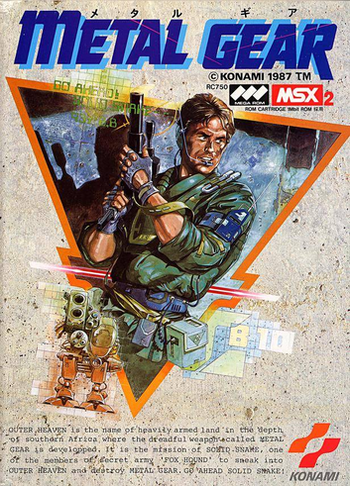
Released in 1987 for the MSX2 computer platform in Japan and Europe, Metal Gear is the first game in the Metal Gear series, and is considered to be one of the earliest examples of the stealth action game genre.note The game came into existence when Kojima's superiors asked him to develop an overhead military shooter for the MSX2 in the vein of Commando and Ikari Warriors after noticing the genre's spread in the arcades. However, Kojima quickly discovered that a fast-paced shooter would be impossible on the MSX2, thanks to the system's own hardware limitations that limited the number of sprites that could be grouped together on the same horizontal plane before the sprites would start flickering (a hardware limitation that the MSX2 shared with the Nintendo Entertainment System, and which many old-school NES players are familiar with). Kojima decided to retool the game around avoiding combat instead, designing the play mechanics around stealth and infiltration.
The player controls a rookie member of special forces group FOXHOUND codenamed Solid Snake, who is sent on a mission to infiltrate the fortified state of Outer Heaven and destroy their top secret weapon Metal Gear, a walking tank capable of launching nuclear missiles from any angle. The game's story is mainly remembered for the plot twist near the end that would serve as the foundation for future games in the series.
Konami also produced an NES version, which was developed without the involvement of the original team (which led to Kojima disowning the NES version in later years). While the plot is the same, the NES version, due to time constraints and Executive Meddling, features drastically different level designs and different bosses, while being nowhere near as polished.
For many years, the NES version of Metal Gear was the only version of the game officially available in North America, since the MSX format was never commercialized in that region. The NES version sold surprisingly well in the U.S. despite the changes made, as players at the time were unaware of the original version. In fact, it was so successful that Konami ended up commissioning the development of a sequel aimed at the NES marked in the west, called Snake's Revenge, which was developed without Kojima's involvement. Kojima would eventually learn of the game from one his colleagues who was working on the development team, something which inspired him to immediately begin work on an authorized sequel for the MSX2, Metal Gear 2: Solid Snake.
In late 2021, the original game, specifically the Subsistence release, was re-released on GOG.com, with returning keyboard support lacked in previous console re-releases.
The MSX2 version provides examples of:
- Actually a Doombot: MGSV retroactively reveals that the Big Boss fought in this game was actually a body double, which is why he's able to show up in the sequel.
- A-Team Firing:
- The submachine gun sprays bullets in all directions. For this reason, it's only useful when surrounded during alert phases.
- This is the specialty of the first three bosses (Shotmaker, Machinegun Kid and the Hind D), and the main attack of the fourth (the tank).
- All There in the Manual: The Japanese manual provides a bit more context to the game's story and characters, going as far as to even provide illustrations of Solid Snake and his supporting cast (including the otherwise faceless members of the resistance movement). A fan-translated version can downloaded here.
- Ambidextrous Sprite: Played straight when Snake is unarmed, but otherwise averted when he's equipped with a gun. All of the enemy guards and the final boss have different sprites when facing left and right.
- Artificial Stupidity: Guards won't notice you unless you're standing in a straight line directly in front of them. Even if you're standing just inches to their side. Even if you kill another guard in front of them (as long as you're using silenced firearm or punching them). This is especially egregious when you reach the checkpoint in front of Building No. 2, where you can kill a guard while wearing the enemy uniform and none of his buddies will react to killing their coworker.
- Banana Republic: Outer Heaven.
- Big Bad: Big Boss. Metal Gear Solid V: The Phantom Pain takes this further with its Retcon; the Big Boss whom Snake confronts at the end of the game is really a body double.
- "Blind Idiot" Translation: The MSX2 version uses preset keywords to compose all of its messages in order to preserve the little amount of ROM space it has. But because English requires a lot more space to write than Japanese, most of the game's messages (mostly related to item pickups) still ended up being removed during the localization process and the rest of the messages were pretty awkwardly shortened, resulting in a rather robotic-sounding script. One of the keywords that the game frequently uses was misspelled "destoroy", and this typo ends up appearing seven times throughout the script as a result. The later Subsistence port, which didn't have to deal with these constraints, would feature a much more comprehensible English script.
- Body Double:
- The fake Dr. Pettrovich in the basement of Building No. 2.
- In Metal Gear Solid V: The Phantom Pain, it's revealed that the "Big Boss" in the final confrontation of this game was one. It makes the real one's return in the sequel more believable.
- Boss Battle: The four mercenaries (Shoot Gunner/Shotmaker, Machinegun Kid, Fire Trooper, and Coward/Dirty Duck), the various vehicles (namely the Hind D, the tank, the bulldozer), the Arnold twins, Metal Gear itself, and the final boss.
- Bottomless Pit: Starting with the fake Pettrovich trap in the basement in Building 2, you'll start running into floors that will open up and try to dump Snake into a pit. Big Boss tries to trick you into one of these upon entering Building 3, and there's one right in front of Coward/Dirty Duck and his three hostages.
- Breaking the Fourth Wall: Near the end of the game, Big Boss calls Snake in a suspiciously distressful tone and orders him to abort the mission by turning off the console.
- Cheat Code: In the MSX2 original, pausing the game and typing certain words or phrases before resuming will activate certain functions such as increasing Snake's ammo/rations capacity or having every keycard at his immediate disposal. These codes don't work in the Subsistence/HD Edition versions due to those versions not supporting keyboards, as well as ironically the keyboard-supported GOG version.
- Copycat Cover: The cover illustration is a blatant trace-over of a publicity still of Michael Biehn as Kyle Reese from The Terminator.
- Cultural Translation: Because the English localization of the MSX2 version was only released in Europe, its script uses the rather British term "lorry" to refer to the enemy's supply trucks. Other than that, its English is pretty neutral, or at least as neutral as you can expect from a poorly-translated 8-bit video game.
- Cut and Paste Environments: All three buildings.
- Difficulty Level: The Subsistence version adds an Easy mode in addition to the original's difficulty, which increases the ammo and item-carrying capacity by twice the amount.
- Dirty Coward: Coward/Dirty Duck hides behind POWs and a hidden trap floor while fighting Snake. Even his name (both of them) spells it out.
- The Dog Was the Mastermind: The revelation that Big Boss is the mastermind behind Outer Heaven is presented as a big climatic twist that happens prior to the final battle in the later plot summaries of the game. In reality, it's actually revealed a bit earlier than that by the sole POW in Building No. 3, who bluntly reveals that Big Boss was behind everything.
- Drugs Causing Slow-Motion: A variant. Towards the end of the game, equipping the cigarettes slows down the in-game timer when Outer Heaven initiates a self-destruct sequence.
- Dual Boss: The TX-11 twins, although the game treats their encounter less like a boss battle and more like an obstacle that needs to be dealt with (the boss theme isn't played when they're around, except in the NES version). You can technically kill them right after getting the Rocket Launcher, but if you don't figure that out, Dr. Pettrovich will tell you to do this after he tells you how to blow up Metal Gear, by which point disposing of them to get the Level 7 keycard, which is needed to enter the desert between Buildings 2 and 3, is required to continue the game.
- Early-Installment Weirdness:
- No crawling. No radar. A transceiver that is completely room oriented. A straightforward, simple plot. A relatively realistic Quirky Miniboss Squad. After playing this, Metal Gear 2 becomes amazing for how much closer it is to the later Metal Gear Solid games.
- Unlike the rest of the of the series, Snake's health bar and ammo capacity Cap is tied to your star rank, meaning you have limited ammunition on your one-star rank and you start with half of your maximum health. The more star ranks you have, the more ammo you can carry and your health increases. However, killing prisoners reduces your rank, and can make the game unwinnable.
- During the maze section with hidden walls, Snake has to kill guard dogs in order to progress. In later games, with the exception of Metal Gear Solid 3: Snake Eater, harming and/or killing animals is very frowned upon.
- Snake is a Heroic Mime for most of the game, the enemy leader (Big Boss) is a Card-Carrying Villain, and Gray Fox has virtually no presence as he disappears from the remainder of the game as soon as he is rescued. This is particularly egregious, considering the sequels made the events of the Outer Heaven mission seem more epic than what actually occurs in this game, such as Snake claiming that Fox was an active participant in the crisis and "showed him the ropes," much like how Snake mentors Raiden in Metal Gear Solid 2.
- While later games feature technologically enhanced humans and disembodied A.I.s, this is the only game to feature artificially intelligent androids (the Blood Brads) as enemies.
- Big Boss is utterly dismissive at the idea of Snake using a cardboard box to hide, which clashes with Big Boss' cardboard obsession in the later prequels. Then again, he is trying to sabotage Snake's mission, so it's only natural he would discourage any thinking outside the box that might help him.
- As aforementioned, Big Boss is revealed to be nothing more than a Card-Carrying Villain in this game. In Metal Gear 2: Solid Snake, Schneider reveals to Snake that Outer Heaven was bombed by NATO, along with everybody else involved in the conflict. This causes many of Snake's allies to defect to Big Boss' side in the sequel. Big Boss' personal charisma would become an enduring trait of the character.
- Given the ending of Episode 46 in The Phantom Pain, some fans have been speculating over the intended nature of Big Boss's true identity in this game. While it is known for certain that the Big Boss that Solid Snake confronts at the end is supposed to be Venom Snake, the one who contacts him over the radio is a different matter.note
- In very stark contrast to all future Metal Gear titles, weapons (and their ammo) required for boss fights are usually not in the same area, let alone room, often requiring lengthy backtracking if you run out of the weapon the boss is vulnerable to or lack it entirely as well as a decent amount of the bosses being only vulnerable to one weapon while later games would encourage experimentation with there often being several weapons useful against each boss.
- Elite Mooks: The jet pack-equipped Flying Army unit that appear on the rooftops of Building No. 1 and No. 2.
- The Faceless: Unlike later installments, none of Snake's radio contacts are shown in-game.
- Fell Asleep Standing Up: Enemy soldiers regularly do this, giving you a chance to sneak up on them and kill them.
- Final Boss: Big Boss. Fought right after Metal Gear is destroyed and a timer starts to the base's self-destruct. Metal Gear Solid V reveals that the final boss was actually his body double, Venom Snake.
- First-Episode Twist: Big Boss is the villain.
- The Fourth Wall Will Not Protect You: Toward the end of the game, Big Boss calls the player and orders them to turn off the game system.
- Gameplay and Story Segregation: Retroactive example: in the sequels, the events of the Outer Heaven Uprising are described to be somewhat epic, but the game itself seems to be lacking in that regard. In fact, the way the events of the game are described in the sequels make it a variation of a Noodle Incident. It's largely for this reason why various fans are constantly demanding remakes of the MSX2 games, this game in particular.
- Gameplay and Story Integration: The likely first time you'll have an inkling that Big Boss is hiding something is on the approach to Building 3; when you get to the front door, it's lined with trucks that guards are pouring out of, and Big Boss calls to tell you to "enter the truck on the right!". In a panic, you'll do as he says, only to find yourself warped back to Building 1 and forced to walk all the way back. Doubles as Breaking the Fourth Wall because the player is the one who feels betrayed here; there's no indication that it canonically happens to Solid Snake.
- Guide Dang It!:
- So much, but then, it is a 1987 game.
- Punching random walls to produce unusual sounds and blow them up? Frustrating, but a staple of games like this. Punching random doors which previously only opened with keycards so that you can open them? Not so excusable.
- Big Boss tells Snake to contact Schneider whenever a specific item is required in some of the early locations (such as the first gas-covered room or the first area with an electrified floor). The problem is that Schneider's number is never given by anyone in the game and it's not even listed in the manual. If you play around with the transceiver in a certain area (namely the first screen of the third floor, after exiting the first elevator) you will eventually receive an incoming transmission from Schneider if you set the frequency to a certain number (which is 120.79). Players who don't experiment with the radio as much are unlikely to ever figure out his number without looking it up on a guide.
- Getting out of Building 2 requires you to perform a series of actions that it would not remotely occur to you to do. Firstly, you need Card 7, which is in the possession of Bloody Brad (formerly known as Arnold) - obtaining this requires defeating him and his twin in the central room on floor 2. However, they are both cyborgs, and immune to damage from all weapons except the rocket launcher, which you won't have at this point. To get it, you need to go to the next room on the right, and after rescuing a hostage, you get given Jennifer's frequency (only once - better remember it!). If you call her in the cell, she doesn't answer, so you need to go back out into the room proper and call her there - you also need to be Class 4, otherwise she won't ever reply, and you can lose class just by killing one singular hostage excluding the fake Madnar thankfully. She leaves you a rocket launcher, which you can collect from the same room, and it uses normal ammo. However, it's not over once you've got Card 7, because then you need the Compass to be able to navigate the desert, and that just happens to be behind a door that can't be opened by any keycards. You might be tempted to think it requires a Card 8 that you don't have yet, but actually, you need to call Jennifer again, at which point she unlocks it for you.
- Heroic Mime: While Snake does have lines of dialogue, most of it is just the same three generic messages: one when he dials a frequency number on his radio, one when he has the maximum amount of ammo/rations, and finally, one when he is in a moving truck. All of his conversions with the other characters are completely one-sided and the only time he ever says anything different is when he locates Dr. Pettrovich's empty cell in Building No. 1, and when he gives his final mission report in the ending.
- Hidden Mechanic: While it's now one of the most famous elements of the franchise, the first game never tells you that you can use the cardboard box as Mobile Shrubbery. The item description is "?" and Big Boss will make fun of you for picking it up, with no indication that it might be useful.
- His Name Is...: Schneider's transmission is cut just before he is about to reveal the identity of the Outer Heaven commander. It's Big Boss, by the way.
- Hostage Spirit-Link: Shoot a POW and your rank goes down. Justified in that your rank is a representation of how many POWs you've saved anyway.
- Human Shield: Dirty Duck hides behind POWs, and shooting them causes a demotion.
- Humongous Mecha: The Metal Gear itself.
- Iconic Item: The cardboard box makes its debut in this game. Every subsequent game in the series will always feature Snake with a box.
- Inconsistent Spelling: The agent that Snake rescues in the original MSX2 version is not Gray Fox, but rather Grey Fox. FOX HOUND, the organization they both work for, is also spelled as two words instead of the one-word spelling (FOXHOUND) used in later games.
- The Key Is Behind the Lock:
- The card key required to access the prison where Gray Fox is being held is inside the prison itself. This requires Snake to get captured on purpose and break out from said prison.
- Likewise, Snake cannot access the courtyard in Building No. 1 where Dr. Pettrovich is supposedly being held without jumping down from the roof with a parachute, since the card key for that area is inside a truck there. The parachute you need for the jump is in the room behind the second boss, Machine Gun Kid, and the jump point itself is behind the third boss, the Hind D.
- Kill It with Fire: What Fire Trooper wants to do to Snake after you run into him in Building 2's basement, past the fake Pettrovich.
- Lost in Transmission: How the events of Snake's mission starts. Gray Fox's final words in his final transmission before it was cut were the words "Metal Gear..."
- Mercy Mode: If you run out of explosives while trying to destroy Metal Gear, you can allow yourself to get killed by the laser cameras and restart the battle with replenished supplies. The game will still keep track of which legs you've already blown up, allowing you to continue from where you left off.
- Mission Control Is Off Its Meds: Most people know by now that Big Boss, Snake's Mission Control, is also the Big Bad, which is why he misleads Snake as he gets closer to his objective, including the famous fourth wall break during the final act. Even in the early stages of the mission, when Big Boss is still ostensibly on Snake's side, his advice isn't particularly helpful. His warnings about new obstacles always start with the excuse "I forgot to tell you...", implying that he is feigning incompetence to further sabotage the mission.
- Mole in Charge: Big Boss.
- No Celebrities Were Harmed: The cover illustration is a blatant trace-over of a publicity still from The Terminator featuring Michael Biehn posing as Kyle Reese.
- No Peripheral Vision: The guards can only see in straight lines. As such, Snake can run alongside them, run past them on the side, and stand next to them as long he wants. They'll never see him unless he's directly in front of one or is already being pursued. The NES version gives enemies better vision, being able to see slightly off what's directly in front of them.
- One-Hit Kill: The two ground-based boss machines (the tank and then the bulldozer at Building 2) will kill Snake immediately if they touch him, as will the pitfalls if Snake makes contact with the area where the gap currently exists. The same also happens if you fall off the rooftop of Building No. 1 without the parachute equipped.
- One Name Only: The supporting cast consists of Schneider, Diane, Steve, Jennifer and Dr. Pettrovich. Elen's full name is given as "Elen Pettrovich" in the Japanese manual, but this was changed to "Ellen Madnar" in later versions to bring it more in line with Metal Gear 2, where the doctor's full name is Dr. Pettrovich Madnar.note Additionally, the resistance leader gained the full name of "Kyle Schneider" in the sequel.
- On-Site Procurement: You're sent in with a radio and a packet of cigarettes. Anything else has to be scrounged. As a result of the twist at the end of the story, it's implied this is less because of a desire for Plausible Deniability and more an attempt to get Solid Snake killed.
- Orwellian Retcon: Some of the bosses (namely Shoot Gunner, Coward Duck, and Arnold) were renamed in the later versions (to Shotmaker, Dirty Duck, and Bloody Brad, respectively) and the cigarettes, which were non-hazardous in the MSX2 original, now drain the player's health when equipped (a gameplay mechanic introduced in MGS1).
- Playing with Fire: This is Fire Trooper's specialty, and you have to deal with him to get out of the Building 2 basement.
- Punch-Packing Pistol: Started the grand tradition of the humble silenced pistol-in this case, a silenced Beretta M9-being your most useful weapon. Most of the other weapons in this game tend to be only useful in specific situations (mainly boss battles).
- Puzzle Boss: Metal Gear can only be destroyed by planting 16 explosives on its legs in a specific order. To make things worse, you have to guess where to put the last bomb. It's on Metal Gear's right foot.
- Random Drop: If you punch a guard to death, they will sometime leave behind a ration or an ammo box.
- Respawning Enemies: Leaving the screen and returning brings back any enemies you might have killed. Due to how the game is coded, this includes using the binoculars to check out an adjacent screen.
- Retcon: As of The Phantom Pain, the Big Boss whom Snake fought in this game was in fact a body double. Meaning Solid Snake defeated his phantom, and now the real Big Boss is out for his blood.
- Rush Boss: The Bulldozer. You run into it in a narrow hall and have to use as many grenades as possible to blow it up before it reaches you.
- Sailor Fuku: Big Boss mocks the enemy by asking if they're "those cute sailor suits" when you call him up about the Uniform.
- Sequence Breaking: Using the "hirake goma" cheat to add every card key to your inventory will allow you to visit areas out of the intended order, such as rescuing Gray Fox before getting yourself captured.
- Shock and Awe: Every once in a while, you'll find an electrified floor. You can destroy a panel on almost all of these floors to turn them off; the exception is the last room before Metal Gear, where there is no panel and you have to run across it.
- Shout-Out: To Howard the Duck, of all things. In the early versions, the boss that was later renamed Dirty Duck was known as Coward Duck. Also, a powerful android that was later renamed Bloody Brad was originally known as Arnold.
- Springtime for Hitler: Big Boss sent in Snake with the assumption he'd fail so as not to interfere with his plans for Outer Heaven. Unfortunately for Big Boss, Snake is a much better solder than he thought.
- Stealth-Based Game: One of the very first.
- The Stinger: Big Boss still lives!
- Taking You with Me: The Dr. Pettrovich impersonator attempts to kill Snake by luring him into a pit trap that ends up swallowing him. Later on, Big Boss confronts Snake on his escape route after triggering Outer Heaven's self-destruct mechanism.note
- Three-Quarters View: The overall perspective, which makes Outer Heaven's architecture seem very weird once you think about it. Why is every single wall trapezoidical?
- Time-Limit Boss: Once Metal Gear has been destroyed, it triggers Outer Heaven's self-destruct sequence; Snake has a limited amount of time to get past Big Boss and the ladder room behind him before the base blows sky high. Using the cigarettes now, however, will reset the timer.
- Tiny World Power: Outer Heaven is a microstate enclaved by South Africa and populated by rogue soldiers and mercenaries. Eventually, it would be discovered that the country had succeeded in creating a prototype Metal Gear — a bipedal mech capable of launching a nuclear attack from any kind of terrain — which rendered it nigh-invincible and thus subverted the global balance of power. This would prompt the attention of FOXHOUND, who deployed Solid Snake in hopes he would destroy Metal Gear and therefore pave the way for the dismantling of the rogue state.
- Treacherous Advisor: If you don't know who it is, consider yourself lucky. He won't actually try to do anything fishy until after you've rescued Ellen Pettrovich and her father, gotten the instructions on how to destroy Metal Gear, and reached Building 3. Once you get this far, he'll try to get you into a truck that will jet off and dump you back into Building 1, and if that fails, he'll try to get you to fall into a trap floor. He eventually tries to get you to shut the game off altogether once you know his treachery and begin going down the final halls to Metal Gear.
- Trope Codifier: For the Stealth-Based Game genre.
- Universal Ammunition: Each ammo box contains 20 handgun bullets, 20 machine gun bullets, 10 grenade launcher rounds and 2 rocket rounds.
- Unwinnable by Design: If you get a demotion in some situations, you will not have enough ammo to destroy certain bosses (or even to obtain an item needed to complete the game). This is particularly egregious during the Dirty Duck boss battle, where he shields himself with three hostages. Killing all three will demote Snake to the starting rank. There might not even be enough unsaved POWs by that point to restore the required four-star rank. One of those hostages (the middle one) is Jennifer's brother and he tells you how to escape after defeating the Final Boss.note
- Video Game Cruelty Punishment: Killing a single POW will demote the player to their previous rank. It’s possible for the player to work his way back to his previous rank if there are enough POWs still left to save, but killing certain POWs (like Ellen or Jennifer's brother) will make the game Unwinnable.note
- Voice with an Internet Connection: Inverted. The only character whose face we actually see in the transceiver mode is Snake's.
- Warp Zone: Some of the trucks, if you get in them, will drive off and send you backwards in Outer Heaven. Big Boss tries to get Snake into one of these trucks outside Building 3; almost all of the trucks stationed in front of the building send you back to the Building 1 courtyard, so ignore them and go for the door.
- Where the Hell Is Springfield?: Outer Heaven and the Galzburg region are stated to be in South Africa, but it is never actually specified where it is exactly. It should be noted that this is one of the few Metal Gear games, and the only canonical installment, to play this straight. Of course, there are persistent fan theories.◊
- With This Herring: Your starting equipment is a pack of cigarettes. You need to search for a basic handgun, and make a second search for ammo. Those cigarettes are only useful after Metal Gear has been destroyed, where you can smoke them to reset the final countdown; using them at any other time is a Press X to Die Game Over.
- You Have Outlived Your Usefulness: Snake was only sent in to ultimately be killed by Outer Heaven's forces as a show of force to the world. Big Boss outright admits that Snake's continued survival defied expectations and ruined his plans, making him take matters into his own hands now that his treachery had been revealed openly.

