

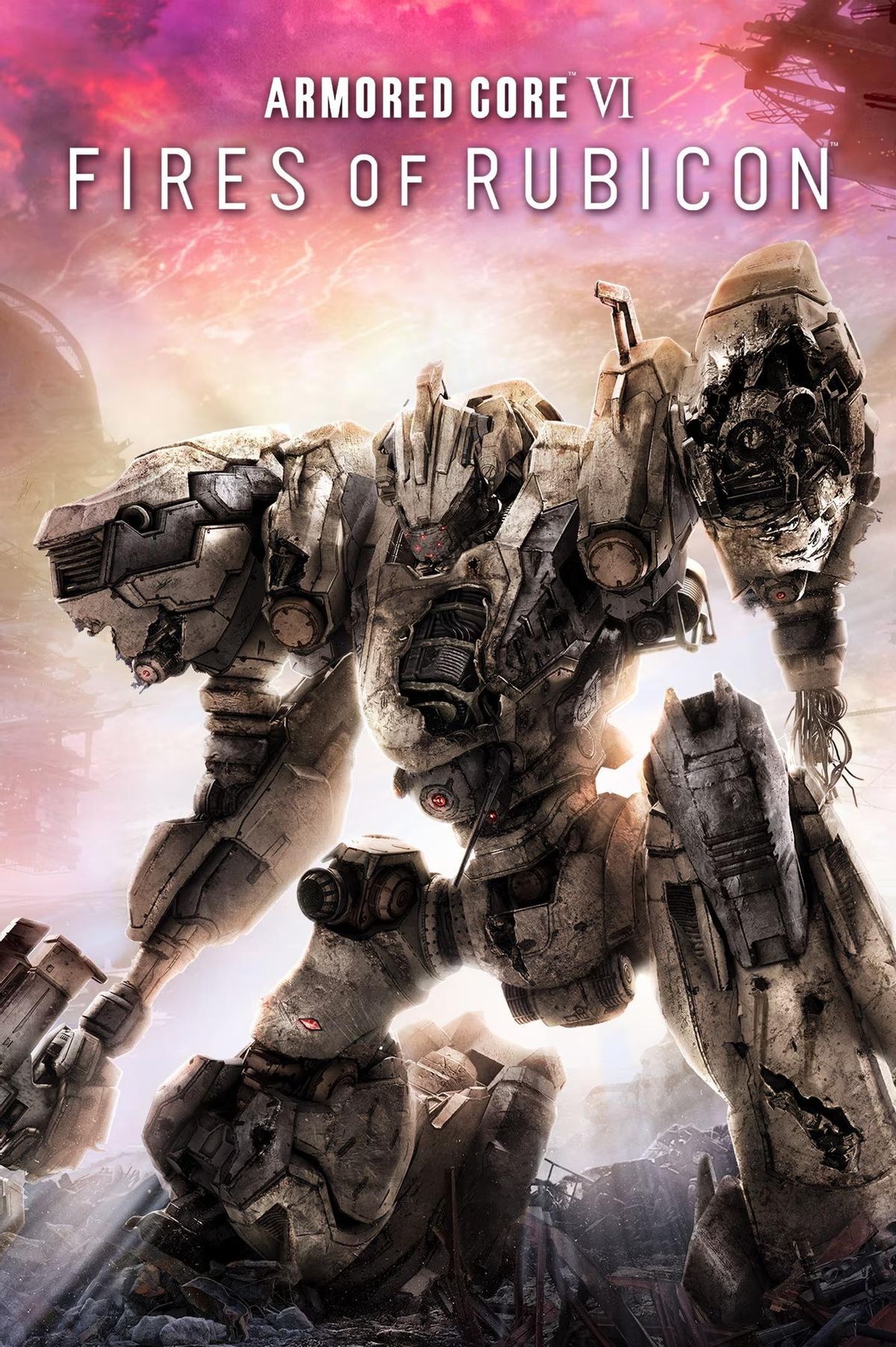
Armored Core VI: Fires of Rubicon is the sixteenth installment in the mecha combat game series Armored Core developed by FromSoftware and published by Bandai Namco Entertainment. The game is the directorial debut of Masaru Yamamura, who worked as the game designer of Sekiro: Shadows Die Twice and Bloodborne. It was released on August 25th, 2023 for PlayStation 4, PlayStation 5, Xbox One, Xbox Series X|S and PC via Steam, marking the end of a ten-year absence for the series since the release of Armored Core: Verdict Day.
In a far future of Humongous Mecha and Transhuman augmentation where humanity has spread to the stars, the enigmatic world of "Rubicon 3" lies in ruin. 50 years ago, a novel substance dubbed "Coral" was discovered on the planet. The sublime Coral promised to revolutionize mankind's energy production, communications and other technological capabilities... until that same substance caused a cataclysmic event that incinerated not only Rubicon 3 but the entire star system surrounding it. This would later be known as "The Fires of Ibis", one reminding anyone daring to use Coral for far more nefarious intentions of its destructive power. Now, decades later, this apocalyptic element has resurfaced on the sealed-off planet, and brought a new cataclysm as off-world corporations descend to wage bloody wars with resistance groups and each other for its control.
You take the role of one of this future's many augmented humans, C4-621, an AC pilot who went so deep into debt they sold their own body for unethical human experimentation, only to eventually be deemed excess inventory and sold off to be the "hound" of an infamous interstellar handler named Walter to work off your remaining loans. Enticed by Walter's promises that Rubicon's Coral is so valuable you can pay off the rest of your debt and fix your broken body and brain if you can just find enough of it, you infiltrate Rubicon 3 as an independent mercenary, and soon find yourself in the center of the struggle over Coral's deadly power with the corporations and other factions.
Gameplay combines elements of multiple previous Armored Core entries as well as FromSoft's third-person games, such as the Souls games and Sekiro: Shadows Die Twice. Your Armored Core is highly customizable allowing you to tailor gameplay to your tastes by changing weapons, body parts, secondary abilities, and so on. Melee weapons in particular have been given an expanded focus, with more options than many past games and an "Assault Boost" mechanic that quickly closes the gap between you and enemies to move from long-range gunfighting to close-range melee at the push of a button. A stagger mechanic popular in From's Souls-like RPG releases has been added to the game as well to emphasize the back-and-forth tempo of combat. Also notable is that the Arena returns after its absence after the V generation games.
Got a trope for you, 621:
- Adaptational Wimp: While still absolute engines of death, the Armored Cores themselves pale in contrast with their performances in prior titles. Compared to previous games where they were elite units reserved for the best pilots on the scene, ACs are routinely found wrecked (with four in the tutorial alone) and the PCA's lines of Light and Heavy Cavalry mechs are treated as being pound-for-pound superior models compared to Armored Cores. 621 and a handful of other pilots still stand out as being true One Man Armies in their own right, but that is more attributable to their piloting skill than the technical supremacy of the Cores. Justified by the game implying that ACs are relatively new tech in the setting, being around three tech generations old (with the third generation being cutting-edge, barely-out-of-prototype stuff).
- After the End: Rubicon-3 is little more than scarred ruins and old facilities, at least on the surface, after the cataclysmic Coral incident scorched it and the entire surrounding star system. Deserts, ashy mountains and factories, and desolate constructs of the previous human outposts litter the landscape from 50 years prior, and what's fresh are mostly new facilities put into place to mine the Coral from what's left.
- A.K.A.-47: Both variants of the RANSETSU rifle manufactured by BAWS resemble giant AK-47s.
- Alas, Poor Villain:
- Of all things, the villain is you: in the Fires of Raven ending, if Ayre kills you during her fight, she either sadly bids a dying Raven goodbye, or greviously mourns that you were the only one who could have united Coral and humanity. Note that this is the ending where you're committing genocide on an entire alien species, albeit to break the Corporations' rampant control of the universe by destroying their superpower resource.
- In the Liberator of Rubicon ending, Walter is reduced to a traumatised, barely-conscious wreck of a human being who has been tortured into being Arquebus's personal suicide bomber against you and Ayre after being subjected to whatever vile methods Snail inflicts on his "re-educated", and this is after his well-meaning plans of breaking the Corporations' stranglehold on the entire universe have been ruined and his close friend has been killed by you and Ayre. Ayre expresses sadness it had to come to this.
- All Just a Dream: Thankfully not the entire game, but it is heavily implied both non-True Ending routes are simulations of ALLMIND: the first time you beat the game, ALLMIND will cryptically thank you for uploading data and you're kicked back to shortly after you landed on Rubicon, with Walter expressing confusion as to why ALLMIND would randomly greet a new merc and their Handler like they've worked in the past. It's further implied by the fact both endings simply go to black after detailing what happened on Rubicon, whereas the True Ending is longer and detailed.
- All There in the Manual: While the story lacks any sort of actual guidebook or the like nor any real lengthy explanation of much of the story and context, the Story Trailer is a notably necessary piece of media in understanding the context of C4-621 and their situation, not to mention the other C4 augmented humans that Walter and several other characters bring up.
- Ambiguous Situation:
- Whether the Rubicon Research Institute was aware that Coral wasn't so much a powerful substance as it is a sentient alien colony. The records left behind by Professor Nagai show the Institute knew Coral had special properties (which led to the horrific C-Pulse generation of augmented humans (Gens One through Four) as well as the creation of the C-Weapons), but there's nothing to suggest they were aware it was alive. In any case, the Institute feared Coral's properties and its absurd propagation capabilities, as well as the potentiality of Coral Convergence, so much they decided to start a star system-wide cataclysmic event in the hopes of destroying it. Walter is the only one who becomes aware that Coral is alive in the Liberator of Rubicon ending where he's hopped up on Coral while piloting the HAL 826, an IBIS-series AC, allowing him to perceive Ayre.
- Much of the game's story revolves around the Coral and the game's endings all focus on the possibility of Coral merging with humanity. But what this will actually entail is left rather vague. Walter and his allies see it as an Assimilation Plot (though the actual plot is exclusive to ALLMIND; the Coral simply naturally want to make contact, and Ayre for the majority of the story is more concerned with helping Raven than advancing an agenda of mass symbiosis) that will result in a Fate Worse than Death for human beings, Ayre sees it as a positive transformation that will uplift humanity, and ALLMIND agrees with Ayre, but wants to 'uplift' humanity by eradicating their free will in the process. Precious little is known for sure about Coral symbiosis, beyond that only augmented humans can join with the Coral and even then it can be dangerous, as 621 was at risk of having their consciousness dissolved into the Coral when making Contact with Ayre and G5 Iguazu is all but stated to be experiencing his own form of Contact that is driving him to madness. On the other hand, Ayre's Contact with 621 proves it is possible for a mutually beneficial relationship with the Coral, but she is also noted to be a Coral "mutation" and it's not clear how much her Contact with 621 can be taken as a normal human-Coral connection (and what a Coral mutation is in the first place goes entirely undefined - and there is the possibility she may have been human before being absorbed by the Coral, if her comment to 621 to wake up before it happens to him says anything). V.III O'Keeffe even lampshades it, noting how 621 has no idea what exactly Coral Release will entail or what comes after its completion.
- There is an implication that Ayre may have been human once — her first meeting with 621 has her tell them to wake up or they'll be absorbed into the Coral hivemind. Whether it happened to her and/or if it's something she has seen happen to others is not elaborated upon. She also has a special interest in finding Institute City — where a lot of people were stationed up until the Fires of Ibis, and where Coral experimentation took place, but it's also where the bulk of the Coral lives, and she could be simply manifesting Coral's inherent desire to flock together with her "brothers and sisters". Ultimately, her exact origins are left up in the air, but regardless she still strongly identifies as Coral first and foremost.
- Animal Mecha: Many of the most dangerous mechs tend to look like aquatic animals; the Institute's Sea Spider and Ice Worm are based on their respective namesakes, while the PCA's NEPENTHES weapons platform resembles a crinoid or sea anemone.
- Anti-Frustration Features:
- One of the game largest fundamental changes from previous installments is that the camera is no longer anchored to your AC's back. This, combined with the new Aim Assist feature alleviates much of the series's learning curve regarding the camera, no longer having to mind the importance of a turning speed stat or trying to keep up with fast enemies by keeping them in view. Incidentally, this makes short range firearms much stronger and the once-vital Quick Turn function is now locked behind an OS Tuning upgrade for a single chip, possibly indicative of how vestigial it has become.
- Armored Core's Stagger mechanic resembles Posture used in Sekiro: Shadows Die Twice, where filling a gauge will cause an enemy to become stunned and vulnerable to more damage. Unlike Sekiro, however, a fraction of the stagger inflicted in Armored Core will linger for quite a long time. So while maintaining an offensive will build Stagger more quickly, tactical retreats won't completely invalidate your efforts like it does in Sekiro.
- The Stagger system is also a marked change to how Stun worked in prior games, where if your AC was not above a certain defense threshold (which, depending on the game, may not even be a factor), individual hits would effectively halt all of your movement altogether and slow you down to a crawl. In certain games, you could potentially get stunlocked to death by an enemy that would not let up and had no need to reload. The Stagger and Attitude Stability mechanics by comparison at least let any build scrape by damage so long as you don't accumulate too much at once or get hit really hard, and even then, the recovery window usually allows you to jet out. Much of the multiplayer's meta is about forcing a stunlock despite this.
- The game is the first in the series to allow replayable missions without needing to beat the game first, allowing players to farm for currency in order to purchase more optimal parts and look for parts and logs. The rankings introduced in Armored Core 3 are also exclusive to replays; your first run of a mission is entirely for pay and story progression, and it's only subsequent runs that will scale you on performance for rank.
- The series had always instantly failed you if you ever left the combat area. This entry blocks you from leaving some open areas thanks to red lines that appear when you're too far. Vertically speaking, if you fall in certain areas, you simply lose some AP as you're brought back to the stage.
- While you still get docked pay for repair and ammunition costs, the game ditches the debt system from previous entries, significantly reducing the financial penalty for mission failure.
- You're able to modify your AC from an option on the continue screen without having to restart the entire mission, in case you run into something that your current build can't handle. You can only change out parts you've already purchased before the mission, however.
- If you want to use an enemy AC loadout for your own purposes, the AC Data has you covered. So long as you have access to the required parts and weapons, and you've beaten that specific enemy AC in the Arena, you can switch to that AC loadout via the AC Data menu from the garage without the extra hassle of manually switching over to that AC's specific parts and weapons. This also includes AC units exclusive to certain ending paths such as V.IV Rusty's Ace Custom Steel Haze Ortus.
- Anti-Villain: All of the major antagonists for the story, save ones like G5 Iguazu or V.II Snail, are all varying degrees of Well-Intentioned Extremists all believing that mankind and its relation with Coral will decide its fate, each intending to utilize the organisms that make it up to either usher in a new era or cleanse the slate, but all are so insanely deterministic in their specific beliefs that they end up becoming as big of a problem as the Corporations themselves.
- Apocalypse How: The Fires of Ibis was a system-wide cataclysmic event caused when an accident ignited a massive deposit of Coral, scorching Rubicon-3 and various other planets nearby. This accident not only caused countless deaths across the Rubicon star system, but damn near rendered Rubicon-3 itself uninhabitable. Survivors of this event were given the nickname "Cinder". In truth, the Fires of Ibis were not caused by an accident, but a deliberate attempt to destroy the Coral—actually a living substance of Starfish Aliens who the Rubicon Research Institute believed were hostile. OVERSEER, the successor of the Institute, wants Handler Walter and "Cinder" Carla to finish the job and cause a second Fires. If you side with Walter, 621 carries out the plan and destroys the Coral, in turn creating yet another devastating calamity. The Planetary Closure Administration and the Corporations unanimously agree to abandon Rubicon, and the calamity comes to be known as the Fires of Raven, named after the infamous mercenary who killed god knows how many people responsible for the second calamity.
- Applied Phlebotinum: Coral is a highly sought-after substance that is seemingly used all throughout society, from Transhuman augmentation procedures to powering equipment such as Armored Cores. As you can imagine, everyone and their mother wants to get their hands on it. Having said that, Coral is extremely volatile; the Fires of Ibis from fifty years ago occurred because a freak accident ignited the Coral and created an explosion so powerful it nearly destroyed the Rubicon star system. That isn't even going into how the Coral is alive.
- Arc Number: Nine is once more associated with individuals of importance.
- 621, when counting the numbers individually, add up to 9. The location they arrive at when landing on Rubicon is Grid 135, which also has a digital root of 9.
- V.IV Rusty is ranked 9 in the arena, just like White Glint LYNX from Armored Core: For Answer; also, his numerical designation among the Vespers (IV) is the Roman numeral for 4, and reinterpreting V (which stands for "Vesper") as another Roman numeral gives us 5, which when added to the previous one gives another 9. Rusty is far more important than he seems.
- A third example would be Nightfall, the AC used by the real Raven. It's the ninth opponent of ALLMIND's Analysis arena.
- A subtle example is the game's True Final Boss G5 Iguazu. The 5th member of the Redguns is also a 4th generation augmented human. 5+4=9, which foreshadowed that this seemingly inconsequential AC pilot would play a major role in the story.
- Arc Symbol: Fire is a recurring symbol, with characters often called "kindling" or "cinders". After the Fires of Ibis incinerated the star system, many are rightly wary of Coral's potential as either a fiery tool of destruction or a light for a brighter future. As the story goes on C4-621's actions light a figurative fire on the long-dormant planet that's locked in a Forever War, finally upending the status quo and pushing things forward.
- Arc Words: "Coral, abide with Rubicon!" Further invoked in the Alea Iacta Est path where it's revealed that what was thought to be a rallying cry for the RLF is actually only the first line in a warning as said in the Wham Line entry below. It becomes clear that it has much more meaning in being the Arc Words of the game due to being all about different factions deciding on what to do with the Coral, but no one wanting to actually "cast the die" aka, take the chance of doing what the Coral itself would want.
- Armor-Piercing Attack:
- Pulse weapons inflict PA interference, making them extra effective against energy shields.
- "Stun" weapons also have a hidden PA interference stat, making them good (but not as good as pulse weapons) for breaking shields.
- Coral energy weapons have their own type of damage outside of kinetic, energy and explosive, and are unaffected by all resistances to those damage types.
- Artificial Stupidity:
- While AI opponents will do their damndest to dodge your attacks all over the place like they're some sort of hyperspeed monstrosity, they have no actual consciousness of the terrain and environment around them until they get stuck on a wall and realize they need to jump. This means trapping them in corners is a plausible method to tighten up their movement, even if only temporarily and using explosives for an Area of Effect splash damage radius can really lay the hurt on them as they can't dodge away so easily. One shoulder missile type even works like a trick explosion that borders on A.I. Breaker because they don't know how to dodge away from it. The PCA Ekdromoi, for example, can wind up boosting into the geometry and under a ceiling, where they become easy pickings.
- All of the AI that have dodge-ready capabilities, from ACs to some of the bosses, will dodge multiple shots in a row via Quick Boosting or whatever equivalent they have, and then only Ibis and its derivatives for final bosses don't exhaust their rapid-fire dodging capabilities to simulate having emptied their energy recklessly. Baiting out dodges with a Macross Missile Massacre or several shots they'll inevitably dodge will often leave them wide open to taking strong hits afterwards, though going in for a melee punish may have them try to immediately smack you for it.
- Artistic License – Engineering: Simply put, almost nothing in this game makes sense from an engineering point of view. All of the Armored Cores would torque themselves apart instantly under the stresses they have to endure in combat (and kill their pilot with the generated G-forces while they're at it), the various megastructures would've crumbled under their own weight long before their construction finished and the Xylem would've shattered into a million fragments even while it was still floating on the ocean. The only thing that's even remotely plausible is the MT class of mechas, due to being much closer to the Real Robot Genre than the ACs' Super Robot Genre. That said, anyone expecting realism in a game about awesome mechas beating each other to a pulp kinda misunderstood the assignment, so that's completely okay.
- Assimilation Plot: What Handler Walter thinks Coral is going to eventually do, knowing of its sentience and ability to symbiotically connect with humans as one of the reasons, alongside the danger of exploiting the substance as the Corporations do, as to why Walter wants to kickstart another Fires of Ibis because being put through near-extinction yet again is a preferable alternative to the idea of humanity as we know it being wiped out by an alien organism in a subversive manner. It's kept deliberately vague as to whether he's right about the Coral, or if his guilt and personal biases are making him Improperly Paranoid. At the very least, he's right to some extent, but it's really more a symbiosis plot than anything.
-
 Author Appeal: ACS strain and audiovisual warning cues before big attacks were taken directly from Sekiro: Shadows Die Twice, on which Masaru Yamamura worked as a lead designer.
 - Bait-and-Switch:
- The fight with the original Raven is set up as originally a Hold the Line defensive mission over protecting the old starport — until you actually arrive and find all the invading enemies are already disposed of (along with the allied MTs who were supposed to assist you) and are instead set up with a sudden boss fight instead.
- This also occurs during the NG++ mission where you must protect the STRIDER instead of destroying it. When the mission starts the STRIDER is already under attack and is destroyed, leaving you to survive against waves of autonomous C-Weapons.
- Bait-and-Switch Comment: During his final fight on the Liberator of Rubicon path, V.II Snail admits treating 621 like a mutt was a mistake and takes it back... because they are clearly vermin that needs to be exterminated right here and now.
- Beat Them at Their Own Game: Two Decision Missions near the end of Chapter 4 involve beating Arquebus or Balam at what they do best:
- "Ambush the Vespers" involves using false information to lure two Vespers into a vulnerable position, mirroring the underhanded tactics they've tried to employ against you.
- "Intercept the Redguns" is a head-on assault against a position of strength, just like the Redguns are always doing. Unlike the Redguns, 621 manages to win.
- BFG: To deal with the threat of the ICE WORM, "Cinder" Carla tasks 621 with retrieving the Overed Rail Cannon, a derelict railgun currently in the hands of a traitorous subordinate of hers. It's so big you might mistake it for a regular piece of level geometry when you see it; it's at least half a kilometer long.
- Big Bad Ensemble: The final missions of the Liberator of Rubicon route involve 621 stopping OVERSEER from triggering a second Fires of Ibis while simultaneously fending off Arquebus's petty attempt to kill them. Walter, the final boss of the route, deliriously alternates between serving one or the other due to his re-education.
- Blamed for Being Railroaded: NG++ gives you the opportunity to defend the RLF STRIDER rather than attacking it as usual. This mission fails pretty much the moment your AC finishes booting up, for reasons entirely out of your control. While you are docked half the payout, the RLF liaison apologizes and forgives 621 over how unexpected the mission turned out; they weren't expecting the STRIDER to be torn apart by a group of self-propelled grinder blades, either.
- Body-Count Competition: During the late-game "Breach the Kármán Line" mission, C4-621 allies with "Cinder" Carla in defending the Xylem from Arquebus's approaching space fleet. Carla, being the cynical sort, immediately makes a game of it, seeing whether the Ace Pilot can shoot down more ships than she can blast them out of the sky with the Xylem's weaponry. As the mission goes on, Carla gives a running tally, though unexpected complications later in the mission causes Carla to forget it.
- Bodyguarding a Badass: While Walter's reliance on his Hounds gives off the impression that he's a non-combatant who cannot pilot ACs, the Alea Iacta Est route shows that he's perfectly capable of piloting despite his advanced age, at a level that impresses even ALLMIND.
- Boring, but Practical:
- The AC Tuneup to let you equip primary weapons in your shoulder slots. This allows you to have an extra left or right hand weapon that you can swap on the fly. It's not particularly flashy, but it gives you a lot of flexibility in what weapons you bring (you can have a standard assault rifle for dealing with mooks and then swap it with a strong but slow grenade launcher for heavier damage against meatier targets for example).
- The humble Laser Handgun makes for a very effective primary weapon. Though it comes with less range and damage than the numerous available Laser Rifles, the difference in the former is negligible, while the difference in the latter is made up for through the Handgun's fast fire rate, low heat build-up, a massive ammo pool of 380 shots and low energy use, which makes it exceedingly easy to slap on nearly any build. A single Laser Handgun is a very reliable gun against both regular enemies and bosses alike; dual Laser Handguns will grant your AC an unparalleled sustained damage output.
- The Pulse Blade you have at the very start is one of the most useful melee weapons in the game all the way to the end. As a pulse weapon, it easily reduces Pulse shields down to nothing. It also does good stagger and direct damage. The brief charge time and forward dash makes it a decent distance closer as well making it more likely you'll actually hit the target. And because it is a starter weapon, you'll likely grow very proficient in its use.
- One of the most useful OS upgrades increases Direct Damage (the damage you inflict on a staggered enemy). The key to bringing down most tough enemies and bosses involves staggering them and dealing increased damage to them while they are down. Hence increasing the damage you can deal in that window is useful throughout the entire game.
- Sometimes the best solution is just to equip dual shotguns and blast bosses at close range to destroy them. Sometimes, grabbing two Gatling guns and unloading close range is the best solution. You can even take that a step further by using the highest AP body parts dual shoulder mounted Gatling cannons and just unloading four Gatlings at close range straight into a boss's face.
- Boss-Altering Consequence:
- During NG, you fight Raven in mission 3-10 "Defend the Old Spaceport". In NG+, if you elected to accept the Rubicon Liberation Front's offer in mission 1-6 "Attack the Dam Complex" and attack your allies G4 Volta and G5 Iguazu, you instead receive "Defend the Dam Complex", where you have to fight three members of the Branch hacktivist collective: Initially a 2v1 against King and Chartreuse, with Raven showing up late as a timed spawn, leading to a potential 3v1 if you don't dispatch the first two quickly enough.
- During NG++, if you took mission 1-7 "Escort the Weaponized Mining Ship" instead of "Destroy the Weaponized Mining Ship", when you fight Sulla in mission 1-12 "Attack the Watchpoint", he gets a bunch of Ghost mechs as support.
- During NG++, if you took mission 1-7 "Escort the Weaponized Mining Ship" instead of "Destroy the Weaponized Mining Ship", instead of fighting another AH12 HC Helicopter as the final boss of 3-5 "Survey the Uninhabited Floating City", you fight Thumb Dolmayan of the Rubicon Liberation Front, who destroys the copter on entry.
- During NG, the midway boss of mission 4-2 "Underground Exploration - Depth 2" is G5 Iguazu. In NG+, if you elected to accept the Rubicon Liberation Front's offer in mission 1-6 "Attack the Dam Complex", it is instead Coldcall, an assassin hired by Iguazu.
- During NG++, if you've been following ALLMIND's path, then during mission 4-6 "Reach Coral Convergence", instead of having IB-01: CEL-240 as the final boss, you instead fight V.II Snail and G5 Iguazu.
- Bottomless Magazines: Played straight for energy weapons, which are instead limited by an overheating mechanic, but averted by ballistic weapons, which need to be reloaded once their magazine runs dry. The only exception to this is the minigun, a ballistic weapon that behaves like an energy weapon in terms of ammo consumption. All ranged weapons have limited ammunition to boot, making ammo conservation an important part of the gameplay, especially if you're shooting for an S-rank.
- Bragging Rights Reward: S-ranking all missions merely unlocks an achievement, but doesn't change anything about the gameplay in terms of unlocking parts or missions.
- Breaking Old Trends:
- Downplayed. While Fires of Rubicon is set in a post-apocalyptic world, it takes place on a planet called Rubicon 3. The last time an Armored Core game took place on a planet that wasn't Earth was Armored Core 2, which was set on Mars.
- The series famously does not depict the appearance of its human characters, outside of a few instances where they're either shown as silhouettes (Armored Core 4) or blurred and indistinct (Armored Core: Last Raven). This game, however, has set of logs containing hand-drawn sketches of Rubicon's shakers and movers.
- Armored Core 2 had featured an extinct alien civilization on Mars as part of its setting, but it's not elaborated upon. Here, however, the Coral resource that is the centerpiece of the entire conflict of the setting is revealed to actually be a sentient alien organism, thereby bringing an alien species to the forefront as one of the major players in the story, with one of them (Ayre) being a principal main character supporting the player for most of the game.
- Break Meter: Fires of Rubicon introduces the Attitude Control System, a refinement of previous games' stagger mechanic. Now all units have an ACS meter that builds up when they take damage. If the meter is full, the unit is staggered, and for a brief time all attacks will deal increased damage to them. Kinetic and explosive weapons are especially good at inflicting ACS strain.
- Call a Smeerp a "Rabbit": The "mealworms" the Rubiconians farm look tiny to the player at AC scale, but they're monstrous meaty multi-legged things with Nested Mouths the size of freighter trucks. They also seem to rely on Coral to live.
- Car Fu: The Boost Kick animation for tank ACs is simply ramming them with the AC's lower body.
- Chainsaw Good: One of the unlockable melee weapons, the Double Trouble, is an assembly of two AC-sized chainsaws. Like all the other RaD equipment, it's made from repurposed industrial equipment.
- Charged Attack: Many weapons have one. Some simply deal more damage when fully charged, others gain new or different functionality on top of that (like switching from single-target damage to an AoE attack for instance).
- Colossus Climb: Various missions involves the player piloting their mech as they make their way through machines and buildings much bigger than their AC. Examples include the RFL's Mining ship and the various large city structures littered throughout Rubicon.
- The Computer Is a Cheating Bastard: Played With. Hostile ACs can use the same repair kits you have, and just like you they are restricted to a maximum of three per mission. However, they can also instantly react to your shots, allowing them to easily side-dodge even some very fast weapons the moment the button was pressed to fire, and some can seemingly cheat out of Staggers on a whim, even in a heavier unit that should have cripplingly low Attitude Recovery.
- Company Cross-References: The prominence of fire and cinders as motifs recall the Dark Souls trilogy, as the player is given the choice of whether or not to ignite a massive fire, a decision with huge ramifications for the setting. That said, the ending where that fire's ignited it is a massively nihilistic solution to the problem as opposed to perpetuating a dying world's cycle, which is instead reserved for the ending that prevents its ignition. In addition, there is a greater emphasis on recognising and subsequently dodging enemy boss patterns, and a system to stun enemies that works like it does in other Soulsborne games.
- Corporate Warfare: A series staple. Multiple off-world corporations vie for control of Rubicon-3 and the Coral, with Arquebus and Balam (and their subsidiaries) providing the bulk of missions that 621 takes on.
- Two early missions involve Arquebus making open calls to mercenaries to deal with RLF artillery and Dafeng MT squads, with Dafeng being a Balam subsidiary. There's also the "Destroy The Tester AC" mission, where Arquebus has you destroy a prototype Armored Core model before Balam can receive it.
- Corridor Cubbyhole Run: Multiple examples, the most clear-cut one is the Underground Depth 1 mission that requires you to descend a deep vertical shaft while dodging a powerful defense platform at the bottom that keeps blasting you with lasers and pulse missiles all the way down.
- Crapsack World:
- Rubicon has long been reduced to a barely-habitable wreck fifty years after a massive detonation of Coral destroyed every single city; the survivors are at the mercy of both the corporations that constantly lay waste to them (and each other) and the government agency that wants EVERYONE off the planet. One log you find says that the survivors under the Rubicon Liberation Front are getting less and less Coral to grow their mealworm farms, and bitterly asks how many more children they need to watch starving to death.
- It's further implied that the rest of the universe is plunged into a never-ending corporate war; nearly every Armored Core shows that this is a bad idea, because at best, corporations freely massacre civiliansnote , and at worst, it plunges the affected planet into a war-torn hellhole of pollution and terrorism that leaves it open to insane ideologues.
- Crosshair Aware: Your AC's HUD has a variant where incoming heavy attacks will have both a directional indicator and a warning siren before the enemy strikes, giving you just enough time to evade being hit by something that will very likely stagger you.
- Cybernetics Eat Your Soul: While unnecessary to become a great AC pilot, many undergo or are put through operations to augment their capacity to the point they pretty much live in their AC. The procedure has seen ten different "generation" of revision, with successive iterations usually posing less psychological and physical ailments, but many poor pilots will opt for older generations that can straight up kill them. Gen 4 augmentations are infamous for requiring Coral and for usually turning most candidates into emotionless, directionless husks who are essentially just corpses until they're given a direction, which they'll follow.
- Dash Attack: The Boost Kick is an OS upgrade that allows your AC to kick after an Assault Boost. In addition, the Pile Bunker throws your mech forward like a boost kick.
- David Versus Goliath: Even though ACs are already Humongous Mechas, many boss fights have you fight enemies that outright tower over your machine.
- Death of a Thousand Cuts: Automatic ballistic guns tends to take hundreds of rounds to destroy anything more resilient than standard Mooks. An average AC can also survive about a hundred micro-missiles. But either can be fired in massive, continuous streams without being telegraphed or slowing the attacker down. This makes dodging less effective, as they generally exhaust the target's energy to avoid most if it, creating openings to use harder-hitting weapons, and at least some projectiles will hit the enemy, doing chip damage that adds up.
- Death World: Rubicon 3 is a planet that was home to a bustling human civilization thanks to the newly-discovered substance "Coral", which unfortunately turned out to be Toxic Phlebotinum that caused not only the planet to basically catch on fire, but the entire solar system. By the time the game begins, the solar system is no longer burning, but Rubicon 3 is now reduced to little more than harsh deserts, frozen wastelands, and abandoned cities contaminated by Coral. The MegaCorps fighting with one another over control of the remaining Coral, and the mercenaries in their employ, do little to make the planet less hostile.
- Developer's Foresight:
- In general, if you're ahead of advice Handler Walter would give you, such as using a repair kit in the prologue before he tells you too, he'll commend your proactiveness.
- During "Destroy the Weaponized Mining Ship", there's no skybox trickery - the STRIDER is slowly trudging across the ground. If you wait long enough (as in, several times as long as it would taken even the newest player to complete the mission), it will eventually move out of bounds, prompting a Mission Failure and dialogue wondering how you let that happen.
- If you, for whatever reason, do not bring the weapon meant to take down the Ice Worm to the appropriate mission, G1 Michigan and Ayre will call you out on it.Michigan: G13! Let's see that fancy gizmo that Arquebus paid the big bucks for. What?! You didn't bring it?! G13, Your ability to ruin my field trips is UNCANNY!!!
- Some bosses have events that occur as the fight continues, such as an AC joining the fray or an ally needing to leave prematurely. The in-game dialogue accounts for what happens if the player defeats bosses before these events even have a chance to trigger. For example:
- If you are able to do a One-Hit KO on the JUGGERNAUT boss before Arquebus forces V.IV Rusty to Opt Out halfway, the game actually accounts for this with Rusty being left in Stunned Silence for a brief moment before acknowledging your accomplishment and saying that he'll clean up the remainder of enemies posted at the location for you.
- In the mission "Defend the Dam Complex", King and Chartreuse will have different dialogue depending on which one of them you attack first, and again depending on which one of them you bring down to half health first. Raven's Operator also has different dialogue depending on whether King, Chartreuse, both, or neither of them are still alive by the time Raven arrives. Defeating them before the real Raven arrives results in Ayre telling Raven that the mission is complete, before suddenly realising that another AC is headed their way. Raven's Operator will also point out how they've been defeated already, advising caution to the real Raven.
- In the mission to assassinate V.VII Swinburne, he will have different responses depending on whether you attack him while his back is turned as Ayre suggests, or wait for him to turn around and see you first.
- If his pleas for mercy are accepted, he becomes untargetable by lock-on but can still be attacked. Having let down his guard, he will be destroyed in a single hit from any weapon, and Ayre will give a unique response calling out Raven for dealing with him in this way.
- The PCA Captain piloting the CATAPHRACT in "Destroy the Special Forces Craft" says different lines when he defeats you depending on if he figured out you weren't the real Raven or not first.
- Late in the game, the player receives a mission from Middle Flatwell to help him ambush two Vesper pilots. If you ignore the plan and just rush in, the pilots will have different dialogue, and Flatwell will chew you out for ignoring him.
- If, for some reason, you defer doing the Training exercises until before the last mission of the NG++ ending, ALLMIND has special lines expressing shock and confusion at 621 having never undergone certification.
- Difficult, but Awesome: The PB-033M ASHMEAD Pile Bunker, specifically its charge attack, has the highest per-hit damage of any melee weapon in the game. However, it has zero forward momentum–you need to be standing right next the target to deliver it. Using it against bosses requires extremely precise timing, but doing so can take off up to 3/4 of their health.
- Disposable Pilot: The Story Trailer shows several AC pilots in action, all of whom work for Walter and are augmented humans like C4-621. The person in charge of these augmented humans shows little reaction to hearing of their demise on the battlefield, even saying their deaths helped "clean [his] inventory". When Walter comes for C4-621, the man even tells him not to expect too much from them as if expecting them to die like the previous pilots. Most humans in the game itself treat any other humans as a cheap and expendable resource whose worth is measured exclusively by their success rate in AC combat.
- Downer Beginning: Events prior to the game, whether a past mission or just becoming an augmented human in the first place, have rendered your AC pilot virtually non-functioning and bed-bound. "Brain fried", as early mission dialogue puts it. Walter's response is to permanently install you into your unit, giving you not only a purpose to live for, but a use to fulfill in payments as a life debt. There's no choice but to fight to fulfill your debt, or die like every C4 troop before you.
- Drop Pod: In the opening cutscene 621 arrives on Rubicon III in what could best be described as a jury-rigged double-ended multi-stage rocket. After arriving in orbit the contraption ejects the capsule before getting nailed by kill sats, which then uses its own rockets to slow down on re-entry before breaking up in atmosphere and ejecting 621's AC mid-air.
- Dual Boss: The further you progress through the three campaigns including NG+ and NG++, the more frequent these become. Endgame battles can slip into outright Wolf Pack Boss territory, with up to five boss-level enemies dogpiling you at once.
- Dwindling Party: For the Chapter 3 ending boss fight, the ICE WORM, you'll enter the field supported by no fewer than three allied ACs. As the fight continues, they'll inevitably bow out one by one until only you remain to bring it down. (Not that they're good for anything except drawing aggro, as they don't deal any damage during the damage phases.)
- Early-Bird Cameo: Most of the Arena fights that unlock gradually while playing are against AC bosses you won't encounter until (much) later, or even not at all in this playthrough, depending on previous choices. The game is nice enough to avoid spoilers by not loading a themed background for bosses you haven't met yet, keeping it at least somewhat mysterious where they'll eventually show up.
- Early Game Hell: The first two chapters don't stock you up with much for shop parts to earn, which isn't too much of a problem until Balteus appears, never mind the Smart Cleaner and Sea Spider in chapter 2. As a result, without using very specific builds almost seemingly designed for these encounters, some players may struggle greatly with the early game. Once you get further in, however, more effective parts become available, which also retroactively make earlier bosses much more tolerable on replay or New Game Plus.
- Easy Levels, Hard Bosses: Most of the standard missions involving gruntwork and standard combat operations are fairly doable, though there's occasionally an Optional Boss or a nasty late-mission ambush just waiting for you. By comparison, the missions with a dedicated boss fight (or even multiple bosses) tend to rocket upwards in difficulty tremendously.
- Ejection Seat: MT's, AC's, LC's, and HC's all come equipped with ejection seats so that pilots can punch out. A few characters survive to fight again because of these seats. The game doesn't always make it clear when a pilot manages to eject or not. Others, it's more obvious. "Invincible" Rummy, the Trainee pilot, and V.VII Swinburne (if you don't spare him) definitely don't survive their fights while G5 definitely survives multiple defeats. Meanwhile others, like V.V Hawkins, Ring Freddie, and Little Ziyi are left ambiguous as their defeat dialogues don't necessarily imply death.
- Elite Mooks:
- BAWS Quadruped MTs are tankier and heavier-armed than the "normal" MTs you face.
- The PCA's SENTRY MTs are as squishy as regular MTs, but have more powerful weapons and boosters letting them dodge attacks.
- The PCA's Light Cavalry units are practically mini-Armored Cores, having the mobility and firepower of one but being much less resilient.
- Emergency Weapon: Run entirely out of ammo and not have a blade equipped? Your AC will default to punching the enemy with its bare metal fists. And yes, this means there's no peashooter with unlimited ammo to fall back on if your main guns run dry. Better make every shot count.
- Empty Shell: It's stated gen-four Augs (including you) are almost always emotionless and directionless, unless given a speciifc order.
- Enemy Mine: After the PCA unleash a giant coral weapon on the corporations, Arquebus and Balam enact a ceasefire to focus on pushing back against the PCA. This is eventually subverted though, as in the final push Arquebus chooses to assault the PCA base where all their valuable equipment is while Balam chooses to attack the aforementioned weapon which doesn't have any such objects of value. Though both factions succeed in their respective missions, Arquebus comes out with a distinct lead over Balam and now that the ceasefire is over, Arquebus proceeds to crush Balam with their newfound technology.
- Escort Mission: One NG+ mission tasks you with escorting an RLF helicopter while it picks up prisoners at three separate spots on the map. Although fairly easy to complete as far as Armored Core missions go, arguably its meanest feature is the fact that it contains a silver battle log hidden on a tanky tetrapod MT in a far corner of the map, forcing you to split your scarce time between this and clearing the way for your escortee. There's also a pair of shielded minigun turrets later on that quickly chew down the chopper's health if you don't quickly boost ahead of it and destroy them from behind before it gets too close to them.
- The Extremist Was Right: Both inverted and played straight in the Fires of Raven ending:
- Inverted: For much of the game, Ayre has been trying to convince you — and, it's implied, the rest of the Coral hivemind — that humanity can be brought to a peaceful understanding and co-existence, going so far as to help you defend yourself against Coral-controlled weapons like the Sea Spider and Ice Worm. It's all for naught, and everything Ayre did for you is thrown out the window when you go along with Walter's plan to destroy all Coral. Once you hit the second phase of her fight, she angrily tells the hivemind that humanity is trying to kill them.
- Played straight: Walter's belief is that the complete destruction of Coral and a second Fires of Ibis will put a huge dent in the Mega Corps, which are heavily implied to be plunging the rest of the universe into endless wars like the one on Rubicon, as well as destroy their military-industrial complex that's reliant on Coral. He's completely right, and the Corporations agree to cease fighting now that the golden goose is gone.
- Eye Lights Out: Averted during normal gameplay. You can examine AC wrecks and notice that they're still emitting lights. Played straight in cutscenes, however.
- A downplayed example after the boss fight against IB-01 CEL 240, 621 is ambushed by V.II Snail with Stun Needle. As the AC slumps down from the paralysis, you can see that the lights are fading out, prompting the capture and re-education by Arquebus.
- Played straight for dramatic effects on all the three endings' bosses to signify their demise.
- In the Liberator of Rubicon ending, after you defeat Walter's IB-C03 HAL 826, he charges his Coral Rifle and aims at 621, only to relent, and the camera cuts from explosions of Xylem to HAL's head part to show his lights fading out.
- A more solemn example in Fires of Raven ending, where you're presented with the remains of Ayre's IB-07 SOL 644, with the camera cuts to the head part to focus on Ayre's fading lights. The Closure Satellite follows suit, with the core light and laser cannon shutting down before being pushed away by the advancing Xylem.
- In the "Alecta Iacta Est" ending, with the IB-07 SOL 644 destroyed and ALLMIND uttering its last words, Ayre ensures that they'll pull the trigger themselves, and the scene cuts to ALLMIND's slumping head, complete with the green lights going out.
- Fighting Fingerprint: At first the PCA marks 621 as high priority target because he is using the callsign Raven, which belonged to someone who leaked the resurgence of Coral. They realize their mistake since their past log about Raven's combat doesn't match 621's style. It becomes a moot point since 621 ends up just as dangerous if not more to the PCA.
- Flaunting Your Fleets: The first mission of Chapter 3 ends with 621 shooting down a PCA warship that ambushed them out of nowhere, only to witness an armada of dozens more passing overhead, broadcasting demands that all combatants of the Coral War surrender or die — a show of force to demonstrate that the PCA is no longer willing to turn a blind eye to the corporations after the disaster at Watchpoint Delta.
- Forbidden Zone: Rubicon-3 is officially a quarantined planet, with the Planetary Closure Administration (PCA) tasked with shooting down anything going in and out with extreme prejudice following the Fires of Ibis. In practice, however, it's more than happy to look the other way at the corporations extracting Coral so long they don't get too cocky and is likewise eager to use Coral-based weaponry on them if they do.
- Foreshadowing: The game is rife with it, between data logs, conversations and the like, that you might not catch on a first playthrough.
- Handler Walter says that 621 can buy back their life if they find the Coral the pair are searching so hard for, and then proceeds to leave it at that. But between his friend he continues contacting and getting missions from throughout the game (which turns out to be talking to himself, using justifications of "data" and "missions" of OVERSEERS research to give you jobs), to his particular dismissal of Ayre speaking in 621's head and his insanely accurate hunches involving the patterns and methods of how Coral works and converges, even Ayre starts to catch on that there's more to his Coral hunt than just profit.
- Everything with Ayre's intentions and origins are worded in such a way to maybe catch some players off-guard, but also hint at her real existence virtually from first meeting. If you don't get it then, the game piles on the foreshadowing as you go, long before The Reveal of what Coral is proper in Chapter 4. When you first meet them, it's after a massive dose of Coral fries your body, and despite claiming she's a random Rubiconian, how did she know to contact your mech, and how does she know that losing consciousness after being dosed with Coral will absorb you into their Hive Mind? Later, they expresses horror that the Sea Spider uses a Coral reactor — it's consuming living beings for fuel.
- A comms record found in Chapter 4 states the Rubicon Liberation Force is building a new Armored Core unit with the assistance of a corporation named Furlong. The pilot mentions bringing this information to Middle Flatwell before "those two destroy each other". At the end of the game, V.IV Rusty shows up in a new AC model; the very same mentioned in the comms record.
- Even earlier, in Chapter 1's Retrieve Combat Logs mission, you can find a semi-legible message intercepted from Rusty's comms: "When the time comes Furlong will share their technology with Elcano. You must stay hidden until then." Elcano is the manufacturer of the ALBA parts used for STEEL HAZE ORTUS, and the parts' description explains that it was created using technology recieved from Furlong as well as stolen from Schneider. Several logs in the same mission also note that several RLF pilots ejected the moment Rusty engaged them, another hint towards his true alliegances.
- In your first playthrough, the Arena and messages from ALLMIND about mercenary status stuff is pretty standard fare for the series. In the first New Game Plus run, though, ALLMIND suspiciously welcomes you back differently than on the first playthrough as if you had never left, and then requests that you take on "Analysis" Arena fights that are embodiment of the various faction AC designs and even non-faction ACs like Ayre's and the real Raven's units, while ominously proclaiming that it's all to achieve a new stage of evolution. Lo and behold, ALLMIND hijacks the plot in your third playthrough and seemingly has somehow hit its evolution point to completely subvert the story where it couldn't before.
- During the mission to wipe out Dafeng MT Squad, one of the first two missions you can choose from, if you fly up through a hole at the back of the general combat area, you can find multiple destroyed ACs and a stealth MT that will attack you. Given that the mission was an open call to all available mercenaries yet you are the only one who showed up, it seems that ALLMIND (who is in charge of the stealth MTs) may have been keeping a special eye on you from the moment you showed up with Raven's merc license.
- Fun with Acronyms: Overed Rail Cannon.
- Fusion Dance: The ''Alea Iacta Est'' ending is essentially this, as a back-and-forth argument in the form of a final battle with the True Final Boss of the story, ALLMIND, to determine not if humanity should merge with Coral — but on what terms that fusion should end up being.
- Gainax Ending: Alea Iacta Est is confusing, to say the least. After 621 and Ayre initiate Coral Release, the gathered Coral implodes and creates what looks like a black hole that sucks in everything around it. The next scene shows 621 back in their starting AC submerged in water. After Ayre wakes them up, they're no longer on Rubicon 3 but someplace else, with Ayre explaining Coral Release has scattered both humans and Coral, now merged, across the stars. Several more ACs crop up, all sporting glowing red optics. The last line of the ending is Ayre saying "Activating Combat Mode", implying that in spite of what Coral Release was intended to do, conflict is very quickly going to rear its ugly head again. And regardless of the specifics, one thing is clear: the die has been cast, and there is no going back from what you just did.
- Gimmick Level: Quite a few of them. One is a Stealth-Based Mission where being spotted by 90% of the enemies on the map is an instant game-over. Another ones takes away your AC and puts you in a sub-basic heap of junk, forcing you to skip as many fights as possible on your way to the mission target. And of course, there's a whole roster of escort and timed missions of various flavors.
- Good Old Fisticuffs: In a first for this series, unarmed ACs can punch enemies. It is a last resort that should not be used in normal circumstances, as it does Scratch Damage. It does build up stagger pretty quickly; it can be chained up to three times before an enemy can react.
- Gray-and-Gray Morality: As per usual for the Armored Core series, the game runs on this with the conflict between the Rubicon Liberation Front, descendants of the original Rubicon settlers who just want to be left alone, and the corporations, who want to use Rubicon's resources for humanity's benefit. This is also true for the impending conflicts between Walter, Ayre, and the ALLMIND; Walter wants to recreate the Fires of Ibis to remind everyone how dangerous Coral is and how it's better off left alone at the cost of hundreds of millions of lives. Ayre understands and sympathizes with Walter on this point, but finds the method far too extreme and opposes him for this reason. ALLMIND, meanwhile, wants humanity to evolve using Coral by perpetuating and continuing the Forever War on Rubicon-3, but it's clear the A.I. wants to evolve humanity on its terms and no one else. Ironically, this particular conflict is perhaps the most sympathetic and lightest of the mecha series thus far in comparison to, say, Armored Core: For Answer.
- Guide Dang It!:
- The two main collectibles get hit with this hard, directly affecting half a dozen achievements/trophies related to finding all AC parts.
- Collecting battle logs advances your Hunter rank, unlocking new AC parts, one for each of the 15 levels. The logs are carried by specific enemies in many missions, with bronze-level logs available from standard mooks, silver and gold logs from minibosses and weaker bosses, and platinum logs carried by many main bosses. While the platinum logs are impossible to miss, the enemies carrying most of the others are often located in really out-of-the-way areas you're unlikely to pass through accidentally. The game is gracious enough to tell you in the Mission Replay screen whether or not you've found all logs in a mission, but that's all the help you get in tracking them down.
- Parts containers have it even worse. Unlike battle logs, they don't require you to fight anything, but the game gives no indication whatsoever as to what mission even contains containers, least of all where they are. Most are extremely easy to miss, and although the scanner can mark them, its range is pitiful, and even if it does detect a container, getting to it is often a challenge regardless. Some of the game's best weapons are only found in containers, so you really don't want to miss out on any of them.
- The last three arena bosses that unlock in an NG++ playthrough aren't available until you have Ayre with you, since she announces them. If you didn't do them for whatever reason, you'll have to wait until Chapter 1 is completed.
- Though the crosshair spreads to show greater recoil than you can handle, how it works between four different weapon is a bit odd. Recoil from all of them is added together instead of measured for each, though only one shoulder weapon is affected by it. For a few months after release, there was also a very strange oversight
 making the fastest-firing weapons completely uncontrollable and dual-trigger fire less accurate if both weapons aren't fired in-sync.
 - The original description for replaying missions didn't specify that time would be a factor—much less the most heavily-weighted one. This was patched a few months in.
- The two main collectibles get hit with this hard, directly affecting half a dozen achievements/trophies related to finding all AC parts.
- Guns Akimbo: Almost any ranged weapon can be dual-wielded, provided you have the funds to purchase it twice and your AC can handle the weight/EN load. While primarily intended for light support weapons like submachine guns wielded by Fragile Speedster ACs, dual-wielding heavier firearms like bazookas is also possible, granted that your AC has the Arm Load to handle the weight.
- Heal Thyself: For the first time in the series, you can "heal" your AC with repair kits in the middle of a mission, not unlike how players in Dark Souls heal with Flasks. The catch is that while you can later upgrade how much you're healed per use, you are only allowed 3 kits per mission and, without careful maneuvering against enemy fire, you can go through all of them in no time. Even worse, enemy ACs in missions can use repair kits too.
- High-Altitude Battle: In the Liberator of Rubicon ending, the final battle with Walter takes place on top of the burning Xylem you just disabled as it slowly plummets to Rubicon's surface.
- Higher Understanding Through Drugs: Achieving Contact requires direct exposure to massive amounts of Coral. Dolmayan, the founder of the Rubicon Liberation Front, did so through what can only be described as a Coral-snorting bonanza.
- Hold the Line: Two missions require you to defend something against waves of attackers, first a trio of long-range missiles for Cinder Carla, and later Xylem's control tower, again for Carla.
- Humans Are Bastards: A reoccuring theme in Armored Core, and it's no exception here.
- About the only people on Rubicon who aren't amoral backstabbing mercs and greedy psychopaths revelling in war and torture turn out to be the Rubicon Liberation Front (and even then they're lead by religious zealots and drug addicts), the Planetary Closure Administration (and even then, they open fire on everyone, even the anti-corporate RLF who should be their allies) and one alien out of many, if not the only one, who wants to make peace with humanity. Even she has to play by humanity's vicious rules, and winds up taking up arms like a human when the Pilot she's been trying to convince ignores her to commit a genocide, albeit out of desperation.
- It's heavily implied that using Coral as fuel kills the Coral. Unfortunately for the Coral, thousands, if not millions, of C-Weapons are in active use.
- It's implied the various Mega Corps are waging war on a grand scale outside of Rubicon, and as nearly every other game in the series shows, at best they're powerful enough to regularly order massacres of striking union workers (as shown in Armored Core 1), and at worst, has caused several apocalypses besides Rubicon's (as shown in 4, For Answer, V, and Verdict Day.
- Human Resources: Coral is actually an alien hivemind. Given the way Ayre reacts when she discovers that C-Weapons use Coral, it's likely that its usage as fuel kills the individuals in it.
- Identity Impersonator: The tutorial mission is about finding an AC wreckage that still contains a valid merc license since you are not legally allowed to operate on Rubicon 3. At the end of the first mission, you assume the identity of a fallen mercenary with the callsign "Raven". It's implied this isn't the first time the Raven callsign has been inhereited this way.
- Indentured Servitude: Dialogue in the opening missions suggests this as at factor of the circumstances that lead to C4-621 becoming what they are today, with Walter mentioning that if they can smuggle Coral off the planet they'd likely make so much money selling it that it would be enough for them to buy back their life.
- Infinity -1 Sword:
- The Stun Needle Launcher, which is given for free just before its intended boss battle against the Ice Worm, deals heavy damage and has the bonus of building up Electrical Discharge (which when successfully activated deals additional damage).
- The Moonlight Sword returns as the IA-C01W2: MOONLIGHT. A Light Wave Blade, it can be found exploring a late-game level in a hidden part container, but can be obtained on a first New Game run. It fires Sword Beams which can either launch two in quick succession or one powerful charged beam, making it a very flexible weapon.
- Infinity +1 Sword:
- Armored Core's other Recurring Element, The Karasawa Rifle, returns in this game. Known as the 44-142 KRSV Multi Energy Rifle, it's unlocked by collecting enough Combat Logs to reach Hunter Level 12, which involves a lot of level exploring to find the enemies that have said Combat Logs. And it's necessary to go through New Game Plus to get combat logs only available in specific routes. But it hits hard, has a reasonable ammo pool, and has two charge mode attacks to hit even harder (at the cost of additional ammo depending on how long it's charged).
- Coral weapons hit hard and ignore defenses, but all of them require more than one play through to obtain. Most notably, the REDSHIFT variants of the NEBULA and MOONLIGHT weapons require not only beating the arena, but going through two additional playthroughs to beat three secret opponents, subsequently gaining access to all three of the game's endings.
- Injured Player Character Stage: The start of Chapter 5 sees 621 escaping imprisonment by Arquebus after they take control of Institute City. Unfortunately, with no access to the player's finely-tuned, custom-built AC, they turn to Walter's pre-stashed AC, unflatteringly built with "Jailbreak" parts. Its armor is paper-thin, its energy use is terrible, and its right-arm weapon might as well be loaded with spitballs. Its only advantages are the Jamming Round Launcher which can throw off an enemy's aim, and the shoulder cannon, which is powerful but woefully slow. Ayre rightly advises 621 to avoid battle in this hunk of junk and focus on escaping the city. As a fun bonus if you put your skills to the test and do fight with it, eventually the Arquebus grunts will panic, realizing they still don't stand a chance against the dreaded Raven and will scream to start shooting to kill.
- Interrupter Attack: The Boost Kick interrupts enemy actions when it lands. Given how fast-paced combat is, this takes some finesse to pull off, but not only is it satisfying to make a Tetrapod MT lining up its nine grenade launchers flinch by kicking it in the torso, it's also left open for a follow-up attack from your own heavy weapons.
- "It" Is Dehumanizing: In the story trailer, Walter cuts the scientist's explanation regarding the AC pilot with a curt "I'm not here to talk. Wake it up." The pilots are seen as little more than spare parts for the ACs themselves. This is slightly downplayed in the game itself, inasmuch as humans are still considered utterly expendable, but Walter at least doesn't call you an It any longer and also tries his best to get your employers to treat you with a minimum of respect.
- Japanese Beetle Brothers: G5 Iguazu and G4 Volta are "partners in crime" within the Redguns, and have matching beetle-themed emblems - Iguazu's is the severed head of a stag beetle, and Volta's is a rhinoceros beetle with a cannon instead of a horn.
- Kaizo Trap: Two instances during "Destroy the Weaponized Mining Ship".
- First is when you succeed in destroying the STRIDER's leg, unless you quickly get away, you'll be crushed by the admittedly very huge falling leg part, killing you instantly.
- After you destroy the Eye, the STRIDER starts to crumble. If you don't move away, you'll be caught in the explosion and die. Unlike the previous example, Walter at least tells you to quickly move away.
- Kill Sat: One appears in the intro, nearly shooting down the reentry vehicle carrying C4-621 and their AC. Dozens of them form the main threat in the first part of the "Ocean Crossing" mission. Run into one of their laser sights, and be prepared to dodge immediately or eat a giant beam that'll chunk most of your AP.
- Laser Blade:
- The Pulse Blade, which players start the game with, has balanced stats with decently fast two-hit combo string. Charging it will result in a wider and more powerful slash. Like all Pulse weapons, it's particularly effective at cutting through Pulse-based defenses.
- The Laser Blade performs much like Laser Blades in older Armored Core titles: a single, lunging horizontal sweep. Charging will initiate a 360-degree sweeping attack; excellent at clearing packs of enemies. It also has a variant that consists of two spinning blades that focus their damage on a single target for massive damage.
- The Laser Dagger, smaller brother to the Laser Blade, is especially quick with a three-hit combo string, but sacrifices per-hit damage and crowd-clearing potential. Charging results in a single, powerful slice.
- And, of course, the requisite MOONLIGHT Light Wave Blade. This hidden weapon generates two diagonal beams that can hit enemies from afar, or a wide horizontal crescent if charged.
- A variant of the MOONLIGHT, the Redshift Light Wave Blade is Coral powered and trades some of the charged damage of MOONLIGHT for more devastating combo slashes.
- Laser Sight: Snipers and most artillery platforms aiming at your AC will shine targeting lasers, giving you a heads-up that you're in their sights. Somewhat absurdly, the orbital kill sats in the "Ocean Crossing" mission also have laser sights that are visible on the surface.
- Leaning on the Fourth Wall:
- The outro to the first mission introduces ALLMIND, who has a line of dialogue that in-universe simply welcomes a MIA mercenary back into the fold from wherever they've been. Out-of-universe, it's akin to welcoming back some long-time Armored Core fans. In NG+, the same dialogue will start to play immediately after the credits sequence, but ALLMIND will pause for a moment while reading off your callsign before collecting herself and proceeding as normal, as if she recognizes that you've "come back.""Welcome back, Raven."
- Walter immediately follows The same dialogue by briefing you on your new identity as an independent mercenary pilot. On NG++, he adds one extra line:"You've got a lot of experience. You should be ready for anything Rubicon throws at you."
- When you defeat G5 Iguazu in Depth 2 of Watchpoint Alpha, his last words to you are him swearing that it isn't over and that next time will be different, but that's his last appearance in the campaign. On subsequent playthroughs, things are indeed different during that mission, as Iguazu instead hires an assassin to ambush you at the spot you normally fight him in.
- The outro to the first mission introduces ALLMIND, who has a line of dialogue that in-universe simply welcomes a MIA mercenary back into the fold from wherever they've been. Out-of-universe, it's akin to welcoming back some long-time Armored Core fans. In NG+, the same dialogue will start to play immediately after the credits sequence, but ALLMIND will pause for a moment while reading off your callsign before collecting herself and proceeding as normal, as if she recognizes that you've "come back."
- Lighter and Softer: Although early trailers played the game up as being far, far bleaker than previous installments in the series, background information found post-release has revealed the game to be on the more hopeful side of things from the very start. For starters, humanity isn't on the decline nor is it implied to be anywhere close to that point at all, as is confirmed by the presence of bustling human civilizations beyond Rubicon-3 and the implications of the rest of the Solar System (at the very least Jupiter) having been successfully colonized by the human race. Although life on Rubicon is portrayed as being short, bleak, and depressing all throughout, this pervading sense of hopelessness is seemingly exclusive to closed-off planets like it. The majority of characters being oddly nice to C4-621 also helps to make it feel much less darker than previous games, where even the Voice with an Internet Connection will constantly chew out the protagonist (as is the case with For Answer). And besides the "Everybody Dies" Ending ending that is the Fires of Raven, the Liberator of Rubicon and Alea Iacta Est endings are decidedly on the more hopeful side of things. In the former, although 621 ends up killing their allies with their own hands, the future of Rubicon has been returned to its own people, with 621 and Ayre being free to determine their own future. In the latter, despite it being quite the Gainax Ending, 621 ends up helping Coral propagate throughhout the universe while also initiating their fusion with humanity, thus bringing a possible end to the Forever War altogether... That is, if you ignore the very last line uttered in this ending: "Activating combat mode."
- Macross Missile Massacre: One of the attacks for the Balteus boss is to inflict a heat-seeking variant of this on you with extreme prejudice that briefly turns the fight into an intense Bullet Hell you have to survive before getting another opening to strike. The player can also subject enemies to one using weapons such as APERITIF.
- Meaningful Name:
- The planet being named Rubicon-3 is actually quite meaningful, but said meaning doesn't reveal itself until very far into the game. The Rubicon is a river in Italy, best known for Julius Caesar's declaration of "The die is cast" as he crossed it with his army, as he considered it a point of no return. Rubicon-3 in this game is much the same: the idea of merging the Coral with humanity has a decent chance of changing everything for the better, but the massive impact it would have on the world means that everyone there is afraid to cross the metaphorical river and go through with it. Fittingly, the route where it does happen is named after Caesar's quote.note
- A number of locations and characters on Rubicon-3 seem to refer to Julius Caesar's life in one way or another:
- The Alean Ocean gets its name from the word "Alea" from Caesar's "The die is cast" declaration. Crossing this ocean is necessary for 621 and the corporations to find the Coral.
- 621 has to deal with "Honest" Brute, a Doser who betrayed "Cinder" Carla—a less fatal example of the Trope Namer for Et Tu, Brute?, whose sudden betrayal contributed to Caesar's assassination.
- Coral being used as the name of the Applied Phlebotinum of the setting is a rather fitting case of Foreshadowing when the substance is revealed to be a living species with their own consciousness and very vital to the survival of Rubicon as a whole, much like the marine organisms that make up coral reefs on Earth.
- Not to mention the name also sounds similar to choral, as in multiple voices singing in unison, fittingly enough for a colony organism.
- Mechanically Unusual Fighter: The two Coral Generator parts work differently than the rest, abandoning easy recharges mid-gameplay in favor of emptying out your EN entirely for a very large supply, and then having a much more rapid refill of the gauge to near-full. This tends to work better with AC styles that emphasize things like the quad-leg flight having a very slow overall drain of your EN, among other uses, but also means they don't fit into the average AC build that would be resulting in more frequent downtime recharge periods that may be fatal in many harder fights.
- Mêlée à Trois:
- In NG+, the mission "Stop the Secret Data Breach" ends with a fight with G5 Iguazu, who had been hired by the opposing Dosers. Halfway through the fight, Institute stealth MTs show up to kill both ACs, and while Iguazu asks for a truce to deal with the new aggressors, you can choose to keep shooting him during the ensuing three-way fight. Or vice versa.
- In NG++, during the mission to assassinate V.II Snail, part way through the fight, Iguazu shows up to kill you. But he doesn't particularly like Snail much more than you, so he states he plans to kill him as well, with Snail sharing the sentiment. And they will attack each other as well as you during the fight.
- Mile-Long Ship: One of the major late-game reveals is that Xylem is actually a gigantic colony ship 26 kilometers long. It plays a crucial role in the rest of the plot of all three endings.
- Mission Control: In the game's early portions, Handler Walter is your primary contact for information and updates while out on the battlefield.
- Mobile City: The STRIDER is a giant walking mining landship that is nearly 5 kilometers long and 1.3 kilometers tall. It is considered the single largest NPC ever created by Fromsoft. Which is one hell of a feat. Xylem, the uninhabited floating city, is also revealed to be a massive colony ship that takes flight in the late stages of the game.
- Money for Nothing: An odd example; you buy most of your parts in the store, but can sell them back for the exact cost you paid. Holding onto spares only helps if you want to change equipment after a mid-mission Game Over—the game even lets you set presets and buy back any missing parts automatically. Even without replaying missions, you'll quickly get enough money to sortie with basically any combination of available parts.
- Mook Carryover: The PCA is comprehensively defeated after Chapter 3; however, their various Elite Mooks continue to be fought through the rest of the game, thanks to Arquebus seizing a mountain of PCA weaponry in the aftermath and making it their new standard.
- Mook Horror Show:
- In the Alea Iacta Est story path, ALLMIND takes control of the Institute MT mechs and proceeds to inflict a very horrific one-sided slaughter against Arquebus and what little remains of Balam's troops. Throughout Depth 2, you see fire and death everywhere, with the soldiers being appropriately horrified and scrambling to get the hell out of dodge. One Arquebus soldier even describes the whole thing as nothing short of hell.
- In the other paths, the mission "Escape" can turn into this. You're supposed to sneak your way out, but a sufficiently skilled player can just run and gun through the level. Shoot down enough Arquebus MT squad members, and soon panic and desperation take hold–even though 621 is piloting a walking junk heap, they still hold zero chance against him. Kill them all, and you get hidden dialogue calling 621 a literal demon.
- More Dakka: You can equip gatlings to both arms and both shoulders, and while this is decidedly awesome, it is not very practical, due to low burst damage to staggered foes and high ammo cost.
- Multiple Endings: The game has three.
- Fires of Raven: 621 agrees to help Walter initiate a second Fires of Ibis as part of his plan to convince the corporations to end the use of Coral. Ayre attempts to stop them, forcing them to kill her. The new "Fires of Raven" cause massive destruction and countless deaths, but Walter's plan works. The corporations immediately and unanimously agree to cease all usage of Coral and abandon Rubicon entirely. The narration states that 621 was never seen or heard from again afterwards, but The Stinger shows Walter speaking with them, thanking them for helping him and wishing them well in their newfound freedom.
- Liberator of Rubicon: 621 turns against Walter and helps Ayre dismantle his plan to initiate a second Fires of Ibis. After crippling the ship that was meant to be used for this, 621 is confronted by Walter in a Coral-powered AC and is forced to kill him. Though Rubicon is saved, the Forever War between the corporations over Coral continues, but Ayre is confident that she and 621 can one day create a future where the fighting ends and humanity and Coral can coexist.
- Alea Iacta Est: The Golden Ending, only available on a second New Game Plus playthrough. 621 and Ayre discover that ALLMIND, the mercenary "support network", is in fact a sentient AI that's been perpetuating the Forever War over Coral as part of its plan to kickstart the next stage of human evolution on its own terms. After helping ALLMIND neutralize Arquebus, Balam, and Walter's faction Overseer, ALLMIND turns on 621 and attempts to dispose of them, but midway through the battle, G5 Iguazu, who had been uploaded into ALLMIND's consciousness after his final defeat, forcibly takes control of ALLMIND in a final bid to kill 621. 621 kills Iguazu once more, ALLMIND is destroyed, and Ayre activates the stockpiled Coral, triggering a massive reaction. When 621 awakens, they find that humanity and Coral have "merged" with each other, ending the war on Rubicon and beginning a new era for mankind.note
- My Rules Are Not Your Rules: When the player AC is Staggered, you're left sitting there eating all damage for the next few seconds without even an opportunity to recover until it's over. When an enemy is Staggered, it's a crapshoot as to whether they'll sit there and take the damage or instantly dodge away mid-Stagger via impossible amounts of Attitude Recovery, leaving you to whiff your intended punishment for them.
- Mysterious Disembodied Voice: A feminine voice calling herself Ayre starts talking in Raven's head after they're caught up in a surge of the local Applied Phlebotinum, Coral. It is eventually revealed that Ayre is a bit of coral herself, not just alive but sapient and seeking to merge with all of humanity like she has done with you.
- Mythology Gag:
- The achievement for beating every Arena match is titled Master of Arena.
- When 621 arrives on Rubicon 3, they take a callsign from a scrapped AC: "Raven", the name of the mercenary profession from previous titles.
- The entire encounter with the real Raven is rife with this, from Raven having a female Operator as a call back to the series tradition of player characters having the same, Raven themselves being a Heroic Mute with an Ambiguous Gender that only their Operator can hear, to being a straight AC encounter with an opponent that is carrying a partial meta-build of some of the strongest AC parts like a player might do, to Ayre finding out after the battle that the title of "Raven" is a generational Legacy Character that is passed on from mercenary to mercenary via those who tend to do what they think is the right thing and change the world for it.
- The Overed Rail Cannon developed by "Cinder" Carla that is used during "Destroy the Ice Worm" takes part of its name from the "Overed" Weapons (called Ultimate in the English version) that appear in Armored Core V and Armored Core: Verdict Day. When its limiters are removed for a final shot (which finally wrecks the cannon, similar to how the Overed Weapons work by being immensely powerful weapons that were not made for an AC in mind and thus can actively damage it while they're in use on top of being one-time-use only), V.IV Rusty's audio distorts in much the same way as the AC's COM does when activating an Overed Weapon.
- The term "Ibis" was previously used in Armored Core: Silent Line, where it was the name of the extremely hostile and defensive AI system that served as the Big Bad, which also had access to unique, highly airborne unmanned crafts, not unlike the Ibis crafts seen in this game. It also continues the series tradition of bird-centric Animal Theme Naming.
- The Ibis series being able to transform from a jet to a mech and back again reference the MT-10-BAT and the Super Scimitar Muscle Tracers, which were both deadly threats to an AC - especially the latter.
- The Ibis series being responsible for the near-destruction of Rubicon recall the suicide drones being unleashed in Armored Core: Nexus during a three-way corporate war that nearly destroyed all civilisation on Earth, not unlike the one on Rubicon. In the Fires of Raven ending, your own suicide bombing mission forces the corporations to unite, albeit to leave a now-ruined Rubicon.
- The PCA and its forces tend to use the word "Verdict" when judging a threat to planetary closure. The word was used in the last game before VI, Armored Core: Verdict Day.
- ALLMIND turning out to be a hostile AI with murderous ideas for protecting and/or uplifting humanity recalls various villains, starting from Nineball in Armored Core 1 tasked with "recreating" the world for the better.
- Neutral No Longer: Once things on Rubicon-3 start really getting out of hand the PCA decides to fully mobilize, prompting the corporations to join forces against the advancing fleet.
- New Game Plus: Much like For Answer, the game includes a NG+ feature. After completing the game for the first time, you automatically start a second playthrough at the first non-tutorial level with access to any and all weapons and parts you obtained in your last playthrough. You'll also have access to new AC parts as well, though some will require you combat new enemy ACs in the arena. New missions are added, and some original missions from your first run are even changed to trip you up. The earliest example is the mission "Attack the Dam Complex" where the RLF suddenly contacts you and asks you turn on the Redguns and assist them instead. This pattern repeats even more pronounced for your third run in NG++, where a large part of the campaign can change, depending on your choices. Completing this is also the only way to access the other endings, with a minimum of three consecutive campaigns being required to unlock everything.
- No Blood for Phlebotinum: The corporations on Rubicon are fighting over Coral, and 621 has to choose whether to stop it.
- Offscreen Moment of Awesome: 621 does most of the heavy lifting throughout the game, but a handful of unseen feats from other characters are commented upon.
- The mission after Operation Wallclimber has 621 investigate the aftermath of V.IV Rusty's handiwork on his flight toward the Wall.
- Rusty gets another one if he's the one sent to eliminate G1 Michigan. If 621 took the job, they would be pitted with not only a legendary AC pilot like Michigan, the infamous hero of the Jupiter War, but the rest of the Redguns' remaining 50 MTs. Walter casually informs 621 that Rusty accomplished the mission while 621 was busy elsewhere.
- Rusty gets a third one during the Liberator of Rubicon route by taking out the Arquebus Interceptor Fleet (the same one you would have had to deal with yourself on the Fires route) while you're busy disabling the Xylem and fighting V.II Snail one last time. Ironically, right after this, he gets put on the receiving end of one of these and is shot down mid-sentence by an unknown craft, later revealed to be Walter in the Coral-infused HAL 826, which in the next mission becomes the Final Boss of the route. Especially notable given that Rusty had recently upgraded to his even more powerful Steel Haze ORTUS by the time this happened.
- In the third and final story branch, we can catch radio chatter between Walter and Carla as they fight off ALLMIND's AI-controlled minions. They seem to be holding their own against copies of the Vesper unit's ACs, but ALLMIND later informs us that Walter and Carla have both been dealt with and are no longer a threat to ALLMIND's plans. In the next mission you only get to see the remains of Walter and Carla's ACs as you confront ALLMIND yourself.
- Older Is Better: Played With with regards to BAWS, whose first-generation weapons and frame parts are inexpensive and tend to have good stats relative to their weight and EN load, but are generally inferior to parts made from other corporations - except when it comes to melee combat, where BAWS excels. Institute-tech, on the other hand, plays this absolutely straight.
- Omnicidal Neutral: The Alea Iacta Est route sees you completely wiping out Arquebus, Balam, Walter and Carla's faction, the RLF and finally ALLMIND itself.
- Once per Episode: Non-humorous example. Most missions involve the client saying that the request is being made on behalf of one of their subsidiaries or their AC squad. Even Handler Walter has a similar tendency with some of his mission briefings, saying his requests "come from a friend". This is subverted with Walter's final mission briefing before the Multiple Endings begin, where he begins to say the request is from a friend before stopping and admitting that it's just from himself.
- Painfully Slow Projectile: Invoked by the BML-G3/P04ACT-01 Active Homing Missile Launcher, which fires a single large missile with strong tracking and deliberately slow movement speed. It's intended to pressure opponents by forcing them to devote attention to repeatedly dodging a missile that chases them across half the arena. The BML-G3/P05ACT-02 variant fires two.
- Paper-Thin Disguise: The first mission has 621 steal a mercenary license and callsign of "Raven" from a destroyed AC as a cover identity for their illegal entry to the planet, but everyone, save the PCA, figures out you're not the real Raven almost immediately. For one, 621's handler Walter, who talks with the corporations, is well-known for sneaking his "hounds" onto Rubicon, so they very likely know the truth (and they probably don't care anyway), while the PCA sniffs it out when 621 engages their CATAPHRACT special craft, attempting to match the player's AC data and fighting style to their file on the original Raven and failing.
- Pile Bunker: The Balam PB-033M Ashmead. It's among the most powerful melee weapons available, but comes with a very short range and a trigger delay that requires some practice to use effectively. Its charged attack has the most single-hit damage of any weapon, but has no forward momentum and requires the AC to stand next to the target.
- Point of No Return: Certain missions can no longer be accessed on a singular playthrough. While the option to replay a mission is available, you have to finish a mission to gain access to it, where the current run will lock that mission off completely. For example, if you choose "Ambush the Vespers", then "Intercept the Redguns" will be locked off until you play it on your next New Game Plus. There are also endgame points of no return...
- The first two endgame routes decide the ending of the game, and the point of no return is deciding whether you will burn the Coral or save it. The fifth and final chapter's third mission gives you a choice (after "Escape" and "Take the Uninhabited Floating City"). If you choose to "Intercept the Corporate Forces" and finish the mission, you are locked into the Fires of Raven ending. If you choose to "Eliminate 'Cinder' Carla" however and complete that, you have chosen the Liberator of Rubicon ending. In both cases, the last two missions will be preset ("Breach the Karman Line" and "Shut Down the Closure Satellites" for Fires of Raven, while you get "Destroy the Drive Block" and "Bring Down The Xylem" for Liberator of Rubicon.
- The Alea Iacta Est route, which is accessed after completing both Fires of Raven and Liberator of Rubicon, has its point of no return in Chapter 4 instead; accepting the mission from ALLMIND to "Eliminate V.III" locks you into that pathway, ensuring an alternate "Reach the Coral Convergence" outcome and giving you three final preset missions.
- Poor Communication Kills:
- The crux of the game's story relies on the fact that Ayre and the Coral can only communicate with Augmented Humans of lower generations, and virtually all of them but 621 was driven to madness by the contact; when 621 does notify Walter of Ayre's voice, he brushes it off as Coral-induced mental instability like a 4th-generation patient would suffer. Walter firmly believes that the Coral is nothing but a blight of a hostile alien species that destroyed everything he cared for and will subsume humanity as a whole should it be allowed to spread untethered, when the Coral just want peaceful assimilation and integration, only fighting to protect itself; Walter's solution is essentially to cause a second Fires of Ibis to absolutely wipe out all the Coral this time and send the bloodthirsty corporations packing for good. With Ayre being completely unable to tell Walter her perspective to protect her species, and Walter either 1) hoping 621 carries his legacy and helps Carla destroy the Coral for humanity's sake or 2) being forced to fight by Arquebus in their attempts to protect the Coral for their own gain should 621 side with Ayre, the communication breakdown ends up fatal for the side you didn't pick. 621 themselves being unable to really communicate properly only bolsters the problem, coming off to Carla as a cruel mercenary to the bitter end if they kill her for the Coral's sake and oblivious to 621's true intentions.
- 621's run-in with V.IV Rusty turns out to be completely unnecessary by both parties. NG+ reveals a new data log on a nearby MT wreck in said mission of a RLF soldier desperately and discreetly trying to find Rusty to bring him the news that Furlong has settled a contract to produce STEEL HAZE ORTUS so he will no longer have to work with Arquebus. Unfortunately for them, this trope is enforced by Arquebus who very much want their two greatest threats to kill each other and intercepted the messenger first. Middle Flatwell arrives to try and mediate, but when both sides refuse to back down he prioritizes Rusty's safety first.
- Post-Violence Warning: At the start of Chapter 3, the Planetary Closure Administration begins sweeping Rubicon with its Suppression Fleet, issuing warnings that everyone on the planet must surrender or die. You receive this warning after one of those warships (and its complement of Humongous Mecha) tried to kill you, unnanounced.
- Private Military Contractors: The Vespers and the Redguns act as this for Arquebus Group and Balam Industries respectively, both being squads of elite AC pilots in command of the corporations' MT squads.
- Punch-Clock Hero: Like virtually every previous Armored Core protagonist, 621 is a mercenary whose only allegiance is to the highest bidder, and commits numerous atrocities on behalf of the ruthless MegaCorps invading Rubicon-3. Apart from Anatolia's Mercenary however, 621's reasons for participating in this system are among the most fleshed out and sympathetic.
- Pyrrhic Victory: The Redguns and Balam are hit with this when they take charge in the mission to destroy the Ice Worm while Arquebus oversees the assault on the PCA's fleet. Destroying the Ice Worm is a spectacular victory that allows Balam to reach Watchpoint Alpha first, but they take heavy losses attempting to invade and explore the facility. Meanwhile, Arquebus helps itself to all of the PCA's captured technology, substantially strengthening their forces. Balam continues to suffer heavier and heavier losses as they fall behind in the arms race and waste manpower on a fruitless venture. Things come to a head when G1 Michigan and most of Balam's remaining forces are wiped out by a single pilot (621 or V.IV Rusty, depending on the player's choice of missions), forcing Balam to withdraw from the planet entirely. Meanwhile, Arquebus is now in a position to seize the underground Institute City and even more powerful weapons. Victory over the Ice Worm effectively doomed Balam in the long run.
- Ramming Always Works:
- Walter's and Carla's plan in all three endings revolves around ramming one humongous megastructure into another, even more humongous megastructure. Whether or not it works as intended depends solely on the ending you're going for, which means yes for Fires of Raven and no for Liberator of Rubicon and Alea Iacta Est.
- After unlocking the Boost Kick OS upgrade, successfully ramming/kicking an enemy deals them a decent amount of damage, launches them backwards, and may interrupt otherwise devastating attack animations. Remember that many bosses, especially the bigger ones, can also use this against you, usually dealing massive damage and instantly breaking your attitude if the ram attack connects.
- Rank Inflation: Replaying missions allows you to earn grades based on your performance, ranging from "D" to "S". Attaining an "S" has steep requirements: complete all mission objectives quickly, destroy a large number of enemies, use ammo sparingly, finish with minimal damage, and accomplish all of that in one run without dying and restarting from a checkpoint.
- Readings Are Off the Scale: During the final leg of the fight against the Ice Worm, V.IV Rusty releases the safety limiters on the Overred Rail Canon, which is already drawing power from the entire spaceport, in order to deliver one last, impossibly powerful payload onto the boss, giving 621 just enough time to destroy it before it recovers. The readings quickly go from 80 to 115% and taper of into static as the power surge overwhelms the coms
- Recurring Element: As expected. Weapons like the MOONLIGHT and Karasawa rifle return as powerful late-game gear, alongside other details like the protagonist's callsign.
- Regional Redecoration: At the end of Chapter 1, 621's attack on Watchpoint Delta accidentally causes a Coral reaction that blows the Watchpoint and everything around it to smithereens. 621 miraculously survives, but in the debriefing afterwards, Ayre shows you that the northwestern tip of the Belius continent is now a giant crater full of seawater.
- Ridiculously Fast Construction: Downplayed. Following the discovery of Institute City and the Coral Convergence there in the game's final chapter, the surviving corporations somehow manage to construct a new, gargantuan megastructure that reaches into Rubicon-3's low orbit in what's implied to be days at most, if not mere hours. However, said structure, the Vascular Plant, is an existing one implied to have been operational at one point in the past, although its sheer size would probably mean it would take longer than a few days to be operational again.
- Sad Battle Music: The Liberator of Rubicon route ends with a boss fight against a Brainwashed and Crazy Walter, and the music used is a slowed-down version of the main theme song, combined with a One-Woman Wail. It highlights the tragic pointlessness of the battle, as Ayre fruitlessly begs Walter to stop fighting, though he's driven insane from his "re-education", Coral infusion, and half-remembered promises to Carla and 621.
- Scenery Gorn: As seen in the Reveal and Gameplay Trailer, Rubicon-3 is a world of burning skies, constantly falling ashes, and burned-out ruins from the cataclysm caused by Coral 50 years ago.
- Sci-Fi Writers Have No Sense of Scale: Rubicon-3 is chock full of human-made structures that would require astounding quantities of material to construct, and some of them even appear to defy physics. The Grid rises far above the planet's mountains and blot out the sky in some regions, the Wall is a veritable mountain range of concrete that stretches across a continent and is taller than an average skyscraper, the city of Xylem is a flight-capable colony ship a little over 26 kilometers long, and the subterranean Institute City looks like it would dwarf Xylem several times over. Arguably the most mind-bogglingly large structure in the game is the Vascular Plant, a giant siphon for Rubicon 3's entire Coral supply that towers above Institute City. In the endgame, the Vascular Plant is extended above Rubicon-3's Kármán Line (100 kilometers) into the exosphere by Arquebus in what is implied to be a matter of weeks at most, and it makes Xylem look like a speedboat next to an oil platform.
- Shotguns Are Just Better: All kinetic shotgun models inflict huge amounts of damage and stagger, usually enough to one-shot any mook and break some bosses' attitude in a maximum of two consecutive hits from close range. Before they were nerfed in patch 1.03, Dual Wielding two Zimmerman shotguns was a popular build that could take on almost anything when combined with a fast AC to rapidly close the distance. Their only downsides were their long reload delays and low ammo caps, but these were hardly noticeable given how fast and easily you could dispatch enemies.
- Shout-Out:
- The PCA Code for requesting backup is Code 78, with 78E meaning that the target is a major threat. "78" is a reference to the definitive Real Robot franchise, Gundam — specifically the original Gundam, whose model number was RX-78.
- This isn't the first mecha story to involve mysterious, planet-spanning alien coral.
- The Xylem is a massive interstellar colony ship capable of transporting an entire city across the stars. Sound familiar?
- Ice Worm is sniped from afar with a high powered gun, just like Ramiel. Although unlike the latter, it requires multiple shots and the player's assistance to be defeated.
- A para-magical resource found exclusively on one planet is protected by a giant worm thing.
- Soldier vs. Warrior: In the conflict between the Corporations and the PCA, the former are the Warriors, whose AC pilots with varying degree of professionalism who executes their missions for mix of rewards and glory. The latter are the Soldiers, who use standardized mechas with government funding and follow protocols to the letter even as they die.
- The Singularity: What ALLMIND seeks to accomplish via releasing a massive Coral pulse wave across the galaxy to achieve Human-Coral symbiosis. In the Alea Iacta Est ending, 621 and Ayre end up enacting ALLMIND's plan in their stead.
- Spider Tank: Quad legs (now called Tetrapods) return as a leg option for your giant robot. Like in older titles, these legs allow your AC to fire heavy weapons without stopping, but new to Fires of Rubicon is the addition of a Hover Mecha mode, allowing your AC to act as a "flying" weapons platform. The Institute's Sea Spider weapon is also one of these, but with a couple more legs attached.
- Starfish Aliens: The Applied Phlebotinum of the setting, Coral, is revealed to be a living, sentient Mind Hive substance that is being harvested and manipulated in the Forever War between the Corporations with most being unaware of its true nature as an organism except certain Armored Core pilots of the fourth generation when exposed to massive quantities of Coral at once can undergo a Symbiotic Possession with one of the consciousnesses that live within the Coral — as is the case with Ayre herself and C4-621.
- Stealth Pun: "Uncle" Middle Flatwell's emblem is a seagull. Each RLF AC pilot is assigned a name after a finger (Thumb Dolmayan, Index Dunham, Middle Flatwell, Ring Freddie, Little Ziyi). He's 'flipping the bird.'
- Story Branching: At first, the game doesn't really split off into its own separate routes as the story is linear, and the ending you get is based on whether you assist "Cinder" Carla or accept Ayre's request and attack her. That said, some missions called Decision Missions will influence what missions you will receive later down the line. This changes in NG++; the mission involving the RLF's STRIDER becomes a Decision Mission where you must decide whether to destroy it at Schneider's behest or assist the RLF and escort it. This not only unlocks new missions and replaces a few such as the BAWS Arsenal investigation, but also introduces a new character named Kate Markson, whose minimal appearance shakes up the story.
- Surprisingly Realistic Outcome:
- One early mission is to destroy a Super Prototype piloted by a student who has not been combat trained, pretty much a classic Falling into the Cockpit story cut short by the reality that 621 has all the advantages and so murders the pilot without much effort.
- When the Corporations pull an Enemy Mine against both the PCA fleet and the Ice Worm terrorizing operations, Balam's decision to fight the Ice Worm ends up costing them dearly. As soon as the alliance wraps up, Balam exhausts itself trying to rush ahead to Watchpoint Alpha, while Arquebus takes the opportunity to steal the PCA's technology after defeating their fleet, giving them the technological edge that allows them to mobilize a much stronger force that eclipses Balam's. Regardless of the story route taken, Balam winds up being pushed off Rubicon-3 altogether, leaving the Arquebus Corporation with an effective monopoly on the planet.
- However, just because Arquebus manages to seize control of the whole planet and gain a monopoly of the Coral does not mean the Forever War ends. Arquebus is now the sole opponent for nearly every faction on Rubicon-3 now — including the RLF, which will fight to the very last man if need be, and Arquebus's Smug Snake tendencies and Chronic Backstabbing Disorder leaves them with very few allies to give them breathing room to capitalize on their newfound monopoly... especially in the Fires of Raven route where 621 ignites the Coral, wiping it from existence alongside most of their Corporation's assets in the process, which renders their clever strategies All for Nothing.
- The Alea Iacta Est route goes even further for Arquebus. Turns out that while they may have gotten a lot of shiny new PCA tech to play with, what they haven't got is anywhere near enough time to study and properly understand it before they're forced to push it into action against all the other factions, resulting in their Super Prototypes being barely tested and hastily deployed rush jobs with most of the intel Arquebus has on them being observations from when the PCA was using it on them. Plus, the lack of understanding leaves several glaring holes in their cybersecurity systems...allowing ALLMIND to start up a massive Mook Horror Show by hijacking all of their stolen PCA technology (like their shiny new Institute MTs) through backdoor hacking and turning it against Arquebus at the worst possible time.
- The PCA, being a mix of police and military force, doesn't use ACs, as the varied customization is fit for independent mercenaries that usually work alone. Instead, they have varied mass produced war machines working as an unit with the equipment either eclipsing or being on par with an AC.
- Suspicious Video-Game Generosity: Mid-mission resupplies that top off all health, ammo, and repair kits are usually a prelude to a boss or an especially tough fight.
- Symbolic Wings: Many of the game's shoulder weapons resemble wings, in keeping with the player character's avian Animal Motif. The most blatant examples are the Trueno needle launcher, Kranich pulse cannon, VE60-LCA triple laser cannon, and Soup missile launcher.
- Tagline: "Feed the fire. Let the last cinders burn." featured in multiple promotional materials, including the Reveal and Gameplay trailers.
- Tank-Tread Mecha:
- Giant tank treads return as a leg option for A Cs. These tracks are also capable of Multi-Track Drifting while boosting.
- The JUGGERNAUT mobile artillery vehicle straddles the line between this and a very, very large tank.
- A Taste of Their Own Medicine: The final battle of "Attack the Dam Complex" is a hilariously lopsided three-on-one with you and two Redguns on one side and a single poor RLF AC pilot on the other. As payback, the NG+ mission "Defend the Dam Complex" pits you, alone, against three enemy ACs (though it only becomes a three-on-one if you don't take down either of the first two fast enough).
- The Needs of the Many: Why V.IV Rusty decides to fight you in Depth 3. He's heavily reluctant, but he rationalizes fighting you by noting that you have nothing to fight for while Rubicon needs him-you've only intermittently allied with the RLF due to the pay, but Rusty is solidly in their corner, so eliminating you won't deny the RLF an important pilot.
- Title Drop: All three endings have their names mentioned at some point during the game:
- Fires of Raven gets name-dropped by the narrator after you beat its final boss.Narrator: "Yet history would forever remember... The Fires of Raven."
- Liberator of Rubicon is name-dropped in the pre-mission dialogue of its penultimate mission, "Destroy the Drive Block".Rusty: "Never thought I'd be rubbing shoulders with the liberator of Rubicon."
- When you fight Thumb Dolmayan, the leader of the Rubicon Liberation Front, as the boss of the NG++ version of "Survey The Uninhabited Floating City", he gives you the whole hymn of the RLF, the first part of which RLF members have been shouting at various times, and the last part of which refers to the name of the third ending, Alea Iacta Esttranslation:Thumb Dolmayan: "Coral, abide with Rubicon. Coral, endure within us all, for none of us shall cast the die."
- Fires of Raven gets name-dropped by the narrator after you beat its final boss.
- Transhuman: C4-621 and various other AC pilots on Rubicon, such as G5 Iguazu and the Vespers, are all "augmented humans" — pilots who have undergone intensive and dangerous surgery to boost their combat capabilities. In the Alea Iacta Est ending, all of humanity ends up being uplifted to a transhuman state via symbiosis with Coral.
- Tutorial Failure: The game is somewhat notorious for explaining important concepts such as ACS strain and melee weapon combos/charge attacks after the tutorial boss, who would have been much easier to defeat otherwise.
- Uncertain Doom: Despite you blowing up many of your AC opponents, surviving an AC's (or even MT's) destruction is quite possible either by ejection or somehow tanking the explosion. In fact, many characters do survive multiple defeats. The game usually makes it clear when a defeat leads to death, but others are ambiguous. For example, you can defeat Little Ziyi in one mission and the man she saved, Rokumonsen, won't even mention it in a future mission. Unless he was uninformed about her defeat or because of developer oversight, it's highly possible she survived her encounter with 621. G5 Iguazu survives multiple grisly defeats at the hands of 621, if the player makes certain mission choices.
- Used Future: Much of the landscape on Rubicon-3 that's not a smoldering ruin is either rugged, utilitarian infrastructure designed to extract Coral from the planet, corporate facilities meant to oversee said extraction, or fortified outposts built out of the remains of cities or dams.
- Video Game Dashing: You can "Quick Boost", expanding some of your energy bar to quickly move in any horizontal direction. The speed, energy consumption, and delay until you can perform another all vary depending on your parts. Though quick-boosting will throw off aim temporarily, it does not give you invincibility frames like the dodge roles in the Dark Souls games, so careless boosting into attacks will cause your AC to eat whatever you're trying to dodge.
- Virtual Training Simulation: The tutorial and AC testing is done in simulations. The Arena is a computer simulation loaded with data of other ACs, which serves as the exam room to increase your rank.
- War Is Hell: From wiping out the settlers and natives of the Rubicon Liberation Front for stealing their limited amounts of Coral, to the mercilessness and ruthlessness of the Corporations to get an edge over the other, and the Planetary Closure Administration attempting to keep the conflict in check, you'd think the life of an Armored Core pilot and mercenary would be luxurious like older games — but C4-621 is treated as an eyesore until they earn their reputation, mercenaries are looked down upon as masterless scavengers with no morals, and your very garage looks more ramshackle and improvised rather than fanciful and dedicated. The war for Rubicon-3 is ultimately a petty, murderous and cruel conflict where everyone's out for their own personal interests, pockets and ideologies, with no glory to be found. And this isn't even getting into the truth of what Coral really is and the sheer conflicts of interest that ensue over said truth. It's stated that the RLF have had children starve to death whenever the Coral output falls and the Mealworms start dying out.
- Wake-Up Call Boss:
- At the very end of the first mission, a security helicopter bares down on you with miniguns and missiles galore. A player who had thought it might be a breeze of a game can get eviscerated in seconds should they foolishly attack it head-on, requiring you grasp the rules of combat quickly with what little the tutorial's given you or die. Also counts as an Early-Bird Boss since you're stuck in your starting AC, with the nuances of the controls and mechanics explained after you surmount this obstacle.
- For those who overcame the helicopter without too much difficulty, Balteus, the final boss of Chapter 1, serves as this. It's one big skill check of just how much you've come to grips with the game's fundamentals: your understanding of how to build an AC that fits your strategies, your maneuverability, your understanding of how to open up opponents, and how to maintain pressure once you do have an advantage before your opponent can regain their defenses.
- In NG++, one of the required missions to achieve the Alea Iacta Est ending is "Escort the Weaponized Mining Ship", where the player is tasked with defending the STRIDER instead of destroying it as in previous run-throughs. While it doesn't focus on a single enemy, this mission is far more difficult than its counterpart and represents a step up in difficulty early on in NG++, requiring you to handle multiple heavily armed Coral MT machines and an entire horde of the dastardly HELIANTHUS grinder wheel machines.
- The War Sequence: The Chapter 4 mission "Intercept the Redguns", the last stand of G1 Michigan, is a cage match pitting the player against five waves of Balam MTs (55 in all) in a grinding battle of attrition. Michigan himself only arrives in wave four, meaning reinforcements will drop in even as you're fighting him.
- Weapon-Based Characterization:
- The MORLEY spread bazooka is only used by notably unstable characters: Nosaac, "Honest" Brute, and V.I Freud.
- Cowardly characters tend to have pulse shields on their AC's back slot, like V.VI Maeterlinck (who's capable but overly cautious), V.VII Swinburne (who'll try to strike a deal with you to spare his life), and G5 Iguazu (a Dirty Coward who doesn't get in fair fights if he can help it). Iguazu replaces the shield with a Laser Orbit after his hatred of you begins outweighing his cowardice.
- ALLMIND has analysis programs that concludes the PCA and corporation A Cs maximize the power of their AC as they see humans as powerless against its environment while Rubiconians factions like the RLF and RaD favors ACs with maximum human-driven input as Rubicon is their home and see themselves as part of the environment.
- We ARE Struggling Together:
- As it turns out, Father Dolmayan, despite still being the Rubiconian Liberation Front leader, did a 180 on his credo and very organisation after coming to the conclusion that merging with the Coral may be a very bad thing. His appearance in New Game++ has him try to kill you, practically an RLF member at this point, to try and stop you — it's further revealed that the RLF still believes he wanted Coral release, but it turns out he wanted to contain Coral.
- Upon starting chapter three, the PCA launches their suppression fleet to lay down the law on the planet. V.IV Rusty of the Vespers working with the Arquebus Group contacts you and says the the Rubicon Liberation Front sees this as an opportunity. Rusty points out, quite reasonably, that the PCA could wipe out every other faction on the planet, implying a truce may be necessary. What's the RLF's very next mission? Assassinate V.VII Swinburne of the Vespers. The fact that this mission was also suggested by Ayre doesn't help much either. Even worse, Rusty later turns out to be a double agent for the RLF and he was probably in on the assassination despite just saying that the PCA had everyone outmatched. Granted, no truce was actually offered or accepted, but it just goes to show how short sighted the factions can be sometimes.
- Wham Episode: The NG++ mission "Escort the Weaponized Mining Ship" sees you tasked with escorting the STRIDER mining rig. When you arrive, however, it's been destroyed by autonomous MT mechs from the Institute, 'showing up three chapters early.
- Wham Line:
- In the mission "Defend the Old Spaceport", you're asked to defend the spaceport you and your allies took over from the PCA. Upon arrival, however, you see that all PCA units and even a warship have all been destroyed by a single unknown AC. The AC turns as the pilot's operator starts speaking...Operator: Do you read me, Raven? I've identified the target. That's the mercenary who took your name.
- In the ALT version of the mission "Survey The Uninhabited Floating City" You find yourself forced to defend yourself against Thumb Dolmayan, the leader of the RLF as he believes you are a threat to Rubicon. During this fight, you hear the full hymn of the RLF that was only partially shouted by RLF members, revealing it was always meant to be a warning:Thumb Dolmayan: How much of our hymn have you heard, menace? "Coral, abide with Rubicon. Coral, endure within us all. For none of us shall cast the die!" The Coral must not be set free!
- In the mission "Defend the Old Spaceport", you're asked to defend the spaceport you and your allies took over from the PCA. Upon arrival, however, you see that all PCA units and even a warship have all been destroyed by a single unknown AC. The AC turns as the pilot's operator starts speaking...
- Wham Shot: The AC you encounter in "Defend the Old Spaceport". It's the same AC from the trailers and the same demolished AC from which you get your merc license. That is not a coincidence. You're fighting Raven, the pilot whose identity you stole.
- What the Hell, Hero?: Multiple characters will call you out when you inevitably side against their faction. Near the end of the game, it becomes clear that Arquebus is going to win the race. For the RLF and Walter endings, you have to turn against Balam either way. The Balam MT pilots outright call you a traitor. Apparently Michigan really had them convinced that you would join their side.
- Whole-Plot Reference:
- To Dune.
- Both stories involve a war being fought on a distant planet over control of an extremely rare and valuable resource (Coral/Spice melange), while the planet's native inhabitants (Rubicon Liberation Front/Fremen) try to fight off the invaders (Corporations/Great Houses of the Landsraad).
- A powerful organization (PCA/House Corrino and the Guild) acts as a nominally neutral police force keeping everyone in line and isn't afraid to deploy its powerful army to crush everyone upon deeming it necessary, with said army not too unlike the Sardaukar in terms of threat-level.
- One of the bosses is essentially a giant mechanical worm similar to the Arrakian sandworms.
- There is a third party (ALLMIND/Bene Gesserit) that is manipulating the various factions in order to advance their own agenda of uplifting humanity.
- Finally, in the Liberator of Rubicon ending, 621 ends up becoming a rallying symbol for the RLF to drive the corporations off of Rubicon, much like how Paul ended up leading the Fremen against the Harkonnens at the end of the novel.
- To Daemon X Machina, which was developed by ex-FROM Software staff:
- A world-ending cataclysm decimating a planet and unleashing dangerous Applied Phlebotinum all over the planet that corporations fight over.
- Augmented mech-pilot mercenaries divided by augmentation generation, with the augs sometimes bordering on transhumanism.
- The player character happening to be specially modified in a way that makes them instrumental to using said Phlebotinum for the villain's plans.
- An AI in charge of dispatching mercenaries who turns out to be manipulating battles and mercenaries in service of "advancing humanity".
- The game is also surprisingly similar to the late '90s Animesque computer game Shogo: Mobile Armor Division. Not only are they both Humongous Mecha games that borrow a lot of their industrial and Cyberpunk aesthetics from classic 1980s-early 1990s anime and take place on a planet in another solar system where interstellar corporations are vying for control of an alien fuel source that resembles something from Earth's oceans (algae rather than coral there), but said fuel, or the organism(s) that produce it, is not only alive and intelligent but capable of possessing people. The True Final Boss is even a sort of composite of both bosses from Shogo's Multiple Endings, being a much larger mech than the player's that uses futuristic melee weapons as in the UCA path, while being fought on a giant spacecraft as in the Fallen path.
- To Dune.
- Worf Had the Flu:
- Exploited by V.II Snail during the "Reach the Coral Convergence" mission, knowing that 621 will exhaust their resources against V.VI Maeterlinck, G3 Wu Huahai, and the IB-01 CEL 240 boss fight, leading 621 to be captured. Otherwise, Snail wouldn't stand a chance, which is proven during the Alea Iacta Est variant of the same mission, where instead of fighting CEL 240, the player fights V.II Snail and G5 Iguazu at the same time, and emerges victorious.
- The reason why V.IV Rusty is easily Killed Offscreen by Walter's IB-C03 HAL 826 despite piloting the very powerful STEEL HAZE ORTUS is not just due to the HAL 826 being even more powerful and far more advanced but also because Rusty has already spent most of his energy wiping out the Arquebus Interceptor Fleet all by himself. During the boss fight against Arquebus Balteus, Rusty will remark about his exhaustion of dealing against the fleet.Rusty: Knew there'd be more... I'm beat, buddy.
- You Are Number Six: In the Gameplay Trailer, the player character is initially called "augmented human C4-621" rather than an actual name. The Story Trailer shows that the player character's handler also commanded several other augmented humans numbered 617-620 before them, all of whom are rendered KIA in the trailer. The C4 part of their designation indicates they have undergone fourth-gen augmentation.
- Eventually, C4-621 encounters the former C1-249, an independent mercenary who survived the first-gen augmentation process and has history with Walter.
- You Have Outlived Your Usefulness: Arquebus gains enough power in the conflict that they suddenly become incredibly petty for 621 ignoring their orders to back off from the Coral Convergence at Walter's behest, and capture both 621 and Walter altogether for "re-education" at the start of Chapter 5. They do this even if, up to this point, you've done nothing but try to help them in your jobs, and V.II Snail is an absolute Smug Snake about it the entire time for the sake of really rubbing it in how he's loving what he's going to do to them.
- Zip Mode: Assault Boost allows the player to rapidly traverse the battlefield. While it is activated, your attacks have enhanced properties, and with the right OST chip, you can perform a Boost Kick.
