











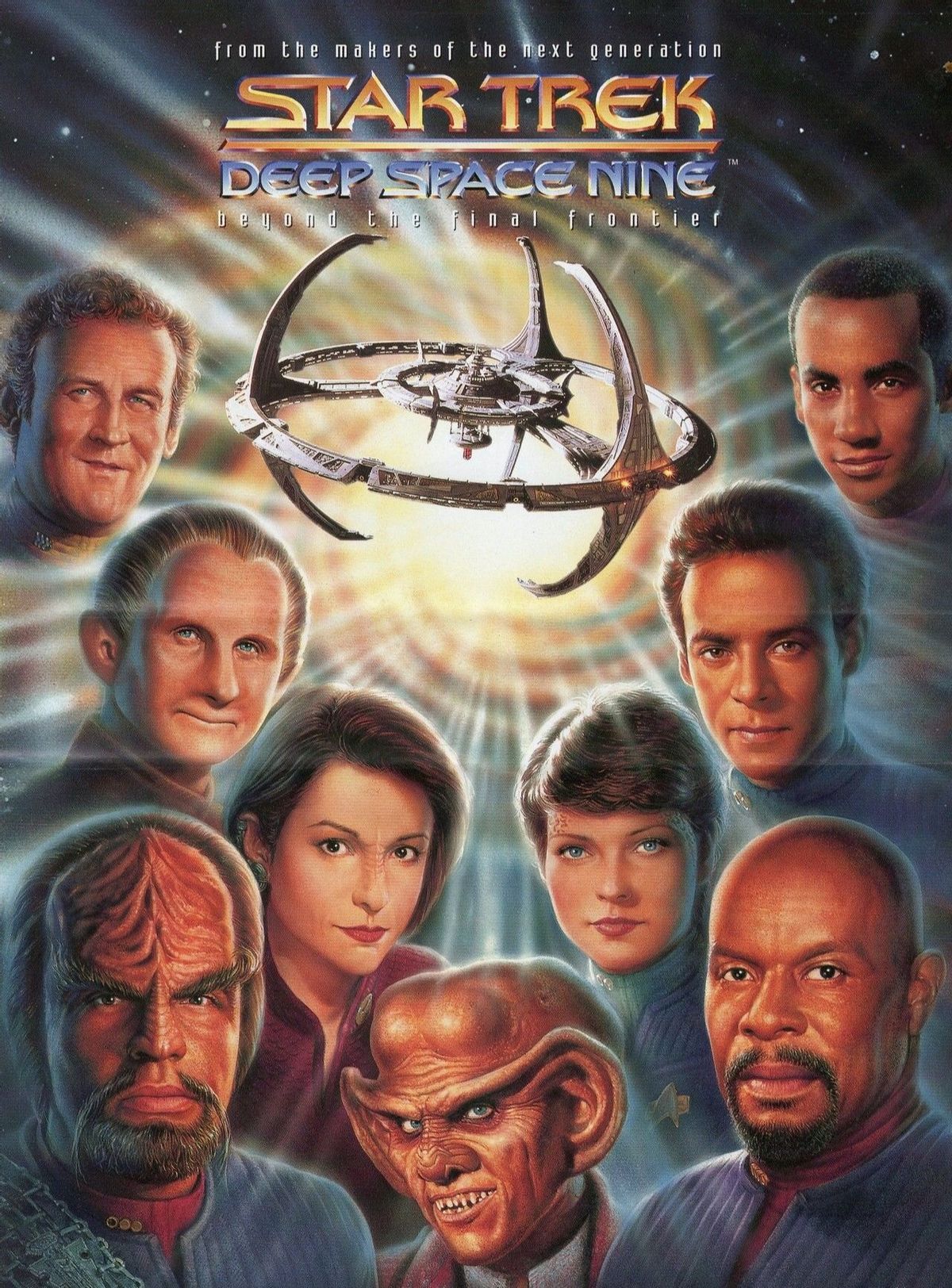
Star Trek: Deep Space Nine is the second of the "next generation" of Star Trek shows, airing after The Next Generation for two years, then alternating with UPN's Voyager for the remaining five years. The show was aired from 1993 to 1999, and like TNG, was offered through First-Run Syndication as opposed to any exclusive television network. Set on an orbital space station, DS9 traded the Wagon Train to the Stars premise for "Fort Apache in Space". Ira Behr, the showrunner, cited The Rifleman as another influence (particularly the father-son dynamic).
The remote world of Bajor had been occupied by the Cardassian Union for 50 years with its people enslaved and the planet strip mined for resources; any Bajorans who managed to break free from the regime either scratched out an existence as migratory settlers/refugees or became part of an armed resistance force committing terrorist actions against their occupiers. Events on TNG lead to changing borders and the Cardassians are forced to withdraw from the planet, leaving Bajorans in charge after decades of exploitation and fragmented leadership. Starfleet sends a detachment of officers — led by Commander Benjamin Sisko (Avery Brooks) as a diplomatic liaison — to provide humanitarian efforts to help Bajor rebuild; as a makeshift Starfleet outpost, they take up residence at the Cardassian space station Terok Nor in the Bajoran orbit which is rechristened Deep Space 9.
In the pilot, a one-of-a-kind stable wormhole leading to an uncharted corner of the galaxy is discovered, instantly transforming Bajor from a rustic backwater into the most valuable piece of real estate in the Alpha Quadrant, and DS9 is assigned to monitor the wormhole's traffic. What's more, the wormhole is seen by the extremely religious Bajorans as the Celestial temple of their gods The Prophets, fulfilling an important prophecy; and, after conversing with aliens in the wormhole who do not understand the physical plane or linear time, Sisko is declared to be "The Emissary" of the Prophets. This provides a much-needed cultural moral boost for Bajor, but it also adds further complications to Sisko's Starfleet duties in guiding Bajor towards membership in The Federation.
Sisko's Starfleet crew is supported by science officer Lt. Dax (Terry Farrell), an old friend of Sisko with a brand new face, the earnest and over-confident Dr. Bashir (Alexander Siddig) and world-weary Chief O'Brien (Colm Meaney), a transplant from the Enterprise note . The Bajoran government presence on the station is Sisko's liaison, former member of the Bajoran Resistance Major Kira (Nana Visitor), and station security Constable Odo (René Auberjonois), a shapeshifter from an unknown species and with mysterious origins, who held the same position during the Cardassian occupation. Quark (Armin Shimerman), the Ferengi owner of the local bar and gambling hall Quarks, is 'persuaded' by Sisko into remaining on Deep Space Nine in order to build a new community and prevent the place from becoming a Ghost Town; and Sisko is also accompanied by his teenage son Jake (Cirroc Lofton), adding to the perspective of the civilian population on the station.
But while these people from several different worlds and cultures gradually come to understand, befriend and trust each other, and as Bajor slowly recovers from the occupation, it soon emerges that the access the wormhole grants to the Gamma Quadrant and new exotic planets comes with a deadly sting in the tail; its appearance has also caught the attention of the Dominion, a far less cuddly counterpart to the United Federation of Planets, and the tensions between the two governments eventually shape much of the show.
DS9 changed the franchise's approach to Worldbuilding, since the fixed location and proximity to one particular planet allowed the show to delve more deeply into the political landscape of the Star Trek universe, fleshing out details and nuance. If you thought of the Enterprise-D (and, later, Voyager) as out there exploring the frontiers and sketching the outlines of the known galaxy, then this show was coloring in the drawing that had already been made.
Star Trek at the time trended towards a Monster of the Week / Monster of the Aesop approach, with maybe a handful of Recurring Extras with limited lines. DS9 immediately bucked that trend by including O'Brien from TNG as part of the main cast and later bringing in Worf at the start of the fourth season, as well as accumulating numerous Fake Guest Stars; former Prefect of Bajor Gul Dukat (Marc Alaimo) who pines for his lost status and influence and burns to restore Cardassia's former glory, Quark's nephew Nog (Aron Eisenberg) and brother Rom (Max Grodénchik) who both intially work for the bar but start to rebel in different ways against the traditional Ferengi mindset, and Garak (Andrew Robinson) a 'plain, simple' Cardassian tailor still resident on the station and far more than he initially seems, had their characters introduced within the first two episodes and held prominent roles all the way up to the series finale. Relatedly, O'Brien's family would continue from TNG with wife Keiko (Rosalind Chao) and daughter Molly (Hana Hatae). There is also Morn, the never-heard-but-always-talking barfly and friend of Quark; he appeared in more episodes than actual opening-credits star Cirroc Lofton, and even had an episode revolve around him... despite the fact that he never once had a line. Later series characters like Martok (J.G. Hertzler) and Weyoun (Jeffrey Combs) would still end up with more than twenty episodes.
Another part of the Star Trek formula left behind was the sense of actions without consequence, due to former TNG writers (namely Ira Behr and Ronald D. Moore) rebelling against Gene Roddenberry's spotless, optimistic future. At the beginning of the story, and continuing for some time beyond the show's pilot, nobody on the station or on Bajor particularly got along with each other; plus, unlike the previous ship-based series, the crew couldn't simply jump to warp at the end of the episode and leave the Problem of the Week behind to sort itself out. Rather than simply being standard Planets of Hats, the Bajorans, Cardassians and even TNG's failed recurring villains the Ferengi were thoroughly developed, with their societies, politics, conflicting factions and beliefs becoming crucial aspects of the narrative. The show employed Myth Arcs more extensively than other Treks, and by shifting the focus away from Starfleet's bold explorers to DS9's overworked jarheads, living among and interacting on a daily basis with people who at first regarded them with varying levels of suspicion, resentment and contempt, the writers were able to scrutinize the Federation as it appears to outsiders: a toothless alliance which still has problems with bureaucracy and some skeletons in its closet. Though the show still comes across as optimistic about the future of humanity, it asks several questions about the Federation's place in the galaxy and the capacity for humans to accomplish great things — even if those great things become I Did What I Had to Do.
Deep Space Nine is very frequently compared to Babylon 5, the other 90's cult Space Opera show set on a space station incorporating matters of faith, interstellar war, and Deconstructing the future. (Indeed, J. Michael Straczynski has implied that Paramount effectively stole a treatment he pitched to them and stuck a "Star Trek" brand on it.) Both shows were ahead of their time: their strong focus on Character Arcs, Gray-and-Grey Morality and Story Arcs feel much more normal to audiences that have since seen shows like The Sopranos and Breaking Bad turn those tropes into the holy grails of Peak TV . Today, they're Better on DVD; when they aired, both shows struggled: B5 had to be Un-Canceled at one point, and DS9 is the Love It or Hate It Oddball in the Series of Star Trek as a whole.
The show originally aired in syndication but has gone on to be shown in reruns and on numerous streaming services.
In 2017, Ira Behr and Adam Nimoy announced they were crowdfunding a documentary about the series, What We Left Behind: Looking Back at Star Trek: Deep Space Nine, which was released in June of 2019. In addition to bringing back most of the major players (including Aron Eisenberg and René Auberjonois before their untimely deaths), the film examined DS9's cultural impact, particularly its post-wrap rise in popularity in syndication and streaming, and featured Behr getting the old writers' room together to plot a "what if" season 8 pilot.
Related works in the Star Trek Expanded Universe include the Terok Nor trilogy, a sub-series of Star Trek: The Lost Era which chronicles the Occupation of Bajor and features many of the Bajoran and Cardassian characters, and the Star Trek: Deep Space Nine Relaunch continuation series; Star Trek Online features DS9 as a player hub, with many of the characters from the show (voiced by their original actors) returning for the Victory is Life expansion. The Promenade portion of Star Trek: The Experience was also based on DS9, featuring venues like Quark's Bar and Restaurant and Garak's Clothiers, and allowing visitors to interact with Ferengi and Bajorans, among others.
