







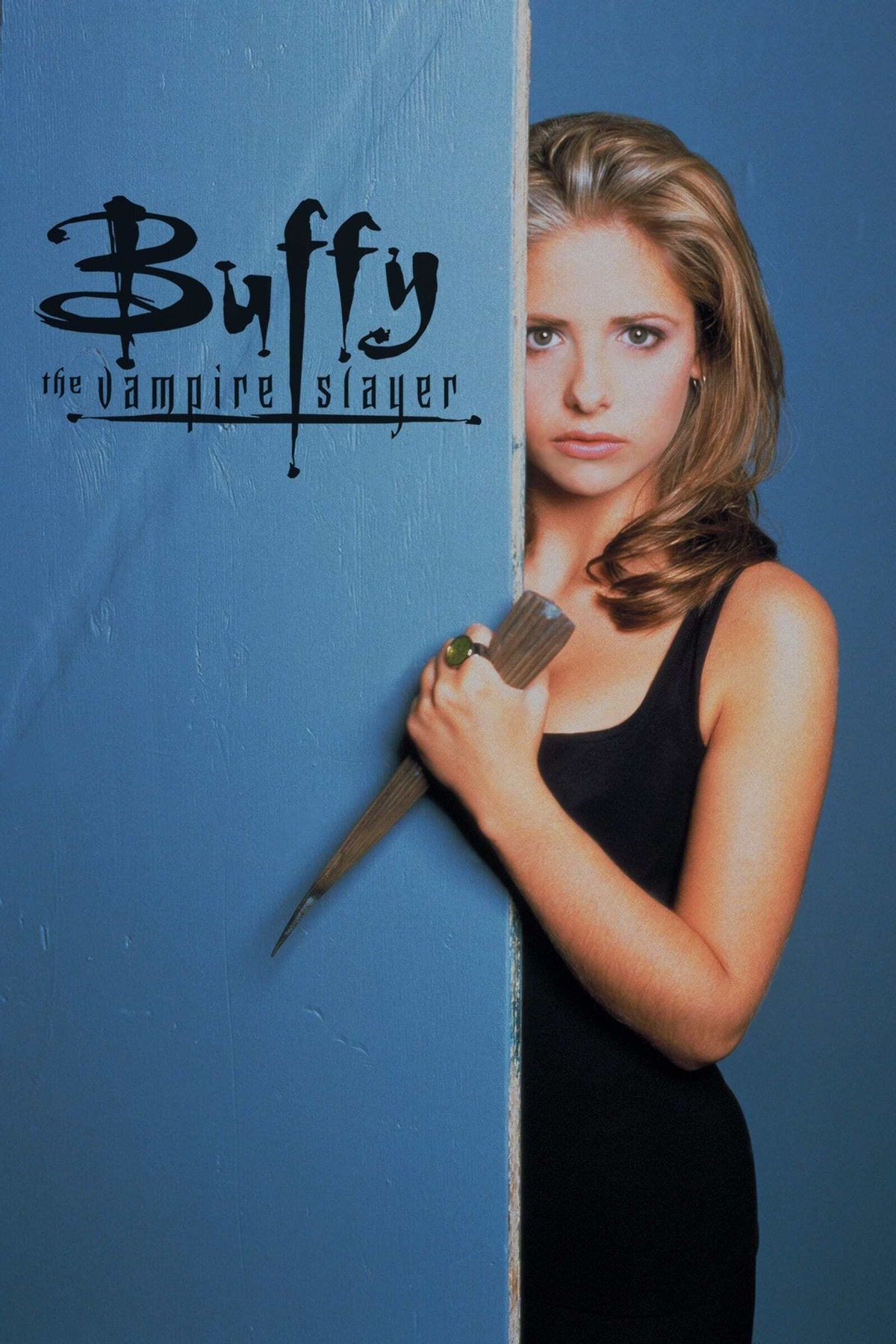
Bluntly put, this show is why TV Tropes exists.
In 1992, the film Buffy the Vampire Slayer, written by Joss Whedon and starring Kristy Swanson as Buffy, played with a bog-standard trope: the fragile (and doomed) blonde Damsel in Distress cheerleader attacked by monsters in a dark alley. In a postmodern twist, the blonde cheerleader is "the Slayer," a powerful warrior that the monsters are afraid of meeting in dark alleys. Since Whedon, a mere writer, lacked creative control over his work, he viewed the actual film as a disappointmentnote . He did love the original concept and the film did end up a Cult Classic, so when he was given the opportunity to revisit it as a television series a few years later, he wasted no time saying "yes."
In 1997, the fledgling WB network raised Buffy the Vampire Slayer from the dead with an abbreviated first season. The pilot takes a Broad Strokes approach to the motion picture, treating Whedon's original script (not the film that resulted) as canon: while living in L.A., Buffy Summers (now played by Sarah Michelle Gellar) learned she was the most recent in a succession of warrior women chosen by fate and given mystically enhanced strength, fast reflexes, instinctual combat skills and loose premonitions that make her uniquely gifted to combat evil. Prior to the start of the series, in a pitched battle she set her school gym on fire to kill the vampires inside. She couldn't fully explain this to the authorities, making her a social pariah. Hoping to elude her Slayer responsibilities, she and her mother moved to Sunnydale, a sleepy town in Southern California. In spite of that, she learns in the pilot episode that Sunnydale is sitting on top of a Hellmouth, a well of evil that attracts all types of demons, with the high school at its centre. She is assigned a "Watcher", school librarian Rupert Giles (Anthony Head), from an Ancient Conspiracy dedicated to finding and training Slayers. Forming a tight-knit group of friends with fellow students Willow Rosenberg (Alyson Hannigan) and Xander Harris (Nicholas Brendon), Buffy battles hellspawn while juggling her double life as a would-be normal schoolgirl. That last part is trickier than it sounds, as Sunnydale's adults are too wrapped up in lawn care (and denial) to acknowledge the evil brewing right under their feet.
Since demons on Buffy are walking metaphors for existing evils — reptilian authority figures, suddenly-soulless boyfriends, and so on — the B-horror trappings take on an entirely new meaning, usually with a sly feminist wink inserted.
The show didn't catch fire in its first season, but did garner enough critical acclaim to attract viewers by year two. However, Buffy (and Angel) were not inexpensive shows to produce, and neither were expected to grow beyond their cult demographic. Although WB attempted to shove Buffy off the air in 2001, it was picked up by UPN in time for Seasons 6 and 7. The jump was heralded by Buffy's literal death and resurrection, along with a ratings-grabbing ad campaign.
The show pioneered the Half-Arc Season, with a singular Big Bad behind that year's events that helped make each season have a self-contained Story Arc while interspersing standalone episodes; they were able to signpost major plot developments months (and even years) in advance. This is in contrast to prior serialized Myth Arc shows like The X-Files, where everything fed into an ongoing storyline but lacked a clear beginning, middle and end. With even the supposed filler episodes usually turning out to be more important than they at first seemed, each season of Buffy would come across as a 15-hour movie and resolve itself in a big Season Finale, and the next season would start over again. Perhaps most surprisingly, the central cast grew like kudzu, with guest stars being Promoted to Opening Credits after a year or two and even walk-on roles getting a dose of Character Development much later on... just in time for Joss to kill them off, alas.
Nobody can deny or ignore the influence of Buffy on the TV shows that followed it, both within and outside the genre. (Russell T Davies had at least one eye on this show when he revived Doctor Who — and Angel when he created its more adult spin-off, Torchwood.) This series has become one of the most Trope Overdosed and Lampshaded shows in existence; thousands of references to Buffy exist across this entire wiki, partially because TV Tropes began with a specific focus on Buffy (based on a 2004 thread on the fan site Buffistas.org) before branching out to all of TV and eventually all of everything. This show is considered part of the Truly Awesome; with over 9,000 wicks and a runtime of 6,056 minutes, this page (well, this entry and its metapages) now has over one wick per minute. Even outside this wiki, analysis of Buffy's characters and themes has become its own academic field, known as Buffy studies or Buffyology .
.
For more information about the franchise that encompasses Buffy, Angel and other spinoffs, check out the Buffyverse.
Tie-ins and Possible Reboot
Buffy remains Joss Whedon's mothership series, with numerous tie-in novels, merchandise, video games, and spinoffs in the offing (see Fray), though plans for a Spike and/or Giles TV show remain in Development Hell. In 2001, Joss even tried shopping around an animated series based on the show, but most networks felt it wasn't suitable for small kids.In 1999, Joss and co-producer David Greenwalt conceived a somewhat grittier Los Angeles-set spin-off starring Buffy's vampiric love interest, Angel — the He-Man to Buffy's She-Ra, if you will. While Buffy focused on adolescent woe, Angel was a Vampire Detective Series revolving around twenty-somethings in often thankless jobs helping the helpless, trying to hold onto their youthful ideals. Angel ended the only way it could have: the gang seemingly sold out to Occult Law Firm Wolfram & Hart throughout its fifth and final season, before confronting the forces of evil one last time in a Bolivian Army Ending. Crossover episodes and cross-references between the two shows were especially prevalent in the first season of Angel / fourth season of Buffy, and persisted even after Buffy ended on TV with the seventh season finale in 2003.
In 2007 Buffy started up again — in comic form. Produced and confirmed as canon by Joss Whedon, it encompasses four "seasons" of TV time (Seasons 8 through 12). In 2011, the mainline series branched off into Angel & Faith, which is London-based (in a nod to Excalibur). The comic run ultimately came to an end in 2018 due to Dark Horse Comics losing the license, which in turn finally ended the original continuity of the series. Boom! Studios picked the license up later and initiated a full Continuity Reboot beginning in 2019.
There were also a few standalone comics based on Buffy's high school days, being much Lighter and Softer than the source material; they only got three books and were forced to end due to the aforementioned losing of the license by Dark Horse. Bizarrely, the series likewise got an all-ages story set in its own continuity, Buffy: New School Nightmare, in which she once more arrives in a new town and has to contend with vampires, joined along the way by a witch and a werewolf Sarafina and Alvaro and a new, female Watcher named Ms. Sparks guiding her. In this version, Buffy is much younger (12) and the vampires are all silly ones from various eras (in fact there isn't any kid vampire at all). While it does mention death and what not (with even Santa Claus being a vampire) it never gets as dark as it's mainstream counterpart and is even more Lighter and Softer than the stand-alone "High School Years" series. A sequel to this continuity is said to be in the works.
A Buffy board game was released in 2016, with an expansion pack following later. Some Monsters of the Week add features to the game, such as the Gentlemen from the episode "Hush" rendering all players mute until eliminated. A Non-Standard Game Over can also occur if the Apocalypse Counter is filled with wounded and/or dead characters.
The producers of the original film (the Kuzui couple listed in the credits) retained the rights to Buffy throughout the show's run despite having no creative involvement past the film. Plans have been proposed to revive/remake the film without Joss Whedon's input. In February of 2025, a Sequel Series was officially announced to be in development with show runners Nora and Lilla Zuckerman (Poker Face, Agents of S.H.I.E.L.D.), and Chloé Zhao directing the pilot for Hulu. Sarah Michelle Gellar will return as Buffy and is also an executive producer on the series. In May of 2025 it was announced that Ryan Kiera Armstrong had been cast as the lead opposite Gellar, as the new Slayer Nova.
Buffy the Vampire Slayer has been indexed to avoid one day breaking the site:
- General Tropes
- Season-Specific Tropes
