

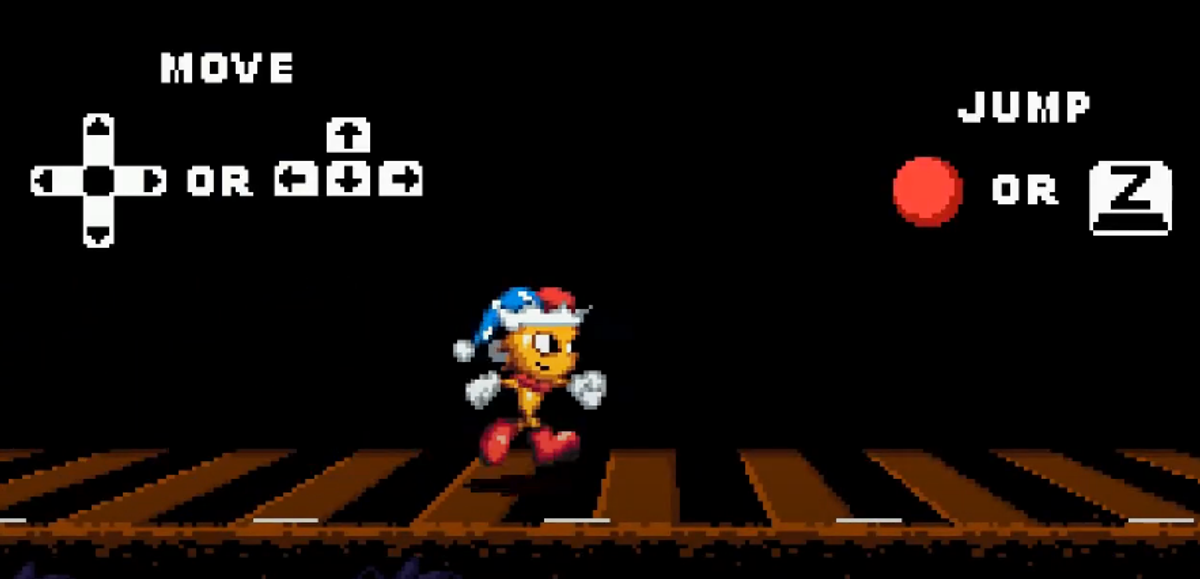
At least as far back as the first Final Fantasy on the NES, developers have reckoned that players might actually not read the manual for all the controls and general know-how of playing the game. As games grew more complicated, it also appeared that some actions were simply really hard to get across with just words, at least without a 12-page essay on the single function. By the seventh generation of gaming and the rise of digital distribution, few games even came with manuals at all, meaning that the game itself is the only place to learn how to play it.
Thusly, in-game tutorials have been in games with increasing regularity, to the point where it's more likely that games have at least one sort of tutorial than none at all.
The basic formula is thus: A game mechanic or element is brought to the players attention, and the player is informed about it, possibly with a demonstration of some sort.
Of course, it's not always that simple. Tutorials themselves have Tropes of their own, each adding another layer of complexity and making game manuals even more redundant here.
Sub-tropes:
- Antepiece: A more subtle version, where an easier version of an obstacle precedes the real thing.
- Auto-Pilot Tutorial: The tutorial that you can look at, but not touch.
- Forced Tutorial: No matter what you do, you have to do this tutorial. Not so fun when it's something you already know from previous games or you're starting a New Game Plus.
- He Knows About Timed Hits: Video game characters explain the game's controls.
- Justified Tutorial: Tutorials that are part of the setting. The instructor says shoot, text in the HUD says to press R1 to fire. As close to canon as a tutorial can get.
- Signpost Tutorial: Tutorials that appear on signs and scenery.
- Training Boss: Tutorials may end with a bang... caused by you, as now you've got the chance to test your new skills in a Boss Battle.
- Training Dummy: The standard punching bag for combat tutorials. Hey, someone needs to get hit.
- Tutorial Failure: The tutorial fails to teach you vital things about the gameplay.
- You Shouldn't Know This Already: Doing actions, before a tutorial tells you about them, will have no result.
Examples that don't fit any of the sub-tropes:
Fan Works
- Hermione Granger: The Witching Hour: Hermione's New Game Plus second chance at life doesn't have a separate tutorial section proper but rather keeps explaining the Sudden Game Interface's features by way of text boxes that pop up as she interacts with it or encounters new situations.
- Hope on a Distant Mountain: The trial has one, despite the fact that it isn't a video game. It takes the form of a separate narrator who gives instructions to allow readers to play along with the trial at certain points, which are framed as if it was a video game (along with several mentions of having to cut features that would be difficult to present in text format due to budgetary reasons) but also talks about past events from the game as if he were an actual character, and in the Logical Dive explanation even references Hinata's version of the minigame, despite the events of that game never happening.
- Quake Champions: Doom Edition: 3.0 integrates the "defrag"/"bunnytrack" movement and trickjumping mode into the game with two maps designed for Quake III Arena movement (qcdf01) and Unreal Tournament movement (qcdf02).
Live-Action TV
- Spin the Wheel: The first round of four spins, which are collectively known as "Quick Spins". This round appears to be an exact copy of the Free Fall round of The Wall, with each question only having two answer choices and the contestant winning or losing the money the ball lands on based on his or her answer.
Tabletop Games
- Scum and Villainy: One of the playbook's pre-baked situations is essentially a tutorial mission for players whose crew of choice is the Firedrakes. The crew starts out imprisoned at Isotropa Supermax. The player must reunite them and help them escape by stealing an impounded spaceship.
- Solitaire: Microsoft officially claimed that the original version for Windows 3.0 was one for training people used to MS-DOS in using the mouse, but it was really just there for fun.
Video Games
- ANNO: Mutationem: Around the start, Ann meets with Dr. Doyle to test out the Grom System by entering a Virtual Training Simulation, with a tutorial interface explaining the mechanics of combat and how to utilize special techniques, secondary weapons, items, and the Ring Menu before engaging a Warm-Up Boss at the end of the segment.
- Asphalt: Throughout the series, there are tutorials at the start of the game and early in your career. For TouchDrive users in 9: Legends, the game also explains the feature's mechanics of designating your car's path, as well as a lesson on how to do a perfect nitro. The career mode's tutorial also explains how nitrous can be gained before eventually concluding with a lesson on how to do a nitro shockwave.
- Bugs Bunny & Taz: Time Busters: In addition to being the Hub Level, Granwich is also where Granny teaches you the basic mechanics and moves of the game before you enter the first Era.
- Caltron 6 in 1: The first level of Porter is designed to teach the player how the game's mechanics work. There are four boxes with the area they must be pushed to directly ahead.
- DanceDanceRevolution: Hottest Party introduced a tutorial song, "Lesson by DJ". It persisted into later versions of the Hottest Party games (and got follow-ups focusing on mechanics introduced by the sequels). It crossed to the arcade versions on DDR A, being played on the "How to Play" screen in attract mode, and automatically launched as a tutorial if a player begins a game without logging into e-Amusement. It even calls out the practice of going back to the center panel in its lyrics.
- Uncommon Time: Numerous examples.
- Five Nights at Freddy's 3: The first night. Unlike the last two games, nothing's out to get you. It's just the new Phone Guy going over exposition and how things work, allowing you to get used to new game mechanics. Justified as on Night 2, he vaguely reveals that the company found an animatronic before he runs off. Probably unaware that the thing can move.
- Half-Life:
- Half-Life 1: Aided by a holographic assistant that takes the form of Gina Cross (the protagonist of Half-Life: Decay), Gordon is put through the "Black Mesa Hazard Course" where the player learns basic first-person movements, and how other mechanics and gun-play in the game work. This is the original game's tutorial mission.
- Half-Life: Opposing Force: "Boot Camp" is the tutorial mission. At Santego Military Base, Arizona, the player character, Corporal Adrian Shephard, and several other Marines of the HECU are put through Advanced Training from Senior Drill Instructor Dwight T. Barnes. Shephard goes through basic training for the player to learn the mechanics of the game. Some of which you only ever see in this game, such as squad mechanics, night vision goggles, and rope climbing.
- Hitman 2: Similar to the Agency Training missions in 2016, this is a low-stakes, low-threat mission with few disguises and a limited number of entry points into the house in order to show the player both the sandbox-esque level design and some of the things they're able to do. This level also introduces some of the new concepts to work with, such as tall grass and working mirrors.
- Kye: The first level of the original level set, "First", is meant to give a tour of how the game's various blocks work. Players are encouraged to interact with the various objects before collecting the single diamond right next to their start point when they're ready to move on.
- L.A. Noire: Case One: "Upon Reflection" introduces crime scene investigation. The situation is as follows: Cole Phelps and his partner are sent to retrieve the gun involved in the murder of Scooty Peyton. Evidence of the true culprit abounds, and the player must learn how different kinds of it are obtained. You also learn that it's possible to get the wrong man, so it's best to think things through.
- Little Samson: The opening solo stages for each character are meant to familiarize you with their special abilities, so that you can figure out the best ones to switch to in later stages based on the enemies and obstacles encountered.
- Prehistoric Kingdom: In the in-game tutorial, Nigel Marven guides the player around the basics of park management, as they clean up and do some light renovations in a British park.
- Quake II: The 2023 remaster has one with the very basics on how to play the game, including holdable items, shield position, and why you should Shoot the Medic First (and the Medic Commander too!).
- Replica Island: The first few memories are of Android just after being activated for the first time, and have Dr. Kabochanomizu teaching it all its techniques.
- RUSE: Most of the single-player campaign is one big tutorial. It starts out as something of a Justified Tutorial, as Major Sheridan is placed in impromptu command of his troops in the field (although even then, some of the things the game tells you should be second nature to anyone who managed to reach the rank of Major). Although the game does start giving the player more choices and options fairly quickly, it still takes its time introducing new concepts (such as aircraft, static defences, and unit upgrades) and RUSEs, and the training wheels only really come off in the endgame. When they do, however, it is glorious.
- Spider-Man 2 – Enter: Electro: In "Enter The Web-Head", the tutorial level, Beast teaches Spidey about web-swinging and creeping behind enemies for a swift attack.
- Super Mario Maker: In addition to the built-in courses at the start of the game, courses that go into how certain objects react and interact with each other are fairly popular in Course World. People have explained everything from how to properly use a cape, what spin jumps can work on, and the extent to how much the Spiny shell protects, and so on and so forth.
- Super Mario Odyssey: The Cap Kingdom starts off as this, being a short and simple stage with few enemies, and all the time and space you need to get accustomed to the game's controls. Then, after the Odyssey is salvaged and Mario's journey begins properly, you can go back to it to find its hidden secrets.
- Tomb Raider II: Lara's obstacle course on her mansion grounds, which are separate from the main game itself. The obstacle course tests your skills with running, jumping, climbing, and swimming and you can set your personal best times as well.
- Unreal Tournament 4: A complete Crash Course was developed for the game, introducing the player to the game's movement and weapon mechanics separately. These maps, as well as the gameplay introductory maps, have Skill Tokens scattered across the area.
- Within a Deep Forest: Harara Mountains is where one learns the game's mechanics. It's entered in a completely separate area from the main game.
Visual Novels
- My Candy Love: Each season has a mandatory tutorial, during which ChiNoMimi or Agatha explains the game's mechanics. LL's tutorial has an option to skip the tutorial and go straight to picking the route you want.
- Slow Damage: Upon the first time playing the game, the player is given a tutorial to tell them how the choice system works this time, since it is different and more convoluted compared to the choice system used in Nitro+CHiRAL's previous games. Later on, they're given another tutorial telling them how Explorations work, and whether the goal of an Interrogation is to maintain the character's Madness or Euphoria level.
- Sweet Elite: Chapter 0 follows Scholar as they're taught the ropes by Serena, one of the senior students. She breaks down the main mechanics of the game before introducing them to Lady Arlington, the school's headmaster.
