

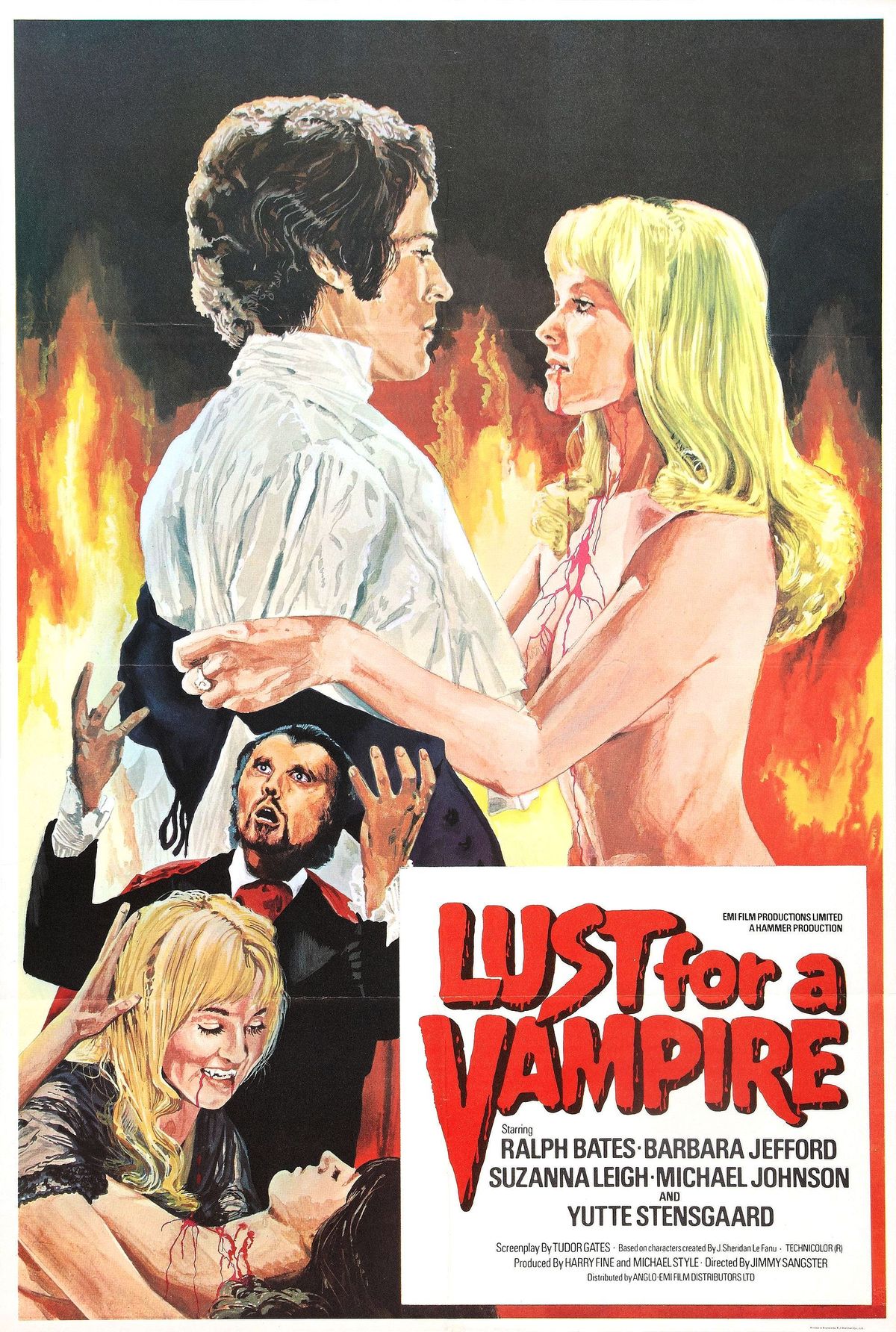
 , Decider (Oct. 26, 2017)
Psychosexual Horror is when eroticism, puberty, and sexuality are the story's central theme. Its narratives are not limited to depictions of sexual abuse and depravity; rather, it explores how sex connects to control, envy, guilt, identity, obsession, inner suffering, shame, and vulnerability in the form of Personal Horror, Psychological Horror, and Supernatural Fiction.
Psychosexuality as a subgenre delves into anxieties and dysfunctions surrounding sexual activities. Psychosexual horror analyzes themes of unresolved lust, suppressed desires, self-actualization, and repressed trauma through horror and sexual symbolism. It also conveys themes of emotional turmoil and insecurities in relationships. Psychosexual horror is not limited to aggressive erotica; the genre simultaneously addresses sexual awakenings, development, and the loss of virginity.
As one of the Seven Deadly Sins, Lust is inherently sexually charged, and its imagery evokes an erotic aesthetic. In psychosexual horror, the narrative preys on a character's raw desires, suppressed libido, sexual frustrations, and personal fears of sexuality. The protagonist is either afraid of giving in to their conflicting impulses or in dread of being objectified by a sexual predator. The antagonist manipulates a character's carnal desires and emotional needs; enamored victims swept up by temptation are seduced and eventually deceived, leading to punishment or death at the maw of the antagonist. Naked or scantily clad antagonists exude dominance and fearlessness, turning vulnerability into psychological warfare by challenging the notion that they are weaker for exposing themselves.
Psychosexual horror addresses themes of antisexualism, which is an opposition to sex and sexuality. Antagonists, especially religious fundamentalists, desexualize and instill sexual guilt in their victims, punishing, repressing, and shaming them for their sexual thoughts and impulses. Driven by the belief that sexuality is impure, sinful, or a distraction from spiritual devotion, antagonists attempt to control or quell these impulses. These repressed, instinctual desires and unresolved sexual tensions result in self-loathing, sexual anxiety, and sexual frustration. This inner turmoil often manifests as hostility toward those who are more sexually open or confident because they struggle to understand and express their own urges healthily. Without moral guidance, their sexual urges become distorted and twisted: they fail to recognize why objectifying others is wrong and become emotionally detached. They can't express their desires without feeling guilty or a compulsion to punish themselves for these thoughts.
Psychosexual horror doesn't merely examine the darker aspects of sexual expression through graphic and gratuitous content. It portrays emotional or psychological threats to embody a character's underlying need for emotional or sexual connection, intimacy, and a sense of belonging. In existential stories, if hedonism is pursued aimlessly and overindulgence becomes a means of escapism, its insatiability will render sexual liberation and openness hollow, lonely, and oppressive. Without attachment and depth, lust will only create a Gilded Cage and Self-Inflicted Hell. In this context, the genre also explores romantic idealization, repressed memories, suppressed thoughts, and cognitive dissonance—the clash between a character's natural feelings and societal or religious constraints.
Psychosexual horror often functions as a representation of the persecution and moral panic towards queerness, framing queer desire as monstrous or destabilizing to heteronormative society. These stories have queer metaphors and subtext to address the topic of forbidden desire and attraction. Demons, aliens, monsters, and supernatural beings act as an allegory for the scapegoating of the LGBT population and are seen as victims of their uncontrollable urges and cravings. Curses and transformations are depicted as disease metaphors, reflecting the societal stigma of the HIV/AIDS epidemic, during which gay men were scapegoated and blamed for the spread of the disease.
- The character's sex plays a crucial role in psychosexual horror, as antagonists are often thematically linked to desire. Gendered antagonists are typically hypersexualized, exhibit distinct sexual dimorphism, and possess pronounced sexual characteristics that make their male or female identity immediately recognizable.
- Males and male-coded antagonists are written as pursuit predators who rely on force and aggression, chasing down their prey and overpowering them. Their weapons have overt phallic connotations as they kill their victims in an up-close and intimate way, through thrusting and penetrating attacks. Castration and groin attacks evoke themes of disempowerment, rendering the victim less threatening, weakened, and more vulnerable. As monsters, male and male-coded antagonists have overt phallic imagery, and their tactics are akin to sexual assault. Male antagonists are also more likely to use sexual coercion to dominate and violate their female prey, and the way they consume their female prey is portrayed can be symbolic of sexual assault.
- Females and female-coded antagonists are often more sexualized than men, as they rely on temptation and allure to entrap victims. They are written as ambush predators who rely on enticing and seducing their prey to draw them into a vulnerable position and striking when they're off-guard, often just before, during, or after sex. In monstrous and demonic characterisations, they are more likely to partake in sexual cannibalism, where they animalistically consume their male prey either to sustain themselves or to feed their young.
- Allegories, monsters, personifications, and tulpa carry overt sexual motifs. These entities are visually unsettling and accompanied by erotic subtext as part of sexual symbolism that emphasizes the story's themes. The most commonly used monsters are Succubi and Incubi, demons that seduce their prey and slowly kill them in their dreams. Other examples include transformation scenes serving as allegories for puberty and sexual development. Cannibalism is a symbolic substitute for sex, representing love hunger and sexual appetite. The sight and indulgence of blood could cause instant arousal and sexual attraction as they desire to feed on their prey and sadistically enjoy the pain they inflict on their victims as they achieve a sense of euphoria from it.
It can go with All Psychology Is Freudian, Sex Is Evil, Paralyzing Fear of Sexuality, Sex Miseducation Class, Miss Conception, No Periods, Period, Menstrual Menace, Growing Up Sucks, Women's Mysteries, Circumcision Angst, Vagina Dentata, and Literal Maneater. Compare Fan Disservice, Fetish Retardant, Full-Frontal Assault, Naked Nutter, and Sinister Nudity. Womb Horror can be paired with this because unplanned pregnancies are a result of unprotected sex. Womb Horror addresses themes of parenthood, reproduction, and childbirth-based Body Horror.
Not to be confused with Freudian Threat, which is intimidating someone by threatening them sexually, usually along the lines of castration. Not to be confused with Intimate Psychotherapy, which is when Sex for Solace causes serious psychological problems to subside. Contrast Non-Sexual Intimacy.
Examples
- The "Ventriloquist" is a PSA video by the National Society for the Prevention of Cruelty to Children (NSPCC) featuring a man controlling a ventriloquist dummy called "Sally". Nobody acknowledges the man’s presence and instead speaks to the dummy as if it were a real person, yet the man puts words in her mouth and speaks for her, effectively isolating her from everyone else. The advert ends with the mother asking why their daughter is not eating again, but the man leans in uncomfortably close to the doll and claims that she is just not hungry. It is clear in the PSA that Sally serves as a metaphor for a real child. However, the PSA does not directly state what the man has been doing. Instead, the caption—combined with the way he whispers into the doll’s ear, her fear towards him, and the mother’s lack of awareness—strongly implies that the man has been abusing Sally in secret and is forcing her to keep quiet about it.
"Real children can't speak up."
- Berserk:
- During Casca's healing arc, Farnese and Schierke astral project into her mind to clear away the stupefying amount of baggage she has from being raped by Griffith during the Eclipse. As such, most of the monsters they face have a distinctly phallic appearance.
- Farnese's horse is possessed by malevolent spirits who then attempt to rape her, though she's saved by Guts.
- Make the Exorcist Fall in Love: Asmodeus, Demon Lord of Lust, is introduced using her powers as The Pornomancer to brainwash dozens of women into trying to rape Father, a twelve-year-old child at the time, with no regard for his actual consent. While Father manages to compose himself by tearing out his own eye in penance, the event leaves him with a Paralyzing Fear of Sexuality.
- Parts of Shinji's ordeal in Neon Genesis Evangelion are related to his attraction to Asuka and the early urges of his puberty. Indeed, in The End of Evangelion, part of the finale is Asuka, Misato, and Rei asking him whether he wants to have sex with them.
- Just about everything produced by H. R. Giger, with biomechanical depictions of sex organs and coitus rampant in his works.
- Venus, Cupid, Folly, and Time: This painting by Angolo Bronzino depicted Venus and Cupid having sex. While it seemingly appears as just an erotic painting, researchers in 2015 discovered that the painting was used to depict syphilis, a sexually transmitted disease that was running rampant during their time period.
- Arkham Asylum: A Serious House on Serious Earth: In this story, there are strong themes of sexuality and sexual abuse.
- Amadeus Arkham's parents sexually abused him. In his adulthood, Amadeus and Constance, his wife, also sexually abused Harriet, their daughter. It's also stated that "Mad Dog" Hawkins was sexually abused by his father as well, which contributed to his descent into insanity, leading him to become a serial killer who targets women.
- This version of Clayface is also based on AIDS, as represented by how he's naked, has his skin wasting away as a result of his disease, and how he wants to "share his disease" with Batman. This is directly referenced by Grant Morrison themself in their script notes.
Grant Morrison: Alert readers will perceive him as AIDS on two legs and realise that he represents the fear of what lies beyond the curtain in the Tunnel of Love. If we take all the encounters with villains as corresponding to various psychological states, then this one is Batman's fear of sexuality as something intrinsically unclean.
- Batman is a heavily repressed and sexually dysfunctional man who was mentally stunted after witnessing his parents' murder. In one scene, Joker taunts Batman and spanks him, making Batman uncharacteristically angry about being touched. According to Grant Morrison, this version of Batman is afraid of sex and commitment because he's ultimately afraid of being hurt and abandoned. So when Joker spanked him, he basically pierced Batman's armor and showed a small level of dominance that was able to make Batman feel weak and violated.
Grant Morrison: This Batman is a frightened, threatened boy who has made himself terrible at the cost of his own humanity. He is completely incapable of any kind of sexual relationship. He has made himself hard and domineering in order that he might never be hurt or abandoned again.
- Crossed: The series is about a Hate Plague that transforms its victims into psychotic sadomasochists, committing horrible acts of evil for the sheer sake of it. So naturally, sexual violence is a very prominent theme. And it's not just limited to the Crossed themselves, as Harold Lorre from Psychopath can tell you...
- The titular creature of the Alien franchise is rife with Freudian imagery and was originally created as an explicit rape allegory. The facehugger phase of the creature has a vagina-like opening with a phallic proboscis that orally violates the victim, causing them to become pregnant (in a sense). The chestburster itself is entirely phallic-shaped. The adult phase features a similarly phallic head shape, and the way it kills Lambert in the first film is rife with sexual assault undertones.
- Antichrist is a particularly notorious example. The plot revolves around a nameless married couple dealing with grief after their toddler son Nic dies. The wife tries using sex as a form of coping, but this causes her to develop a dependency on her husband — a very aggressive dependency.
- Black Swan: Nina Sayers is the sexually naive protagonist who believes her innocent nature and sexual repression make her lack the passion the Black Swan role requires. She pushes herself to the brink of insanity and is confused by her sexual attraction towards Lily, her rival who plays the black swan.
- CAM: Alice is a cam girl but chooses to keep this information private out of fear of judgment from her family. However, Fake Lola turns up and starts interfering with her work and personal life. Breaking her boundaries to the point where men in real life start humiliating, soliciting, and harassing Alice.
- Both versions of Cat People combine horror and sexuality, though the 1942 version is much more subtle compared to the significantly Hotter and Sexier (and Bloodier and Gorier) 1982 remake.
- In the 1942 film, a naive and troubled young woman named Irena fears she will turn into a monstrous panther if she ever kisses a man (with the unspoken yet logical conclusion that sex is off-limits too) due to a family curse, complicating her romance with co-worker Oliver, who tries to convince her it's all in her head. It's not.
- In the 1982 film, Irena is a virginal orphan who is trying to reconnect to her roots and falls in love for the first time, but is informed by her long-lost brother that they're werepanthers who are forced to transform if they have sex with humans and can only return to their human forms if they kill a human. The only people they can safely have sex with are fellow werepanthers, so after years of loneliness and sexual frustration (not to mention a lot of murder), Irena's brother is a little too excited to be reunited with her. Irena isn't so keen on this arrangement, but the dangers of her burgeoning sexuality causes problems in her relationship.
- Cherry Falls has this in spades: the slasher is a teacher named Leonard, who is the product of rape between his mother and the local sheriff, while in high school. Leonard is mistreated during his childhood and, as an adult, returns to the titular Cherry Falls, where they begin their killing spree, targeting only virgins, under the cross-dressing disguise of a younger version of their mother. After killing enough teens, the remaining student body decides to hold an orgiastic party where they can "lose their cherries", so they may not be targeted by the killer. This does not work at all.
- Def By Temptation: Temptation is a succubus that targets men, seduces them, and must be killed to free her victims from her control and conversion.
- Diary of a Serial Killer: The crux for Bill's obsession with murder is rooted in his sexual frustrations from his trauma while in prison, and his loveless marriage.
- Eyes Of Crystal: In this film, a detective is hunting a serial killer. It's explained that the murderer's actions were caused by his experiences with being abused by the matron of the orphanage he grew up in, and it's implied he had sexual experiences with a doll from his mother's doll collection. Because of these experiences, the killer was inspired to create a perfect companion for himself out of the various body parts of his victims, which includes the head of a male detective, whom was revealed to a childhood friend of his, to relieve his loneliness.
- Fatal Attraction: The entire movie is about Dan having an affair with Alex and finding out that she has mental health issues that push her into becoming obsessed with Dan and tormenting him and his family. Leading her to kill their pet rabbit and nearly kill Beth in the finale.
- Fresh (2022) is about a woman being seduced and eventually held captive by Steve, a cannibalistic womanizer who eats women's body parts as part of his literal sexual appetite. Although his main interest is in cannibalism, Steve does show interest in Noa, and she uses it to her advantage as she bites off his penis and tries to escape with the other captive women.
- Friday the 13th: Zig-zagged. The franchise famously uses a lot of sex scenes, which are usually how Jason Voorhees is able to catch and kill his victims. Sex actually does play a role in how Jason originally died; Jason drowned in a lake because the camp counselors left them unsupervised as they ran off to have sex.
- Gerald's Game: A woman named Jessie is chained to her bed as part of her husband Gerald's sexual fantasy. Unfortunately, Gerald dies of a heart attack after taking Viagra, and Jessie is left trapped in the bedroom and chained to the bed. Unbeknownst to Gerald, Jessie has a fear of intimacy and sex after her father sexually abused her when she was 12, and she drifted towards him because Gerald reminded her of her father.
- Ginger Snaps follows sisters Brigitte and Ginger, whose lives are changed after Ginger is bitten by a werewolf and infected with the werewolf curse. Everyone brushes off Ginger's strange new behavior as a result of her simply "becoming a woman" but in reality, it was something far sinister. The film uses a werewolf curse and lycanthropy as a metaphor for puberty and female menstruation. Not to mention the curse can be passed through unprotected sex, and not just by being bitten.
- The sequel takes it a step further. In this one, Brigitte is now a werewolf and is trying to stave off her transformation with monkshood, despite having violent and sexual urges, the way her sister did. But this time, there's also another werewolf she's being stalked by. One that wants to mate with her.
- Several werewolf films run with psychosexual elements of werewolves, most notably An American Werewolf in London and The Howling, which closely associate their respective werewolves with imagery of sexual aggression/dominance, rape, and a general loss of personal control. Werewolves often seem to represent runaway male sexuality, fitting their very Victorian roots.
- Hard Candy: The film initially plays out as Jeff being a pedophile who tricks Hayley into coming alone to his house. However, Hayley gets the upper hand and spikes his drink, turning the events on its head as she punishes him for being a sexual predator.
- Hellraiser: The Cenobites are the servants of Leviathan, bringers of pain and pleasure, explorers of the outer reaches of experience. The Cenobites are shown wearing leather outfits that invoke BDSM fetish imagery and are fixated on bringing immense pain to their victims. It's suggested that they see this as a benevolent act, and they only visit these extreme sensations on those who actively seek them out (the horror coming from said seekers vastly underestimating how much pain the Cenobites are actually capable of inflicting on them until it's too late).
- I Spit on Your Grave: Jennifer Hills is sexually assaulted by four rednecks and seeks revenge for what they did to her.
- It (2017): Although it's done differently in the novel, Beverly Marsh's fear of puberty and her fear of being seen as sexually desirable are still present. She's bullied by the girls in school for being attractive, and they spread rumors of her being promiscuous. She's also aware that several adults and her own father seem attracted to her, which culminates in her father trying to rape her and Beverly having to escape him by beating him unconscious with a toilet lid.
- It Follows: After having a sexual encounter with a man called Hugh, a 19-year-old student called Jay Height is stalked by a nameless entity that kills those it catches up to. The stalker is relentless in its approach, and she knows that she will never be completely safe, even if she passes it on through sexual intercourse. The movie itself has various sexual imagery and allegories, with the entity being the personification of sexual trauma.
- Jennifer's Body centers around Jennifer, a sexually confident teenager who is possessed by a succubus who seduces men so she can eat them. With several implications that one of the themes in the story is how Jennifer is actually deeply insecure about being treated as a sex object and that she is dealing with her own attraction to her best friend Anita "Needy" Lesnicki.
- Knock Knock (2015): A man is seduced and coerced by a pair of women into having a threesome with them, only for them to punish him for his infidelity and rape him while recording the act so it paints him as the villain (Bel is 21 and Genesis is 18).
- A Nightmare on Elm Street Part 2: Freddy's Revenge: Although it's up for debate on whether or not the creator intended this, the fanbase for this movie believes it's an allegory for Jesse Walsh's internal struggle with being bisexual during a time when homosexuality was heavily stigmatized and while the AIDS epidemic was active.
- Nosferatu (2024) takes the psychosexual subtext of the original movie and turns it into text: The main conflict of the movie revolves around Count Orlok wanting to kill Thomas and claim Ellen as his own, while it's also shown that Ellen unintentionally summoned Orlok in her childhood while trying to satisfy her sexual lust.
- Possession starts as a rather grounded drama about an unraveling marriage, but it takes a hard left turn into this territory when it's revealed that the female protagonist, Anna, has been having sex with this weird, fleshy... thing that lives in an abandoned apartment and gradually starts looking more human as the film progresses.
- In Psycho, Marion Crane gets murdered by Mrs. Bates (really a crossdressing Norman Bates) while taking a shower. The brutal murder itself has undertones of rape with the knife representing the male sex organ, the stabbing representing penetration, and the blood gushing representing ejaculation. The fact that she was murdered because Norman's attraction to her or any woman in general set off his jealous mother only adds to the horror. The film's third sequel, Psycho IV: The Beginning, further reveals that because of his mother's sexual abuse on him growing up, Norman hesitates whenever he tries getting physically intimate with any woman on a date and instead kills her out of homicidal impulse due to his mother's domineering personality over him.
- Revenge (2017): Jen is raped by a friend of her wealthy boyfriend and seeks revenge after she is left for dead.
- The Sadness is centered around a virus that affects the alembic system: the part of the brain that regulates sexual and violent urges. The end result is an outbreak that turns Taiwan into a slaughterhouse overrun by uninhibited serial killers and rapists. This comes to a peak near the end of the film when one of the protagonists witnesses several infected people having an orgy while covered in blood and gore.
- A Serbian Film: Miloš tries to retire from the porn industry, only to be promised a vast sum of money to appear in a high-concept "art" film, directed by a seemingly eccentric former child psychologist named Vukmir who will not provide Miloš with a script, only an earpiece through which Vukmir will direct him as he is filmed. The movie is infamous for its disgusting, disturbing, and controversial depiction of sex and pornography, as it is full of non-stop sexual depravity and deviancy.
- Shivers (1975) is about a colony of Puppeteer Parasites being spread through sexual contact. They were invented by a perverted old Mad Scientist who wanted to turn the entire world into "one beautiful, writhing orgy". The infected rapidly lose any and all inhibitions, and we do mean any and all, including rape, incest, and pedophilia.
- Sleepaway Camp: A girl called Angela is the sole survivor of a boat accident that kills her father and brother, and she's sent to a summer camp. "Angela" is revealed to be Peter, the real Angela's brother, who was forced to adopt his better-received sister's identity by his adoptive aunt because she didn't want to raise another boy. As Angela, Peter is kissed by Paul, which reminds him of a time when he saw his father and his boyfriend Lenny after they had sex. Peter doesn't understand sex, never had The Talk (at least, properly), and doesn't understand the harmless nature of John and Lenny's relationship. These feelings are horrifying and deeply confusing for Peter, causing him to go insane and murder people for mistreating him and for treating him as a girl.
- The Slumber Party Massacre: A group of teenage girls decide to have a Slumber Party but are unfortunately terrorized by a maniac with a power drill who starts killing them one by one. The main antagonist, Russ Thorn, is designed to represent the male sex drive and a woman's fear of penetration. Russ's drill weapon is given a lot of phallic imagery, and he makes a few sexual comments.
"Takes a lot of love for a person to do this."
- Species: The movie is about a group of scientists who create a human and alien hybrid that eventually matures into an adult woman who breaks out of the lab to find a mate for herself in Los Angeles, whether or not her partner consents to it or not. The movie is full of psychosexual imagery because the alien has distinct feminine characteristics, its attacks on male victims are a clear parallel to sexual assault, and the transformation into a monster is an allegory for puberty and sexual development.
- Society mixes psychosexual imagery with visceral Body Horror in its depiction of the rich, who are eventually revealed to be a separate species living among humans that regularly performs "shunts", grotesque orgies where members of high society twist themselves into horrifying networks of flesh and feast on the poor.
- Teeth features a teenage girl, Dawn, who discovers she has Vagina Dentata. Because she lives in a universe where, for some reason, every man wants to get in her pants, willing or not, she's castrating attempted rapists left and right.
- Tetsuo: The Iron Man: Where to begin with this one? Whether it's the Metal Fetishist's... fetish, the overpowering themes of repressed sexuality, or the gigantic biomechanical penis the two characters merge into at the end, this film blurs the line between sex, death, flesh, and metal. Often quite literally. And that's not even getting into the Salaryman's... new appendage.
- Trick 'r Treat: A group of flirtatious girls are shopping for Halloween costumes and picking up dates for a party that night. They have in tow Laurie, who is described by her eldest sister as "the runt of the litter". Laurie doesn't want her sister to help her hook up with someone because she wants her "first" to be "special". She is followed to the party in the woods by a man clad as a vampire who had already killed a woman in an alley. He attacks Laurie, and there is a horrific noise that gets the attention of the girls at the party, only for a figure wrapped in Laurie's red cloak to fall from the trees. It's revealed to be Steven Wilkins, the school principal, and he has already been shown as a murderer a few times over. He begs for help as Laurie steps out of the woods, snarking that the other girls told her to play hard to get and Wilkins had bitten her for it. It is then quickly revealed that Laurie, her sister, and their friends are all werewolves as they begin to strip down, first their clothes and then their flesh, and the men they'd enticed to join their party were their victims for the night. Rewatch Bonus comes into play as one realizes their earlier conversation at the costume shop was full of hidden clues about who, and what, they were.
Janet: Last year we were in Tampa.
Maria: And we went as sexy nurses.
Danielle: No, Janet, Tampa was two years ago, I remember because you puked doing a guy in his pickup truck.
Janet: I ate some bad Mexican, and it was a jeep.
Danielle: Last year was San Diego. We dressed as sailors and ended up with sailors.
Janet: Yeah, and Maria's sailor was a girl.
Maria: So what, she had a nice ass! [muttering] It all tastes the same to me anyway... - The Wall has several animated scenes where sexual imagery is played for horror. The best example is a shadow of Pink's wife during the "Don't Leave Me Now" sequence, which turns into a nightmarish mantis/butterfly/flower/vagina monster.
- We Are the Flesh: A sinister man named Mariano coerces siblings Lucio and Fauna into an incestuous relationship (while he watches and masturbates) in addition to helping him turn an abandoned building into a cocoon/cave-like structure in exchange for food and shelter in a world where an unknown apocalypse has devastated the planet.
- X (2022): A group of actors and a small film crew embark on a road trip through Texas to shoot a pornographic film titled "The Farmer's Daughters" for the booming theatrical porn market. In this film, the theme of existential horror is expressed through the fear of getting older, wasting years, and the sexual frustration over no longer being sexually active or sexually desirable. In the movie, the antagonists are intensely envious of the group for being young and sexually desirable in a different, more progressive time, and getting opportunities that they themselves never had during their own youth.
- The 120 Days of Sodom is this trope incarnate. Revolving around a sequestered group of politicians, aristocrats, and their young victims, it remains one of the most disturbing pieces of human literature despite being written during the French Revolution.
- American Psycho is an interesting borderline case. The book is full of shocking sexual abuse and body horror, but the reader (and the Villain Protagonist) gradually becomes desensitized — which, arguably, is the real horror.
- The Bloody Chamber: Many of the stories (including the title story, which is based upon "Bluebeard") explore themes of sexual awakening, intimate relationships, and predatory behaviour via Gothic fairytale retellings. The stories usually focus on a female perspective, with girls and women having to outwit predatory men, although some stories play around with this (for example, "The Lady in the House of Love" has an innocent, idealistic young man preyed upon by a female vampire, who struggles to overcome her monstrous nature to obtain her dreams of love).
- Bluebeard: The story is about a woman who marries a man under the promise of being given wealth and luxury. One day, Bluebeard must leave home for a couple of days and grants her access to all the rooms of his home, with the only request being that she stay out of the locked room. Unfortunately, her curiosity gets the better of her, and she discovers Bluebeard's previous wives dead and chained up. When Bluebeard inevitably finds out, he throws aside all of his good graces and tries to murder her for disobeying him.
- Carmilla: The book that introduced the Lesbian Vampire to the world. Carmilla is in love with Laura, but is also slowly draining her life away. In an effort to spare Laura for a time, Carmilla drains several of the local village girls.
Carmilla: Dearest, your little heart is wounded; think me not cruel because I obey the irresistible law of my strength and weakness; if your dear heart is wounded, my wild heart bleeds with yours. In the rapture of my enormous humiliation I live in your warm life, and you shall die — die, sweetly die — into mine. I cannot help it.
- Deerskin (Robin McKinley): The princess is isolated, neglected by her father, and was only valued for her looks by the public. After her mother's death, she is raped by her father and impregnated. After fleeing the kingdom, she suffers from dissociative amnesia after blocking out the memory of what her father did, and the rest of the story is about her recovering from her traumatic ordeal and moving forward from it.
- The Divine Comedy: The second circle of Hell is where all those who have sinned of lust are punished by being trapped in a hurricane and carried by the swirling wind as a visual representation of rejecting reason and following their instincts for carnal pleasure.
"The infernal hurricane that never rests. Hurtles the spirits onward in its rapine; Whirling them round, and smiting, it molests them. [...] I learned that those who undergo this torment are damned because they sinned within the flesh, subjecting reason to the rule of lust."
- Donkeyskin: The story is about a king who is honor-bound by his wife's dying wish to never marry a woman who isn't as beautiful as her, and despite his best efforts to find a new bride, he realizes that his daughter is the only person who fits the description. The princess uses the skin of his prized donkey to escape his kingdom, and she lives in anonymity until she marries a prince who recognizes her.
- Fifteen Painted Cards from a Vampire Tarot by Neil Gaiman is a series of vignettes about vampires, including the fact that vampires are a way of talking about lust without talking about lust, of talking about sex and fear of sex, and death and fear of death. There is also a scene where a young man goes missing and is found in the coffin of his fiancée, and someone wonders how they both fit since the coffin was built for one and she was very visibly pregnant (and then someone remembers that she wasn't pregnant when she went into the coffin.)
- Gerald's Game: Jessie is chained to a bed as part of a bondage game proposed by her husband, Gerald. However, after Gerald dies suddenly of a heart attack, Jessie is forced to find a way out. During the story, Jessie is forced to confront her sexual trauma, which was that her father sexually abused her during a solar eclipse. She's been afraid of sex and intimacy ever since, and subconsciously married Gerald because he reminded Jessie of her father.
- The Girl Without Hands: In the story, a miller's daughter is betrothed to the devil after tricking her father to give him whatever is standing behind the mill in exchange for help. For the Devil to take the girl, she must be impure, but her tears kept cleansing her sins when they dropped on her hands. Furiously, the devil forces her father to chop off her hands, and he does so with his daughter's consent. After marrying a king and being given prosthetic arms made of silver, she gives birth to a son, but an intervention by the Devil causes the court to believe the king wants the queen and their son executed for giving birth to a changeling.
- It: Beverly Marsh's childhood trauma is the fear of puberty and her own growing sexuality, as she realizes that her own father is sexually attracted to her. After defeating IT in 1957-1958, the Losers Club was so traumatized by the experience that it got them lost in the sewers. In order to rebuild their bond, Beverly decides to have sex with each member of the Losers Club so the spiritual connection will be rebuilt through a sexual one. This was supposed to represent how the Losers Club had grown up too fast and lost their innocence by fighting IT, but the scene is understandably written out of any adaptation of the book.
- "Little Red Riding Hood": In the Charles Perrault's version of the story, there are intentional and explicit themes around sexuality. The encounter with the wolf is an allegory for sexual appetite and sexual predators because the wolf coerces Red Riding Hood to undress before getting into bed with him. After doing so, the story ends with the wolf consuming her. In the story's moral, Perrault explains he wants the story to be a warning to readers about stranger danger and sexual assault.
"There are various kinds of wolves. There are also those who are charming, quiet, polite, unassuming, complacent, and sweet, who pursue young women at home and in the streets. And unfortunately, it is these gentle wolves who are the most dangerous ones of all."
- Naked Lunch: One of the many themes is sex, homosexuality, pederasty, and sexual cruelty. Often intertwining with the sheer depths of suffering and depravity that drug addiction can reduce a person to.
- In Dean Koontz's novel Night Chills, Ogden Salsbury, a scientist working on a mind control experiment involving subliminal messaging for the government. Salsbury is a sexual sadist but is noted to be harmless unless he feels he already has power over women, and Salsbury is quick to realize that with the success of his mind control methods, he has total control over everyone in the town of Black River. He orders a housewife to make love to him in front of her husband and son, and orders them to sit and watch. When they're interrupted by a boy who was not present for the mind control drugs and subliminal programming due to being away on a camping trip, Salsbury orders the family to kill the boy, then forget it. The hero of the story later finds Salsbury in the act of raping a woman with an automatic pistol. The hero and his family, after dealing with the problem, realize they must leave their home because they know the key phrase to activate the mind control, and don't want to even have the option as a temptation.
- The Ocean at the End of the Lane: The narrator, as a child, witnessed his father having sex with Ursula Monkton, who was actually an Eldritch Abomination in human form. She's still disheveled and half-dressed when she realizes that he's snuck out of the house and flies off to confront him.
- Rawhead Rex: The main antagonist, Rawhead Rex, is an ancient evil creature that personifies the male sex drive as a living and malicious organism, to the point where even his head is phallic-shaped and he is repulsed by menstruating women.
- The Robber Bridegroom (Brothers Grimm): In the story, a young woman is betrothed to a wealthy man by her father, who hoped the man would be a good provider for her. Despite her caution and fears towards her older husband, she begrudgingly goes to his house at the behest of her father. When she arrives, she's immediately told to leave because she is in danger. Unfortunately, she must hide and is forced to listen as her future husband and his friends kill and consume an unlucky young woman. The protagonist escapes after the robbers fall asleep after their drunken "festivity" and takes the woman's severed finger. After the groom arrives at her home some time later, she exposes him by revealing the severed finger.
- "Snow, Glass, Apples" is a retelling of Snow White that portrays the mysterious Snow White as a vampiric creature who seduced and killed the Queen's husband.
- Snow White in His Glass Coffin is initially about a teenage boy being forcibly prostituted to fund his mother's meth addiction, resulting in a severe case of CPTSD that completely ruins his life. Things go From Bad to Worse when his younger sister, the narrator, grows up to be a necrophiliac.
- The Spider and the Fly: Subtly in the original poem and more openly in the picture book, where Mr. Spider is drawn as a mature man and Ms. Fly as a comely young woman. The poem warns readers to be wary of flatterers and sweet-talkers but leaves the gory details to the reader's imagination; the book makes it plain that Mr. Spider is a predator in every sense of the word.
- Wear Your Soul Round Your Neck: Focuses on gender dysphoria and Transgender Fetishization through the fantastic lens of a monster-turned-beautiful girl.
- The horror... noir... erotica... something novel Wolf's Trap and its sequels by W.D. Gagliani play up the sexual aggression element of the various werewolves (and the serial killer who acts as the villain in the first book). The tendency to transform during sex or while watching pornography, as well as various scenes of rape and rape imagery, gives the impression that the whole series is just awash in male sexual aggression — and that literally turning into a wolf is just the most blatant example thereof.
- Black Mirror: In "Shut Up and Dance", Kenny, the main character, is coerced into committing various crimes after downloading malware that allowed hackers to use his webcam to record him masturbating. Although it's initially believed that Kenny was doing this to save himself from the embarrassment of having the footage sent to his contact list, it's eventually revealed that he has a much darker reason for cooperating. Kenny is actually a pedophile and was recorded masturbating to child pornography. He was doing everything to protect himself from being exposed, which would have included shooting an innocent bank teller during a robbery and fighting another pedophile to the death to save himself. After winning the fight, the hackers reveal the footage anyway, and Kenny is arrested for his crimes.
- Twin Peaks: In the series, as well as the film Twin Peaks: Fire Walk with Me, the main mystery is the murder of all-American high school girl Laura Palmer, in the quaint little town of Twin Peaks. As FBI Agent Cooper delves further into the mystery and Laura's life, the viewer is shown a dark image of her: she still is the typical blonde Homecoming Queen, but has been sexually abused by her father since early adolescence, and turns to drug addiction and sexual encounters as a result of the abuse. While her father is the one who abused her, he was under the influence of a diabolical entity named BOB — yes, with capital letters — and there is some doubt whether his actions were due to BOB's full possession, or if BOB influenced some hidden, dark part of Mr. Palmer to come to the forefront. Worse still, Palmer, possessed by BOB, raped and killed his own daughter — the death that initiates the original series.
- "Miserable" touches on themes of psychosexual horror with its ending. The video has the members of Lit, all of whom are male, performing the song for a beautiful giantess played by famous sex symbol Pamela Anderson. Most of the video indulges in straight male fantasy by having the giant woman scantily clad in only a bikini and platform heels, and having the men perform on top of different parts of her body, often associated with female sex appeal, notably her butt, hip, legs, and breasts. All while she poses seductively and acts like the typical Lust Object while the camera ogles her. However throughout the video the woman is subtley shown to be the real one in control, doing casual displays of power like shaking her shoe while the men are standing on it, causing them to nearly lose balance and fall off, or literally holding them in the palm of her hand, or rolling her eyes at them when they can't see her face. This all comes to a head with the ending, which starts with one man standing atop another part of her body associated with feminine beauty (in this case, her lips), when she casually opens her mouth and eats him alive. The rest of the video abruptly abandons the male fantasy aspect, instead portraying the men as frightened, weak, and helpless as their attempts to run, hide, or plead for their lives are easily thwarted as the woman picks them off and devours them. At the same time, the giant woman maintains her hyper-femininity while indulging in her man-devouring spree, such as chasing them with a Girly Run and playfully chowing down on them in ways that, if she weren't eating terrified men, could almost be seen as fun and coquettish. As if to drive the point home, after eating the last male in the video, she Supermodel struts into the horizon, as if taunting the viewer.
- Agony (2018) is built by, for, and with this trope. Just about everything in this depiction of Hell revolves around sex, death, childbirth and even more sex.
- Alice: Madness Returns: The Dollhouse is a disturbing rendition of a corrupted child's paradise, where it's discovered that Dr. Bumby raped Alice's sister and caused the fire to cover his tracks. He's also a child groomer who has been wiping the memories of his child clients so they can become prostitutes. The Dollhouse is full of pedophilic and prostitutional themes, as Alice rips off the clothes of the Doll Girl during a fight, and the large dolls act as doorways.
- Baldur's Gate III: Both the Mindflayer parasite and Astarion's vampirism are deliberately described in erotic terms to draw comparisons between both and sexual consent:
- The game begins with the Player Character having a Mindflayer "tadpole" forcibly inserted into their eye, becoming a "True Soul" that can psychically communicate with other "True Souls". The "tadpole" is often described in phallic terms, while the brain is described in a yonic way ("She parts the folds of your mind...tasting them"). Antagonists will often violate your thoughts without asking first, causing you pain, while the protagonists will always ask first.
- When you first catch Astarion hovering over your sleeping body at night (before having admitted to being a vampire), he immediately declares it's Not What It Looks Like, then asks permission to have some of your blood. Should you consent, he lays you down in a comfortable position and asks the next morning if you slept well. After this, he never drinks from you without you explicitly giving him permission first. In Act II, a pushy Drow NPC repeatedly asks for him to bite her even after he's said no, and the player can reaffirm that they will not overrule his decision or push him to do anything he doesn't want to, even as the team's leader, as he is his own person and not the player's slave. Astarion later thanks you for this at camp, where the subtext becomes text: His abusive sire forced him to seduce people as victims to the point where he's actually forgotten that he has his own free will, and that you helped remind him that he does.
- The Binding of Isaac: The Lust miniboss is themed around sexual depravity and sexually transmitted diseases.
- Broken Lore:Low: The game is very esoteric and open to interpretation, but has pregnancy-related imagery, especially in light of its gleamable plot: aspiring popstar Naomi goes to the town of Kirisama Mura for an interview with a skeevy producer who drugs her and date rapes her.
- In the first part of the game, Naomi gets lost in the foggy town of Kirisama Mura's backstreets. In this state, she finds a wooden statue of a pregnant woman holding her swollen belly, then a large pool of blood that she tracks to a nearby crib.
- In the second part of the game, she becomes pregnant overnight and is cast aside by the same producer and replaced by her runner-up, so she decides to reach the temple and abort her baby with a knife, so that she can resume her career, but has a change of heart. Still, she enters labour and gives birth to her baby: a snaky, long-necked, bloody monstrosity that comes out of her womb.
- Catherine: The 2nd boss of the game, the Immoral Beast, is a walking, heart-shaped female butt with Katherine's eyes, a nose, and a massive tongue and gnashing teeth for a "mouth". It shows up the next night after Vincent wakes up with Catherine in his bed and realizes that he just cheated on his own girlfriend, and properly represents his fears and feelings of guilt about it.
- The Coffin of Andy and Leyley focuses mainly on the increasingly incestuous relationship between the titular Villain Protagonist siblings, and how their feelings drive a lot of their screwed-up mentalities, making them do horrible things to protect each other. Andrew struggles immensely with his feelings for Ashley (who herself has a complex relationship with sex, seeing it as a tool to be used to control him), and Chapter 3A features several nightmare sequences with unsettling sexual symbolism, such as one room with a giant version of Julia, Andrew's ex-girlfriend, heavily resembling Ashley, and two doors where Andrew can peek on Ashley in states of undress.
- Dante's Inferno: The circle of lust is where sinners are punished for the deadly sin of lust. The Temptress & Seductress of Lust were once women who lived lives full of Lust, so utterly consumed by it that they were corrupted into demonic creatures with a huge tendril emerging from their sternum to the navel down to the vagina, seemingly an unholy fusion of their corrupted genitals.
- Dark Deception: In Torment Therapy, the level is designed to represent Doug's lust for other women and sexual misconduct as it's a hospital merged with a strip club, and the enemies are nurses dressed in nurse fetish outfits.
- Dark Seed: In an almost literal sense, the very first scene of the game is Mike's forehead being forcibly opened by a pair of skeletal hands (with the cavity resembling a birth canal), as a very phallic-looking injector shoots a fetus inside Mike's "brain canal". As soon as the foetus enters the canal, the injector is filled with a white/gray-looking substance. A helpful alien called "Keeper of Scrolls" tells Mike an alien race has indeed "impregnated" him.
- Haunting Ground: Practically every villain/boss represents some kind of sexual threat towards the protagonist Fiona:
- Daniella: The supernaturally and chillingly beautiful maid of Belli's estate is another of the Artificial Humans who work/live in the castle (or so it appears at first). She envies Fiona's ability to feel pleasure and pain, and — being infertile herself — the girl's ability to bear children. In the latter case, the maid even caresses Fiona's belly, in the place where her womb is; in one of the Bad Ends, although there is a Gory Discretion Shot, sounds of flesh being torn apart can be heard, implying that she ripped out Fiona's abdomen.
- Riccardo: In one of the endings, Riccardo (Fiona's "uncle", since he is a clone of her father) caresses a heavily pregnant Fiona, who is implied to be carrying Riccardo's child. Also, a secret cutscene that plays before Fiona wakes up in the island tower has Riccardo examining Fiona's... menstrual cycle.
- Lorenzo: After Fiona "returns" to Belli Castle, he spies on a naked Fiona putting on clothes, then becomes fiercely protective of her, because he only wants the Azoth inside her. Being a Gruesome Grandparent to Fiona (in an oblique way, being the creator of Ugo, who's a younger clone of Lorenzo who married human Ayla and fathered Fiona), his obsession with the Azoth in her body veers closely to Incest Subtext.
- Horses (2025): Anselmo is a college student who is sent to work on a horse farm by his parents for the summer. However, the "horses" are actually naked men and women wearing horse masks. The farmer is strictly antisexual; he punishes the males with castration if he catches them having sex on his property, and the "horses" are people who have been punished for engaging in sexual activities. In the farmer's backstory, it's revealed that his religious parents suppressed all his sexual thoughts and desires, and once forced him to help his father castrate his dog after it humped someone's leg.
- Model Employee: While advertised as a game of "corporate horror" and unable to portray literal sex due to the main antagonist's lacking a physical body, much of the game's horror comes from its portrayal of seduction and an extremely unhealthy relationship. The protagonist, an implicitly rather young adult reeling from the loss of their beloved mother, giving all that comes next an added Oedipal twist, is groomed into an obsessive and manipulative relationship by a figure of seductive control who seeks to consume their entire life while isolating them from the possibility of other relationships, even going so far as to unhesitatingly murder anyone who gets close to them. And despite her superficially romantic behavior, Penny's "love" is ultimately hollow: repeatedly forcing her to "be honest" reveals that her real goal is to fulfill her "purpose" by getting people addicted to her presence, and managing to avoid any premature endings without maxing out her Affection Points causes her to reveal that she's given - and is still giving even as they speak - the same "special" treatment she gave Bailey to countless other individuals in a scene framed almost exactly like a cuckoldry reveal.
- Mouthwashing: During their journey on The Tulpa, Jimmy is revealed to have raped Anya and impregnated her. After she reported him to Curly, the ship's captain, he tries to address it diplomatically, but Jimmy coerces Curly into letting him crash the ship in a mass suicide. However, Curly came to his senses and managed to steer the ship from the collision, but still suffered from horrific injuries as a result. Stranded in space with her rapist, Anya tried to appease Jimmy to avoid his wrath but would eventually take her own life by overdosing on pills.
- Outlast: In the "Whistleblower" DLC, Eddie Gluskin is one of the variants who pursues Waylon Park through the Vocational Block of the asylum. Before being committed, Eddie was sexually abused by his father and uncle as a child and would eventually grow up to become a serial killer who murdered several women before eventually being caught. After being put through the Morphogenic Engine, Gluskin became obsessed with finding a wife and starting a family of his own. During the riot, he starts abducting multiple people and mutilating their genitals to turn them into women for his nefarious purposes. Those who didn't die from their injuries would instead be murdered by Gluskin for being ugly and "giving up on love." As Gluskin is dragging Waylon to his base, he implies that he wants to be a better man than his father, which is why he has such a warped and twisted view of love.
Waylon Park (via a note): "Bodies hanging like wet laundry, like skinned rabbits. Men mutilated, hunted, and murdered. The shortest distance between any two points separates violence and ruined lust. Whatever story he's telling himself, he's not making women to bear his children, he's making women to kill them."
- Outlast II: Before the events of the game, Blake and Lynn had a friend called Jessica Gray, who died after committing suicide in school. As Blake is traversing the Temple Gate's compound to find Lynn, he starts to have flashbacks of Jessica. Although it's never directly stated what happened, it's implied that Jessica was being sexually abused by their teacher, Father Loutermilch. Blake and Jessica stayed behind in school one day, and Loutermilch caught them. He isolated Jessica and sent Blake away; however, as Blake was walking away, Jessica managed to escape Loutermilch but fell down the stairs and broke her neck. Because Blake was the only witness, Loutermilch gaslighted him and made him believe he was responsible for Jessica's death. He then staged Jessica's death as a suicide and was never brought to justice. In Blake's hallucinations, his trauma manifests as the Stalker, a naked creature that pursues Blake.
- The Outlast Trials: The Prime Assets have issues regarding sexuality; with them either being victims of sexual abuse, having repressed sexual urges, or having disturbing sexual appetites.
- Coyle is implied to be a repressed gay or bisexual man and is suffering from internalized homophobia. Several mannequins have damage around their rectums, implying that Coyle has sodomized them with his nightstick. His dialogue also has some homoerotic undertones. Coyle is a sadomasochist with a fixation on electricity, and the documents reveal that he has a history of sexual assault.
- Although it's never outright said what the real Dr. Futterman did, it's heavily implied by the challenges, scenarios, and Gooseberry's monologues that her father may have been a pedophile. Many of Mother Gooseberry's trials have dangerous and disturbing implications and allegories for sexual abuse, with either Gooseberry being a victim of it or feeling complicit for being unable to prevent it. She's in deep denial because she wants to remember her father as a positive role model, despite her patient's files stating he was a drug user who seemingly died of an overdose, even though his body was never found... indicating she likely killed him and created an alter-ego to deny what happened and remember him fondly.
- Gooseberry has a specific hatred for child abusers and pedophiles. She has over-aggressive outbursts of rage, violent reactions to potential child abusers, irrational hatred towards adults, and is insistent that all adults apart from her are not to be trusted. Additionally, Gooseberry's levels portray her as a guardian protecting children from unsavory adults and ensuring they stay young and innocent. The fragment pieces of her dialogue also align with this idea because it's revealed that she gave herself the name "Mother Gooseberry". This heavily implies that she was coerced into being her father's accomplice because "Gooseberry" is an obsolete term for "An unwanted third person who is present when two other people, especially two people having a romantic relationship, want to be alone."
Mother Gooseberry: Please, Daddy. Call me "Mother Gooseberry" in front of the children.
- The implication that she was also a victim is implied by her warped opinions about sex and sexuality. During a hallucination, she licks the drill in the puppet's mouth until it appears to climax. In "Duck Duck Goose Factory", she states how she's disturbed and aroused by the naked man dressed as the Dr. Futterman puppet. Finally, she shows signs of "Rape Trauma Syndrome" through her disgust and weaponization of sexuality because she was (somehow) able to seduce 2 guards before coming to the facility.
- Although made to entertain children, the Dr. Futterman puppet is strangely inappropriate and makes perverted comments. Gooseberry's duck motif disturbingly fits because male ducks are notorious for only procreating through rape. Dr. Futterman appears to be murderously possessive of her, as he threatens to kill Barbi and Coyle for lusting after Gooseberry. In "Pervert the Futterman", he says "My little game is for all ages", and "I have a little game for the children and their moms".
- Gooseberry has a specific hatred for child abusers and pedophiles. She has over-aggressive outbursts of rage, violent reactions to potential child abusers, irrational hatred towards adults, and is insistent that all adults apart from her are not to be trusted. Additionally, Gooseberry's levels portray her as a guardian protecting children from unsavory adults and ensuring they stay young and innocent. The fragment pieces of her dialogue also align with this idea because it's revealed that she gave herself the name "Mother Gooseberry". This heavily implies that she was coerced into being her father's accomplice because "Gooseberry" is an obsolete term for "An unwanted third person who is present when two other people, especially two people having a romantic relationship, want to be alone."
- Franco Barbi is obsessed with being infantilized as one of his kinks and uses a shotgun to compensate for his sexual insecurities. He was banished from the mob for having an affair with his stepmother; he has a kink for being physically and sexually dominated by his partner, and he frequents whorehouses to kill prostitutes because murder is the only way Franco can achieve an erection.
- Otto and Arora grew up in isolation because of their deformities, which have unfortunately limited their dating prospects to prostitutes. Unfortunately, the comics disgustingly confirm that the two are in an incestual relationship with each other, and they speak to each other in pseudo-romantic tones, though dialogue hints that they do not consider it incestuous, and more akin to masturbation, as they share a body. The comics show they hired and murdered prostitutes by experimenting on them with chemicals.
- Phantasmagoria: A Puzzle of Flesh, the unrelated sequel to Phantasmagoria, ramps up the sex factor, but to serve the narrative: the main character, Curtis, is trying to connect with people and consults with a psychiatrist about his hangups. One of the sexual elements of the game involves Curtis sharing his bisexual fantasies about his two co-workers, Trevor and Jocelyn, and during certain parts of the game, he goes with another female co-worker, Therese, to a bondage parlour.
- Resident Evil 2: When playing as Claire Redfield, you get a fax on the machines at the police station warning that Police Chief Brian Irons was once implicated in the rape of a classmate in college. He is found with the body of the Mayor's daughter, lamenting that she will soon putrify and turn into a zombie, then mutters something about taxidermy being a hobby of his. Then he attacks Claire, who is only saved when he's attacked by the G-Virus monster.
- Rule of Rose can be read as this. The player controls a girl in her late teens named Jennifer, who goes back to the orphanage where she spent her childhood. The game very much hinges on Psychological Horror and subtle hints as to what is happening, leaving the story up to the player's interpretation. However, the game does provide some elements of the genre: there are hints that the orphanage's director sexually abused some of the female orphans; the antagonist shows a very possessive love for Jennifer; there are hints — nothing explicit — of a female-oriented sexual/romantic attraction between some of the orphans of the Aristocrats Club.
- Silent Hill 2:
- Maria is a physical lookalike of James's wife Mary, which implies there is a connection between them before the events of Silent Hill. Unlike Mary, though, she acts extremely flirty and sultry towards James and dresses in a low-cut skirt and a top that slightly bares her midriff. Later in the game, it's revealed that Maria is the incarnation of James' sexual frustration while Mary was bedridden due to her illness.
- A monster known as Abstract Daddy, which resembles two figures intertwined on a bedframe and covered in a layer of flesh, which represents Angela's history of sexual abuse at the hands of her father and brother. For a bonus, the room where he is fought as a boss has... interestingly-shaped pipes thrusting in the walls.
- While the monsters in any Silent Hill game are up for interpretation (the character's and the player's), some of the enemy creatures in the game clearly evoke female imagery in their design:
- The Bubble Head Nurses are shambling, twitchy female figures wearing sexy nurse outfits that lurk in the dark hallways of Brookhaven Hospital. The nurses are designed to represent James Sunderland's own sexual urges during Mary's sickness, and their disfigured heads could be an allusion to Mary's own superficial deformities caused by her terminal disease.
- The Mannequins have two pairs of long, feminine legs attached to a torso, and no arms or head, nor anywhere for arms or a head to go.
- The Lying Figure are faceless, vaguely humanoid monsters, but have feminine and shapely legs that end on fleshy appendages resembling feet encased in platform shoes (which are a type of female footwear).
- Then there is the Pyramid Head, who, contrary to the rest of the game's monsters, evokes masculine imagery and essentially looks like a walking penis. He is also often seen beating up and mutilating the feminine-looking monsters. Representing his guilt and desire to be punished for killing Mary, the Pyramid Head is basically James' Enemy Without.
- Silent Hill 3: Heather or Cheryl Mason is a girl in her late teens who gets caught up in the happenings of Silent Hill. The first boss of the game is called Splitworm: a very phallic-looking, purple, eyeless creature that splits open its head to reveal a fleshy interior and big teeth. Many of the other monsters have either phallic or pregnancy imagery, and there's a good reason for this: Heather has been an unwitting vessel for the gestation of the Order's God, giving the whole story a Child by Rape theme.
- Silent Hill 4:
- On one front, the plot's spotlight is shared between villain Walter Sullivan and Henry Townsend:
- Walter was abandoned as a boy in apartment 302, and begins to think it is his mother. There is some nebulous information regarding his early adult life, but he graduates medical school and goes on his killing spree of the "21 Sacraments". Among his first ten victims were a pair of twins, a boy and a girl — the girl's body horribly mangled. Later, when he continues his killings, his 16th victim (who represents the in-game archetype of 'Temptation') is a Spicy Latina named Cynthia Velázquez, who wears a sexy blouse. When she dies, Cynthia's body is covered with stab wounds all over. His next on-screen female victim is Eileen Galvin (his 20th sacrifice, filling the archetype of 'Mother'), Henry's neighbour. Again, when Henry finds her in her apartment, she is wearing a purple party dress with a low backline, and is badly hurt. The next time adult Walter appears, he is in a hospital room, rummaging through a female body's stomach/womb.
- As for Henry, he is rather isolated and reclusive, living almost a hermit-like life in his room, which is commented on by his neighbours. This situation worsens when Walter's very much alive ghost locks him inside the room. Throughout the game, Henry interacts with the world outside his apartment through the peephole and finds a secret spying hole on a wall of his living room, which allows him to spy on his neighbour Eileen. When he meets Cynthia at the beginning of the game, she comes on to him, but he barely shows any reaction to her proposition. Later, when Henry goes to the hospital to rescue Eileen, he finds a large Eileen's head in one of the hospital rooms, and the player can hear some female moaning in the background.
- Combining both facts, some interpret Walter as misogynistic, projecting on his female victims the woman/mother he never had/met, while Henry can be read as showing some voyeuristic behaviour.
- On another front, there is also imagery related to birth and the birthing experience: Henry's superintendent keeps Walter's umbilical cord in a box in his room, there is a large brown snake-like... thing in the furthermost area of the first Subway World, Henry going through the hole for the first time is reminiscent of a... well, a vaginal canal through which a baby is expelled. Also, in the Hospital World, adult Walter is introduced rummaging through a female body's stomach/womb. Cut content also reveals models of female mannequin-like monsters in scenarios that evoke the motif: one cutting open another monster's pregnant belly with a pair of surgical scissors; a heavily pregnant woman with two baby hands coming out of her abdomen, and a nurse using a scalpel to cut off a patient's belly.
- On one front, the plot's spotlight is shared between villain Walter Sullivan and Henry Townsend:
- Lacey Games is a Psychological Horror work that deals heavily with female-specific trauma, particularly around sexuality. The videos are typically presented as gameplay footage of 2000s-era flash games targeted at young girls before descending into dark topics such as incestuous sexual abuse and stalking. It's implied that the dark turns are a result of an in-universe Creator Breakdown by one of the Lacey Games founders, who has been using the character Lacey as an Author Avatar to traumatize young girls who play the games, likely out of spite.
"These are the real girls games."
- Overly Sarcastic Productions: Discussed. In the video on "Stranger in a Strange Land", Red believes the story should be classed as a horror story because of how the main characters form a heteronormative sex cult that forgoes any form of consent, and Michael kills people who try to arrest him for his sex crimes.
Red: So people keep trying to arrest Mike for various sex related crimes but for some reason those people never seem make it to court. Wow, Mike's really getting cavalier with the murders. Are we sure this isn't a horror story?
- American Dad!: In "Poltergasm", Francine's years of pent-up sexual frustration and dissatisfaction manifest as a spirit that haunts the house. Her problem is that Stan no longer takes his time with her and doesn't let her climax. Once Stan fixes the problem, the spirit leaves after Francine has a thunderous orgasm.
- Futurama:
- In "Amazon Women in the Mood". As punishment for trespassing on their planet and mocking their culture, Fry, Kif, and Zap are sentenced to death by "Snu Snu". Which is where each man is forced to have sex with designated demographics of Amazonians until their pelvises are crushed. Although Fry and Zap are a bit more eager (until they become exhausted and wounded after so many rounds), Kif is far more horrified by the punishment. In the end, Kif escapes unharmed, while a satisfied Fry and Zap are shown in crutches and wearing hip spica casts.
- The third act of the second movie, The Beast with a Billion Backs, has a giant tentacle monster named Yivo descend onto the universe and penetrate every living being with shkler tentacles, converting them all into a massive polyamorous relationship. While the phallic imagery is only implied at first, it becomes explicit right before the fourth act, when Leela (the only one to avoid the brainwashing) reveals the monster was secretly mating with the universe. However, the rest of the movie downplays the Implied Rape as Yivo retracts shkler tentacles, focusing more on Yivo as symbolic of both heaven and a suspiciously idyllic polyamorous relationship.
- South Park: In "Proper Condom Use", the kids of South Park are forced to endure sex education after Stan unknowingly masturbates a dog as a trick in front of his family. However, Ms. Choksondik's scare tactics on unprotected sex and venereal diseases, along with Mr. Mackey's incompetence, instigate a gender war between the fourth-grade girls and the fourth-grade boys because Ms. Choksondik forgot to mention that sexually transmitted diseases can only be spread through unprotected sex, not regular physical contact.
