

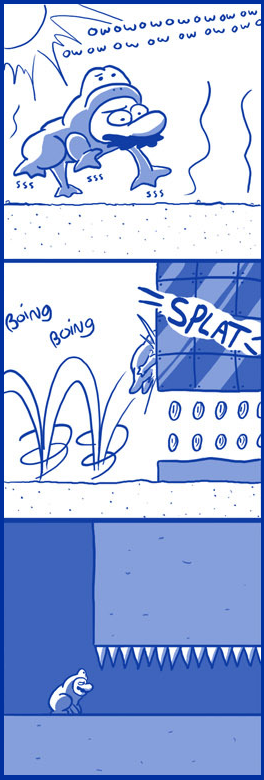
Heat vision sends out a laser with the range and power of an ordinary punch.
Super breath 1 looks like an ice crystal, and does absolutely nothing.
 on the power-ups in Superman (NES video game)
Sometimes a game includes a powerup that just powers you down instead.
In the worst case you grind, grind, grind, losing sleep and growing calluses. Maybe you are doing the grinding in a particularly dangerous place, or fighting an ungodly difficult boss over and over, with a higher loss-to-win ratio to your name. Every second day, a rare ingredient drops. When the final one drops, you combine them with trembling hands and are rewarded with a fancy glowing sword... that hits like a rubber chicken.
Some powerups are easier to get than that. But lame powerups disappoint, and frustrate, in myriad ways:
- An Enemy Scan that doesn't provide useful information (unless the enemy in question is immune to scans).
- Movement that sure is fast but perfectly uncontrollable.
- Stealth movement that is so slow the player dies of boredom.
- Speeding or slowing time when you have no earthly need to do so.
- Distraction devices that have to be used right in an enemy's face.
- An instant use upon picking it up, which almost never happens where it will have the best effect.
- Something which replaces a far more useful ability.
- Does provide an actual in-game benefit in pure numerical terms, but it's tied to something cosmetic (e.g. an Interface Screw, an Overly Long Fighting Animation, or just a really annoying sound effect) that makes you avoid it when possible.
- Actually does serve a helpful function... that's confined to a specific area's gimmick (or in particularly bad cases, a single obstacle, such as a fire attack that only serves to melt one ice wall) and useless everywhere else, effectively turning it into a fancier door key.
- The condition required is far too demanding or so overly specific that you rarely ever get to use it.
- Requires a peripheral not included with the game to be of any use.
- Eats up too many valuable resources when there's something else that isn't quite as powerful but has a far better output vs input ratio.
- It comes with downsides that makes the game more difficult and not worth the trouble using.
- Increases your score in a game where your score is completely meaningless apart from bragging rights. Bonus points if it's stashed in the same places and drops from the same enemies as the useful items.
- The boost it provides is so minor that it's functionally irrelevant.
Related Tropes:
- Awesome, but Impractical — The powerup does have its perks, but there are costs or downsides that outweigh them.
- Bragging Rights Reward — You obtain the powerup at a point where you no longer need it.
- Cool, but Inefficient — The powerup looks cool on paper but doesn't offer much of a mechanical improvement.
- Cosmetic Award — The powerup doesn't offer any gameplay changes.
- Double-Edged Buff — The powerup is intended to have a downside. Can cross into this trope if the downside outweighs the benefit.
- Joke Item — It's weak on purpose.
- Scrappy Weapon — A weapon is derided by the players for its weakness.
- Useless Useful Spell — The powerup would be cool if it actually worked in situations where it's needed (or if there actually were a situation that demands it).
- Bonus Feature Failure — Apply this trope to extra content (optional modes, DLC, etc.)
Sometimes this is just situational. Ice skates may work well on rinks, but throwing them at the player during the spy mission to make them lose their wall crawling boots means they still qualify. For hazards disguised as useful power ups, see Poison Mushroom. Contrast Nerf Arm, which is the opposite of this trope (it only looks like a Joke Item, but its stats are perfectly fine). Also see Lethal Joke Item (a Joke Item that is surprisingly powerful through fulfilling hidden conditions or exploiting game mechanics), which can also overlap with this trope. See also Zonk, where the player is given a "prize" that isn't worth anything. Contrast Negative Ability, for abilities that are meant to be a handicap.
Example Subpages:
Non-Video Game Examples
- Bleach: Shinji views his Bankai as this, as befitting his sword's general theme of inversion. His Bankai, which inverts perception of friend and foe, is highly-effective against masses of weak foot soldiers, but is completely useless in a one-on-one fight against a powerful opponent. His Shikai is the superior option for that situation, despite nominally being the weaker ability.
- Dragon Ball Z:
- Trunks assumes a higher form of Super Saiyan called Super Saiyan Third Grade, which greatly increases his strength by bulking his muscles up to a huge degree. However, while he is dominating the battle at first Cell soon turns the tides and begins beating Trunks down. A Cell himself explains, the form drains energy very quickly and is too cumbersome for speed — since all Cell had to do to win was dodge Trunks' sluggish movements until the Saiyan tired out, it was far less effective than the "weaker" forms of Super Saiyan. Ironically, Cell himself makes a similar mistake: after Gohan becomes Super Saiyan 2, Cell swells up in fury to counter his attacks... and gets beaten up due to making his new form also becoming much slower and inefficient. Trunks takes a moment to rub the wound by stating Cell has truly lost it.
- Despite how hyped it was, Super Saiyan 3 turned out to be this. Unlike Super Saiyan 1 and 2, which were critical to defeat the Big Bad of the arc where they debuted, no one using Super Saiyan 3 was able to score a victory against Majin Buu in any of his forms (or any victory at all outside one Non-Serial Movie), as even if the transformation was immensely powerful, it also consumed energy like crazy, leading to not just abruptly ending when the villain was still standing, but in Gotenks' case it also prematurely undid the fusion. On top of that, it fell victim to The Worf Effect in Super when Beerus effortlessly trounced Goku in that form. It wasn't until Dragon Ball DAIMA when somebody using Super Saiyan 3 finally scored a win, thirty years after said transformation was introduced.
- Naruto: Naruto masters his Rasenshuriken by applying wind style to the incomplete Rasengan, thus making it a formidable weapon. But... due to its nature by attacking every cell in the body, it also risks damaging Naruto's hand, thus making Tsunade ban the Jutsu. Later, during Pain's invasion, Naruto uses Nature Energy in Sage Mode to negate this weakness and making the Jutsu function as intended in the first place.
- Pokémon the Series:
- Pokémon the Series: Diamond and Pearl: Ash's Turtwig was a pretty decent Pokemon in battle. After it evolved into Grotle, however, aside from its victory against Candice's Sneasel, Grotle has suffered loss after loss throughout its battles whenever Ash brings him out due to the loss of its speed it used to have as a Turtwig. Even later evolving into Torterra didn't do it any favours at all, as it continued to lose battles on-screen and became a major victim of The Worf Effect. It's to the point that fans state it was better off not evolving and staying as a Turtwig.
- Pokémon the Series: XY: In "Down to the Fiery Finish!", Ash's Greninja utilizes an upgraded version of its signature move Water Shuriken as a Giant Red Shuriken to try and finish off Alain's Mega Charizard X in the Kalos League finals. You would think a never-before-seen powered-up move like that at this critical juncture would be what is going to win the battle against a foe it never defeated, right? Nope. It barely shrugs the dragon, and Ash-Greninja is subsequently defeated by a Blast Burn, leading to Ash once again losing the league, this time after coming so close to finally winning a League Conference.
- Peter Chimaera's Digimon Trilogy: In DIGIMON 2: RETURN OF DIGIMON, the titular character creates a Robot Body to better fight against evil forces. However, the only time he uses it, his opponent, Evil Digimon, managed to survive the battle. When Digimon fights against Evil Digimon without the Robot Body, he utterly defeats him. This implies the Robot Body features no real advantages over fighting without it.
- The Mini Mushroom's status as one is acknowledged in The Super Mario Bros. Movie, with Mario getting beat up horribly by DK after mistaking it for a Super Mushroom. This trope is also exploited in the climax, where the heroes forcibly feed Bowser one in order to easily imprison him.
- Blood Sword: Having armour is better than not having armour. Unfortunately it's only in the first book that armour has a good chance of preventing a character from getting hurt. Every book after, your enemies's damage potential goes up astronomically (reducing damage by 2 points means a lot when the enemy does a single dice of damage, not so much when even weak foes do 3d6 or more). Additionally it's only in the last book where you'll find armor that's superior to what your character's start with.
- Cradle Series: A "Goldsign" is a Mark of the Supernatural that someone acquires when they advance to the Gold stage, which is considered the first step of a real sacred artist. Many goldsigns are purely cosmetic, but the better ones have some side benefit that preferably synergizes with their Path. Yerin's sword arms mean she is never unarmed (which is important because her Path absolutely requires a weapon to be at all useful), while Jai Long's Nightmare Face is theoretically a powerful weapon but is so horrific he keeps his face wrapped in bandages at all times. In Reaper, Lindon's sister Kelsa becomes the first person on the Path of the White Fox to gain a goldsign in centuries: A cute little fox tail made out of foxfire. It's theoretically a useful weapon (as the fire inflicts spiritual damage), but it would be awkward to use in combat.
Kelsa: I still hate it.
Jai Long: It could be worse.
Kelsa: It's not practical, even if it can burn people. Snowfoxes have claws and teeth. I could have gotten those. - Fighting Fantasy: Some of the early books had this for weapons and armour you found. That's because those items would grant you an improvement to skill that only works to compensate if you've been crippled somehow. So if you burnt your hand or sprained your ankle, then the improvements from your newfound sword, helmet, shield and armor will start kicking in but only enough to bring you back to original skill level. Magic swords did have the benefit of allowing you to hit enemies that were immune to normal weapons but in those books, you'd seldom encounter foes like that. Later books gave real benefits to finding new weapons and armor.
- Some of the magical weapons that Lone Wolf finds are only useful for a single book or two, such as the jewelled mace. Sure they are some of the only items that can be brought over to the Grandmaster series of books, but they offer no benefit over a normal weapon.
- Sagas of the Demonspawn: The third book has Fire*Wolf transformed into a bigger (8 inches taller!), more beautiful golden warrior. This gives him completely new set of stats. Unfortunately while the stats are at minimum good or even excellent (with his Attractiveness score actually beyond anything that can be rolled), the stats are actually worse than what you may have rolled for Fire*Wolf in the first book. Worse yet, this new Fire*Wolf build is heavy on looks and charm, but surprisingly low for combat stats like strength. Tin Man Games' adaptation pragmatically didn't alter any of your stats, when Fire*Wolf is transformed.
- So I'm a Spider, So What?: After absorbing the energy of a Fantastic Nuke, Kumoko ascends to godhood... and becomes much weaker as a result. While mortals in this setting can grow to great strength by gaining levels and powers in an RPG-like manner, all of these abilities are provided by "The System" that the gods placed on top of the world's magic to prevent it from being depleted. After becoming a god herself, Kumoko no longer has The System's assistance and is limited to the same abilities as a real-life human until she manages to learn real sorcery from scratch. Zig-Zagged in that this will eventually make her stronger than she was previously.
- Kamen Rider:
- Played with in Kamen Rider Kuuga. When Godai first transforms into his Dragon form, he appears to be weaker than his default transformation, feeling like this trope. However, he initially doesn't realize his Rider powers run on Multiform Balance and that Dragon Form is a Fragile Speedster as opposed to his Jack of All Stats default form. Once he realises the strenghts and weaknesses of his new form, it's no longer a letdown.
- Played for Laughs in Kamen Rider Decade. The titular character is able to turn into all Kamen Riders from past shows, with the caveat that he has to unlock them first. After unlocking Kamen Rider Den-O, he tries to use it against Kamen Rider TheBee and Gattack, but discovers the form only spouts its associated catchphrase, rather than actually being useful in combat.
- Kamen Rider Gaim sees Micchy get his hands on the Yomotsuheguri Lockseed near the end of the show, which is advertised by its creator as a Deadly Upgrade which will let Micchy finally defeat Kouta. Said creator opts not to mention that deadly also means painful, and the Lockseed proves so agonizing to use that Micchy does more writhing on the ground with it than actually attacking, making it by far his weakest form.
- Kamen Rider Ghost gets the Grateful form halfway through the show, which looks like a Next Tier Power-Up and has an impressive array of abilities that should make it one. However, the opponents introduced in the same episode have the ability to strike Ghost with paralysis from anywhere in the world if he tries to use it, making it worthless.
- Kamen Rider Build has a villainous example with the Washio brothers, who normally form a Bash Brothers pair using the Gear Engine and Gear Remocon powers, but can give both powers to one brother to form Hell Bros. While it's allegedly much more powerful, being reduced to a single combatant takes away the teamwork and skill at covering one another's openings that made the brothers dangerous in the first place, while the power increase isn't nearly enough to keep pace with the growth of the heroes. Hell Bros only wins its first fight through an underhanded ploy to make their opponent stop fighting back, and then never wins a fight again.
- In Kamen Rider Zi-O, Woz Power Copies a future Rider named Kamen Rider Quiz, who has the special ability to ask true-or-false questions and attack enemies when answered correctly, but get penalized himself when wrong. Unfortunately, such an ability is Difficult, but Awesome; Quiz can use the power effectively but Woz doesn't always ask the right questions. "I'm going to defeat you. [buzzer] What do you mean, 'Wrong'?!"
- In a DVD spinoff for Kamen Rider Zero-One, Kamen Riders Vulcan and Valkyrie receive new Super Modes that are powerful, but unstable and painful if not actively harmful. While Vulcan is bullheaded and reckless enough to make sure his enemy gets wrecked as badly as he does when he uses his, Valkyrie is more cautious and she gets thrashed because the pain keeps her from fighting effectively.
- Kamen Rider Revice has every user of the Demons Driver quickly reckon with how its Power at a Price is light on the power and heavy on the price. George is smart enough to only use it on very rare occasion, while the users that try using it more often are never effective in battle and quickly end up hospitalized at best. People only keep using the Demons Driver despite its obvious worthlessness because it's also one of the only ways for a normal human to gain powers.
- Power Rangers Lightspeed Rescue: Played with when the Lightspeed Solarzord debuts. Its component zord, the Max Solarzord, had previously shown it could beat Diabolico's most dangerous monsters on its own, so combined with the Megazord it should be strong enough to handle Diabolico himself, right? However, nothing the new formation has does anything to hurt Diabolico. Just make him angry. Then it subverts the trope hard when the solar panels absorbs his attack and sends it right back at him in the form of an Alpha Strike.
- Assembling the Toaster Gun in Junk Yard changes the Video Mode from running away from Spike to attacking him with the Toaster Gun. The mini-game where you run away from Spike is not only easier, it yields more points. Thus, assembling the Toaster Gun actually hurts your overall score.
- The Mystery award in The Lord of the Rings (Stern) can be a cross between this and Annoying Video Game Helper at times, due to the way multiball stacking works. The game allows you to stack a Movie Multiball on top of many other things as long as the Movie MB is started last. But Mystery will often start a lit Movie MB, often in cases where it would be far more advantageous to start something else first.
Examples by creator:
- Older White Wolf games like Exalted and Old World of Darkness tend to make how many dots you have in a Background more representative of how impressive the Background is, rather than how useful it is. As such, it's usually better to take only 3 Dots in a background rather than a full 5, as the latter often dips into Awesome, but Impractical, with mentors being nigh divine entities that are too busy to pay attention to you, reputations being world spanning names for yourself that draw endless public scrutiny, and backers being massive conspiracies who own you.
Examples by work title:
- BattleTech: The Draconis Combine spent many years engineering a mech-scale sword to equip their captured Hatchetman mechs, because no true samurai would want to use a clumsy and uncultured axe. True samurai, presumably, are unfazed by the minor detail that the sword is noticeably less damaging than the axe, on a mech that has already had many versions be left behind by the march of technology.
- Dungeons & Dragons 3.5's Prestige Classes — special classes that can only be taken after reaching a certain qualification — have a lot of duds, if only because there are hundreds of them. Certain feats are also completely worthless:
- Any casting-based class that provides less than full advancement is rarely worth taking, because it's rare for any class features to make up for being behind. Even worse is if the prestige class fails to provide any casting advancement in favor of either adding bonus spells per day or providing a completely new spellcasting progression (both of which ensure that you'll be saddled with a lot of weak spells that aren't able to accomplish nearly as much as the more powerful spells you'd have had access to without the prestige class).
- The Arcane Archer. Its primary ability (enchanting every arrow you fire) can be duplicated by simply owning any kind of magic bow, and despite requiring casting skill and having some of its other features key off casting, the class doesn't have a casting advancement.
- The Duelist attempts to lock the player into a traditional "fencer" fighting style (rapier and no shield or offhand, no armor, etc) and provides them bonuses while doing so. The problem is that said fighting style is terrible in 3.5, due to having bad durability and abysmal damage, and the Duelist doesn't do nearly enough to drag you out of the hole.
- The Reaping Mauler, a grapple-centric class, has similar issues. Grappling with Grappling Rules in 3.5 is already not a fun time, but when you're a grappler who can't be greater than Medium-size due to the class's requirements, can't wear armor when you lose your Dexterity bonus while grappling and need all the AC you can get, and whose features key off Wisdom, of all things, rather than the Strength or even Constitution that a grappler would actually need... well, suffice to say it's not going to make grappling a better experience.
- Dracoliches gain undead immunities, the standard phylactery dealie, and some minor abilities. None of those really make up for losing their Constitution score in the process, which usually ends up halving their HP.
- The Order of the Bow Initiate. Supposedly a group of Warrior Poets who treat archery as a form of Zen, their primary feature, Ranged Precision, lets them fire a shot with a moderate damage boost. What's the problem? Ranged Precision doesn't deal damage to certain targets, can't be used at long range, and most importantly, only fires one shot per turn. Meanwhile, most archery builds are based on using full attacks to get as many arrows in the air as possible, since arrow base damage is fairly low — meaning that most of the time, the single boosted shot of an Initiate pales horribly in comparison to the six or seven shots fired off by a regular archer. (For added comedy, one of the prerequisites for the class is Rapid Shot — a feat designed for the above strategy, that can't be used with Ranged Precision at all.) The class also has pretty intensive feat requirements for something meant to be entered at 6th level, making it hard for any character aside from a pure fighter to qualify, locking out better archery classes like rogues and scouts, which get bonus damage comparable to the Initiate, but can actually use that damage with full attacks to multiply it several times over. In short, it's a class that requires you to be a subpar archer... and then makes your archery worse.
- The Shining Blade of Heironeous's gimmick is to give their sword magic enhancements... but only off a very limited list (Shock, Holy, and Brilliant Energy). Activating this ability requires a standard action, you can only give one enhancement per activation, so you need to spend multiple turns to get your sword fully charged, the enhancement lasts for only a few rounds and goes away if you aren't touching the weapon, and it can only be used, at most, six times per day. This is the Shining Blade's only ability, aside from advancing divine spellcasting... which it does so at half rate, meaning maxing out Shining Blade puts you five levels behind on spells. At one point on the WOTC forums, someone put out a challenge for a build where the Shining Blade wouldn't constitute this trope. The "winner" was a 12th-level paladin/1st-level Shining Blade - for the uninitiated, paladin level 13 is an Empty Level.
- The vast majority of druid prestige classes are this. In their case, it's not for being poorly balanced — it's because the druid is universally regarded as a Game-Breaker, with its Voluntary Shapeshifting, powerful pet, and good-sized spell selection. Consequently, any prestige class that only advances or specializes in one of the three comes out as being worse than just taking more druid levels. It's worth noting that the Planar Shepherd, one of the few prestige classes that does advance all three, is universally banned.
- Some magic item abilities hit this trope as well. By far the most useless was the Spell Resistance enchantment for magic armor in 3rd Edition. It came in three flavors: Lesser, Moderate, and Greater, which granted Spell Resistance 5, 10, and 15, respectively. What made these useless is the way Spell Resistance worked in 3rd Edition: a creature would automatically negate the effects of a spell cast on it unless the caster could overcome it by rolling a D20 and adding their caster level- if the resulting number was equal to or higher than the target's Spell Resistance, the spell worked on them. A Spell Resistance of 5 was therefore completely useless against all but the lowest level spellcasters, and 10 and 15 weren't much better. The effects were clearly ported over from 2nd Edition without bothering to check their power, since in 2nd Edition magic resistance was a percentage check (5%, 10%, or 15% to completely negate a magic effect), which actually did provide a functionally useful defense.
- The Great Cleave feat. Cleave was a feat that gave you a free attack once per round if you dropped an enemy with a melee attack. Great Cleave functioned the same way, but could be used as many times per round as you successfully killed someone. In theory, the earliest you could qualify for the feat was 4th level, but in practice, unless you were playing a fighter, you couldn't get it before 6th. As fighters did not have a reliable way to significantly boost their damage as they leveled, aside from the reliable old Power Attack, and enemies that were weak enough to be dropped in a single melee attack would likely be starting to get scarce at 6th level, this was a major issue. Most of the time, if you could drop two melee enemies in a single hit at that point, they probably weren't much of a threat to you anyway.
- An abnormal number of feats only provide very small, flat bonuses (usually in the +2 or +3 range) to certain skill checks. Skill checks are some of the easiest things to boost in the game, between crafted items, masterwork tools, or simply pouring all your ranks into it; it's not uncommon to see skill-focused adventurers with a +12 or more by 5th level, quickly turning those bonuses into a drop in the bucket. Combat Casting is one of the most notorious, because it's almost directly obsoleted by Skill Focus (Concentration), which provides a +3 bonus to all Concentration checks, rather than a +4 bonus for one application of Concentration checks.
- Due to clumsy wording, a strict reading of the Focused Lexicon feat (meant to make it harder for certain enemies to resist Truespeak) actually makes it harder for the user to use Truespeak against those enemies.
- Dodge is probably the most infamously worthless feat: it provides a +1 bonus to AC against a single foe that you designate. Even at very low levels, a +1 to AC (equivalent to about a 5% chance of working) is rarely going to block an attack, and because it only works on one enemy, it's useless against, say, a bunch of enemies attacking you at once (one of the few situations where a +1 to AC might reliably save you from a hit or two). There are multiple feats that simply provide a flat +1 or more to AC, which are still bad, but render Dodge obsolete. What really puts it in this category, though, is that the designers decided to make Dodge a prerequisite for forty different feats, and multiple prestige classes, which is a bitter pill to swallow for anyone interested in them.
- The binder vestige Agares provides immunity to fear, among some other features. This wouldn't be too bad, except binders at the level where they can use Agares already have fear immunity as a class feature. Even binders with Improved Binding to bind Agares earlier only pick it up one level before it becomes redundant.
- Probably the silliest example of this is the Mountebank and Risen Martyr, which both have about the worst capstone feature you could ever ask for: both classes are based on pacts with higher beings, so when you reach the max level in those classes, it results in the being you made your pact with deciding your time is up. In the Mountebank's case, you get turned into a demonic thrall and placed under permanent mind control, while in the Risen Martyr's case, you Ascend to a Higher Plane of Existence — as in, you die. Whoops. At least the Risen Martyr required your character to be dead before you could take it, so it was more of a "you can either take this prestige class to keep playing with the character until the end of the campaign, or roll up a new character".
- Firefly: As a rather hastily done marketing tie-in, the Serenity RPG had a number of these. One strong example was Healthy As A Horse, an ability that improved your hit points. It cost exactly as much as upgrading your Constitution one rank did, gave exactly as many hitpoints as raising your Constitution did, and provided none of the other benefits of raising your Constition. Even if you'd already maxed your Constitution out (something you were highly unlikely to do in a normal game), taking it was still of dubious value given how damage worked in the game: typically the difference meant you were looking at being left alive with a Career-Ending Injury rather than simply being dead.
- Hotels in Monopoly. Upgrading to a hotel on a property increases what your opponent must pay if they land on it, but landing on four houses is already a debilitating blow and the cost to upgrade to hotels really only pushes that slightly higher and likely won't even cover the cost of upgrading in the first place. There are also only thirty-two houses in the game — enough for around three monopolies — and you can't upgrade to a hotel until you have four houses on a property: it is far better to keep four houses on as many properties as possible to lock your opponent out of having them than it is to "upgrade" to hotels and make all those houses available for purchase, unless you are upgrading to hotels in order to make houses available for more of your properties... in which case you're already clearly so far ahead and likely to win already that all you're really doing is flexing on your poor opponents.
- Shadowrun: The Drake character type. In theory it sounds awesome: you're a human (or elf, or dwarf...) with the ability to shapechange into a small dragon at will. In practice, it's actually terrible. When transformed, you gain innate armor... that's too weak to protect you from even the weakest gun and can't be combined with any other type of armor. You gain significant boosts to your physical stats... but can't actually use any weapons or tools to take advantage of them. You gain an elemental attack... that's weaker than just using an ordinary gun or spell. And if the fact that you're a Drake ever gets revealed, you'll have every one of the megacorps trying to capture you so they can dissect you to figure out how you work. And on top of this, the karma required to create a Drake character is enormous, meaning that you'll be significantly lacking in skills and equipment compared to a normal metahuman character.
- In Yu-Gi-Oh!, a number of cards have "upgraded forms", usually requiring another card or other conditions, on top of the base form, to summon. Frequently these forms are not worth the effort for them.
- Larvae Moth is pretty hard to summon: play Petit Moth, a very specific monster with bottom-grade stats and no effect, then equip it with a card that changes it into a mediocre Stone Wall, and then protect it for exactly two of your turns, at which you can tribute Petit Moth for Larvae Moth at last. For all your effort, it goes from 300 ATK to... 500 ATK. For comparison, common low-level monsters even at the time tended to average around 1400-1600, and they required no more work than Petit Moth to play. You basically sunk three cards and multiple turns of effort to turn a monster with terrible stats into one with still-terrible stats that can't benefit from Normal Monster support because its summoning condition counts as an effect (and it doesn't have any others). The higher Moth forms have an identical condition (bar the number of turns required), but they at least have tolerably high stats to push them into "awful, but someone might try building a deck around them for the cool factor" territory. Larvae Moth isn't even on that level.
- Blue-Eyes Shining Dragon requires you to Tribute the already impressive 4500 ATK Blue-Eyes Ultimate Dragon to summon it. Though it gains a rather helpful form of targeting protection and an ATK-boosting effect, it also starts with only 3000 ATK, and said effect requires at least five other Dragons in the Graveyard to bring it up to the level of its lesser form. Though given the summoning conditions, there's a good chance that four of those dragons (Blue-Eyes Ultimate Dragon, plus the three Blue-Eyes White Dragons used to Fusion Summon it) are in your Graveyard already, making this a Downplayed Trope.
- The very practical Cyber Dragon has a few branch "upgrades", and one of them is the very terrible Cyber Barrier Dragon. While it has a respectable 2800 DEF, its purely defensive effect only takes effect when it's in Attack Position, where its paltry 800 ATK leaves it vulnerable to most monster attacks. The only thing it does in that position is negate the opponent's first attack each turn — you don't even get to control if it triggers or not. It's definitely not worth giving up a Cyber Dragon for.
- Jinzo - Lord, despite being summoned by tributing one of infamous monsters in the original series, is arguably a downgrade. Its ATK is a whole 200 points higher than the standard Jinzo, and its only additional effect is being able to destroy the opponent's face-up Traps and do 300 damage for each — not only will opponents rarely be controlling enough face-up Traps for this effect to deal anything significant, but standard Jinzo negates Traps anyway, so if your opponent is playing a field of Continuous Traps, then letting them stay out and uselessly clog up the opponent's field is arguably better. On top of that, its name means that it can't benefit from cards that require the original, like Cyber Energy Shock and Everlasting Alloy. There are some circumstances where Lord is marginally helpful, such as using a Jinzo summoned through Returner's effect (which would normally die during the End Phase) or tributing the weaker and easily-summoned Jector instead, but even those don't warrant using a card that can only be summoned by tributing Jinzo over the easily-summoned standard variety.
- Red-Eyes Black Metal Dragon is Summoned by Tributing a standard Red-Eyes equipped with Metalmorph. A standard Red-Eyes with Metalmorph has 2700 ATK, and REBMD has 2800, so it's already barely an upgrade. What puts it into downgrade category is that Metalmorph has a secondary effect (which REBMD doesn't get) of heavily boosting your Monster's ATK when it attacks, meaning that Metal Dragon is actually a big step down from its lesser form in terms of offensive power, and only marginally better in terms of defense. There's also the matter of it only being able to be summoned from the Deck, not the hand. On top of that, the standard Red-Eyes is also the centerpiece of a variety of support cards, and a Normal Monster, which gives it even more support cards.
- Life Stream Dragon was heavily hyped-up as the true form of Power Tool Dragon. Summoning it requires Summoning Power Tool, then Tuning it with a Level 1 Tuner... but on reflection, it's better to just keep Power Tool. Life Stream does have 600 more ATK, but Power Tool's effect allows you to add Equip Spells to your hand, meaning its ATK can be much higher. Life Stream can also make your LP 4000... but that's only useful if you're already on the verge of losing, since players start with 8000. Life Stream can also make you immune to effect damage, but there are plenty of cards that do it better, and this is inherently situational. Life Stream attempts to duplicate Power Tool's destruction-dodging effect, but without the ability to search out Equip spells, it's much worse at it. Finally, Life Stream is a Tuner... but it's also Level 8, which makes the number of cards you can Synchro Summon with it sharply limited at best. The only real advantage is being immune to effect damage, and it doesn't outweigh the advantages of Power Tool at all.
- Few RUM-based cards are outright upgrades over their starting counterparts and many are situational improvements at best. Not helping matters is that not only would you need to get the correct Rank-Up Magic card, but the monster you have to upgrade off may be overcosted or at an inconvenient rank.
- Mechquipped Angineer upgrades into CXyz Mechquipped Djinn Angeneral — it gains 800 ATK, but swaps out its extremely useful protective abilities (able to save any of your monsters from destruction for a turn) for wholly unimpressive position-switching and burn effects.
- Number C5: Chaos Chimera Dragon boasts exactly one legitimate advantage over its unupgraded form, Number 5: Doom Chimera Dragon — while Doom must choose between two effects at the end of the Battle Phase (attaching a card from the opponent's Graveyard to it as material or sending a card from their Graveyard to their Deck), Chaos gets to activate both at once. Aside from that, they share the same effect of gaining 1000 ATK for each attached material and being able to attack all opposing monsters, but Chaos also gains two massive downsides: first, to activate the "attack all" effect, it must detach a material (something Doom doesn't have to do), and second, to activate the Graveyard effect, it forces you to pay half your life points (something Doom does for free). Curiously, Doom Chimera Dragon was released second, meaning it managed to Power Creep its own Super Mode.
- Number 92: Heart-eartH Dragon cannot be destroyed by battle, and forces the opponent to take any battle damage its controller would have taken when it does battle (which is likely to be hefty, considering its original ATK of 0), its detach effect can banish all cards that the opponent Normal or Special Summoned or Set that turn, and if it's destroyed while it has Xyz Materials, it can Special Summon itself from the Graveyard, gaining 1000 ATK for each banished card. This results in a monster that, while difficult to summon, can dish out tons of damage, banish cards en masse, and return with massive stats when killed. However, while its Number C form, Heart-eartH Chaos Dragon, has 1000 more original ATK (which is not nearly enough to do any attacking with it) and retains the immunity to battle destruction, it lost every other effect possessed by its previous form. Instead, it has a comparatively mediocre effect that increases its controller's LP by any battle damage they inflict on the opponent, and the ability to negate the opponent's card effects for a turn if its original form was attached (as opposed to banishing them). Keep in mind, this is the Ranked-Up version of a Rank 9 monster. To say it's not worth it is a massive understatement.
- Synchro monster Arcanite Magician has the effect of placing two Spell Counters on itself when summoned, both of which grant it 1000 ATK, and its upgraded form, Arcanite Magician/Assault Mode, has the same effect, but starts with 500 more ATK. However, where Arcanite Magician can remove a counter to destroy one card on the field, Assault Mode can remove both its counters to destroy all cards on the opponent's field. This seems like an upgrade... only removing both its counters turns it into a pitiful 900 attacker, meaning the opponent can easily flatten it. And more dangerously, where the original can remove the counters from anywhere on your field (like, say, a Magical Citadel of Endymion that can easily accumulate dozens of the things over the course of the game, meaning it can already effectively nuke the field), Assault Mode can only remove them from itself. It still has its uses, like replacing a burnt-out Arcanite Magician, but it's hardly the straight upgrade that most other Assault Modes are.
- "Savior" Synchro monsters, also known as "Majestic" in the TCG version, are great upgrades over their original form, except for one seriously heavy drawback: They return to the Extra Deck during the end of the turn and summon their weaker form into the field, leaving you -2 in terms of cards for a huge boss that only lasts a turn. Not to mention, they require a specific Tuner monster to summon, one that literally has no use other than to summon these Synchro monster upgrades.
- The venerable Gate Guardian is the fused form of Sanga of the Thunder, Kazejin, and Suijin, requiring all three on the field and then tributing them to summon itself. It has a colossal 3750 ATK, but it's also just one big monster with no other effects, making it rather easy to deal with. And Sanga, Kazejin, and Suijin already have pretty impressive stats and their own effects (even if said effects aren't that useful), and three monsters are by nature harder to get rid of than one. Simply equipping Sanga with United We Stand or something similar would give it even more ATK without needing to lose multiple monsters. This means that even in a deck that can somehow consistently summon the big guy, he's considered to be something you only bring out for bragging rights.
- Vampire Genesis, one of the earliest Structure Deck boss monsters, requires you to banish Vampire Lord to summon for a beefy 3000 ATK body and the ability to revive Zombie monsters by discarding higher-level ones from your hand. The problem is that Vampire Lord at the time was the best Zombie monster in the game because if he was destroyed by card effect rather than battle, he would revive himself the next turn, making him difficult to get rid of once he hit the field. Summoning Genesis requires you to remove the Zombie ace monster (so he can't even be revived) for a monster that loses that protection in exchange for a clunky revival effect that's outdone by the Book of Life copies that come with the Structure Deck.
- Homestuck: It's possible, through care and training, to get a Fiduspawn to mature into a stronger form, such as a Horseaponi becoming a Horsaroni. However, these advanced forms only change a little in size and appearance, don't become much stronger, and really only need to eat more.
- In Beast Wars, when Optimus Primal is upgraded to Transmetal form, it is overall an upgrade except for his flight mode which suffered a massive downgrade where now only his Beast Mode can fly where before he could fly in Battle Mode. Megatron, whose Transmetal form enabled flight in both forms, quickly points this out:
Megatron: Flight is no longer your advantage, Optimus Primal!
- Mighty Ducks: The Animated Series: "Monster Rally" sees the Ducks utilise their new vehicle, the Mega-Migrator X2, after the original Migrator is damaged in battle. However, while the Mega-Migrator is larger, when the Ducks tries to use it in battle the weapons either miss their target or fail to deploy at all, the vehicle ultimately exploding when the original engine is stolen for their enemy's current vehicle and they try to improvise with the enemy's original engine. After the original Migator is repaired, Tanya (the Ducks' Gadgeteer Genius) shows the other Ducks the plans for the Hyper-Migrator X3, but their cold reaction prompts Tanya to conclude that the original Migrator is fine as it is.
- Steven Universe: Alexandrite, the powerful fusion of Garnet, Amethyst, and Pearl, can come off as ultimately impractical. In spite of having incredible strength and access to all the weapons of lesser fusions, they need a great deal of focus to maintain stability, or they’ll easily unfuse. As such, they do not bode well for casual situations like dinner, where the components’ conflicting personalities cause issues in socialization. However, their biggest issue is their subpar luck/success rate in battle; their size makes them an easy target, and they’re easily overpowered by stronger giant characters like Malachite and Steven in his monster form, or attacks from Aquamarine and Blue Diamond.
- Seanbaby pointed out several of these on his Useless Power-Ups page - though the Feather is more of a particularly nonsensical Plot Coupon, others include a defensive spell for countering an attack nearly no enemies use, an invisibility power that makes it impossible for you to see where you're going but doesn't impede the enemies, and an attack that requires you to touch the enemies in a game with Collision Damage.
- Software updates for programs, mobile phones, and the like can sometimes be this. It is not at all uncommon to receive an upgrade, only to find said software or device is now slower, less compatible, has no recognizable improvements other than a few cosmetic changes, or even lacks features that a previous version had. This can even push into Poison Mushroom territory if the upgrade was intended to stop homebrew apps from running, of if a glitch in it causes it to not work at all.
- Likely the most extreme case of this was the "Other OS" feature on early PS3s. It originally allowed people to install a Linux operating system on their PS3 for bonus functionality, and PS3s had even started to be used in computing clusters due to their low price-point for their high power. But then a hack was found using it, so Sony patched it out, and anyone who didn't upgrade lost access to the Playstation Network, which handles essentially all of the online functionality of the native OS. A class action lawsuit was actually filed about this (by the military of the USA no less), though it ended up getting dismissed.
- Youtube's updates are also this for anyone with a below par internet connection, as each update seems to be an arms race between Youtube trying to limit buffering and force quality reductions, and viewers who want higher quality videos and would rather pause and wait for it to buffer rather than watch a 144p mess of pixels that's vaguely in the shape of their favorite Lets Playernote .
- To most users who rely on third-party add-ons, Firefox Quantum was this, owing to the countless add-ons no longer being compatible with it and how genuinely difficult it is to downgrade to Firefox 56.0 and keep it that waynote . Of course Quantum actually had countless valuable new features and bug fixes, but many users didn't feel this justified the loss of add-ons they liked or relied on.
- A fairly infamous case of this in gaming was a netcode update for Street Fighter V. According to the developers, it was meant to fix the poor netcode of the PC release. What it mostly did was shut down a widely-used mod that improved the netcode, dropping the game's online back down to near-unplayable territory.
- In the magical world of cellular phones:
- One unlucky user had his iPhone X outright explode after being upgraded to iOS 12.1. It was theorized to have either been a defective battery or charger, but the possibility that a glitch in the update caused the phone to exceed its safe limits was noted to have theoretically been possible. Either way, in the words of Comic Book Guy, "Worst update ever."
- And of course there's the Samsung Galaxy Note 7 that had two separate defects, a design flaw that could short the battery terminals and a welding defect that pressed too much on the battery. Anyone unfortunate enough to have upgraded to the first release of these phones were at real risk of having the thing spontaneously blow up in their pocket. Numerous injuries, a worldwide ban on air crafts, and an investigation likely to cost Samsung billions later, this was one hell of a letdown for users and the company alike. Humorously, one Grand Theft Auto V modder took advantage of this by swapping out sticky bombs with Note 7s.
- Fast Startup in Windows 10. It is actually, in effect, a form of hibernation where ram is dumped to a file and stored, and then loaded up in order to start the computer faster than normal as the machine can just refresh itself with the stored ram rather than reloading the kernel, drivers, and system state individually. The issue is this causes tons of small bugs due to incompatibilities from drivers and devices designed for a proper cold boot (just to name a few, this is a common cause of the "90b system fan error" in HP laptops, mounting issues when using disk encryption, and USB driver errors when using an externally powered USB Hub), can cause no end of issues with software updates that expect a proper boot, and will even prevent the hard drive from dual-booting if multiple operating systems are installed. The amount of time it saves, around 30 seconds on a regular hard drive and only about 5 on an SSD, is rarely worth the problems it can cause. If you still need a form of fast startup — even with it disabled — then the hibernate function works just fine and as an added bonus, also lets you pick up where you left off with whatever programs were open.
