

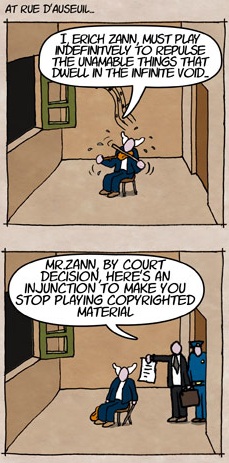
Lawful Stupid, also known as Lawful Anal, is for people who may call themselves Lawful Neutral or Lawful Good but lean toward such rigid adherence to the law that anybody who breaks any law, anywhere, for any reason, is the enemy. Even saying an unkind word to someone is an act of pure evil to this kind of character, and the Lawful Stupid can and will act as Judge, Jury, and Executioner. That is why they are called Lawful Stupid, not Lawful Neutral or Lawful Evil.
Woe betide the fellow party member who fails to live up to their obsessive standards. If the thief so much as jaywalks, Mr. Lawful Stupid will insist on turning him in to the "proper authorities" (regardless of what alignment said authorities are), or even execute him on the spot. Then he'll berate the other members of his party for "condoning" the thief's behavior, and may turn on them as well. This makes this guy highly irritating as well as stupid for turning in his only allies. For newbie DMs, the best solution is usually a blunt force object applied to the head of the offending character — if not the player.
The Lawful Stupid character often claims that ignoring any violation of the law would inevitably plunge society into chaos. This quickly leads to Fridge Logic when you realize that people were breaking laws long before this character showed up and somehow society still functioned pretty well without them (depending on the setting, of course).
In tabletop roleplaying games, this was once such a common behavior for paladins that acting Lawful Stupid is what everyone expects paladins to do these days. The reason for this has to do with game mechanics in early editions of Dungeons & Dragons which required Paladins to act this way in order to avoid a De-power. A lot of inexperienced players failing to understand the difference between Intelligence and Wisdom didn't help the Paladin's image on this front, either. In fact, this kind of behavior from players is so common that the D&D Sourcebook Book of Exalted Deeds spends a good number of pages explaining how to be Lawful Neutral or Lawful Good without being stupid, largely included because the creators themselves got sick of the attitude.note In-universe, a Paladin is supposed to be more street-smart than well-read, but there was a big difference between Paladin lore and the way players used the class, as well as the lore saying one thing and the rules saying another. Essentially, thanks to some miscommunications, confusion, and contradictions in the rules of early editions of D&D, the Paladin class as a whole has had to shake off the reputation as a class for Lawful Stupid behavior. Even after decades of efforts to correct the issue, the Paladin still isn't completely in the clear.
This trope is a Lawful character carrying the Idiot Ball because that is the Lawful thing to do. Remember, however, that Tropes Are Not Bad. When properly used, this trope can actually be used to add depth to a character rather than reduce them to a farce:
- A Lawful Neutral character strongly supports an authority, governing body or personal set of principles and doesn't care much about good or evil — this makes them prone to both Blind Obedience and doing what they decide needs to be done.
- A truly Lawful Good character, on the other hand, believes that a lawful, orderly society is necessary for the good of all and that Honor Before Reason is a virtue, not a vice. They may see all crimes as equal because even breaking a minor law hurts the greater good in some way, and cannot go unpunished — one stolen loaf of bread may seem a petty offense, but if thousands are stolen across a city every day, every baker will be ruined. On the other hand, many a Lawful Good character would argue against that sort of thinking as well. And in the most extreme cases of a lawful good holding the idiot ball, where a Heroic Sacrifice turns out to be completely unnecessary and pointless, they would rather die in a futile gesture or acting upon incorrect information doing what they believed was right than live having done nothing. Although again, not necessarily true of every Lawful Good character.
- Lawful Evil characters may seem unlikely to be vulnerable to this, but Even Evil Has Standards. Many a Noble Demon has met their downfall because I Gave My Word. Others may have no problem with harming "players in the game" but not innocents, which may leave them vulnerable to deception. Stranger still: Corrupt Corporate Executives or Black Knights might do anything within the rules to further their ambitions, but the suggestion of even a minor actual violation of the law or their personal code is a Berserk Button. Many a Jackass Genie has been defeated as they are often compelled to grant wishes even when said wish would cause the Genie's defeat.
Usually prone to be Bothering by the Book. When this behavior is caused by faith, Belief Makes You Stupid is present. Compare and contrast Chaotic Stupid, Stupid Good, Stupid Evil, and Stupid Neutral, which are the Moral/Ethical Alignment Stupid equivalent tropes for Chaos, Good, Evil, and Neutral. The Fundamentalist, Inspector Javert, and Knight Templar usually fall under this alignment, and may eventually develop into Tautological Templar. Non-sentient Robots and AI also tend to also to this alignment as they follow will dutifully follow the literal meanings of any instructions without considering the potential consequences or the non-literal intentions of those instructions. A government under The Caligula normally becomes Lawful Stupid, as history has shown.
Worth noting, this is actually how Lawful Neutral was classically written, but it has since been redefined. A good way of interpreting the modern definition might be that Lawful Stupid is when someone is Lawful Neutral to a fault.
Example subpages:
- Anime & Manga
- Comic Books
- Fan Works
- Films – Live-Action
- Literature
- Live-Action TV
- Tabletop Games
- Video Games
- Webcomics
- Western Animation
Other examples:
- The Vacintians in the Big Finish Doctor Who drama "Time Reaver" are an extremely orderly and by-the-book race who have begun policing a former Wretched Hive to track down an incredibly dangerous weapon which they created, because it never occurred to them anyone would use it as a weapon. However, their method of doing so is to insist that everyone has the proper paperwork. In theory, this should lead to everyone on the planet being arrested, except that it also hasn't occurred to them that the people they've arrested won't voluntarily make their way to the Customs House. At one point the Big Bad gloats that they can't do anything to stop him without orders signed in triplicate.
- Wasabi from Big Hero 6 is the sort of person who will come to a complete stop at a red light and wait for it to change... at night, in an industrial area with no sign of traffic, while being chased by a murderous supervillain.
Gogo: [to Wasabi] Did you just put your blinker on?!
Wasabi: You have to indicate your turn! It's the law!
Gogo: [takes out gum] That's. It. - In Zootopia (2016), Judy writes herself a parking ticket while issuing parking tickets.
- Ray Stevens' "Super Cop" is about a cop who solves problems in very humorous and unintelligent ways, such as shooting a man in the foot to justify his parking in a handicapped space, or forcing a woman to consume one of her purchases due to having 11 items in a 10-item express lane. Unfortunately, it's the corn oil.
- From Hindu Mythology: Daksha hated his son-in-law, Shiva, for living a rather chaotic lifestyle. Shiva doesn't mind that until his wife, Shati, committed suicide in grief of her father defiling and mocking her beloved. Shiva was infuriated; he later killed Daksha, then revived him, with a goat's head as punishment.
- In The Bible, the Pharisees are generally characterized this way. These were the top religious guys, who knew every law backwards and forwards and took great pride in following them to the letter (and made sure everyone else knew it). Until some carpenter from a backwater town started calling them out saying "Hey guys, you're doing it wrong." The fact that he claimed to be the Son of God (you know, the one who wrote the laws in the first place), and backed up that claim with miraculous powers, didn't make them any more inclined to listen to him; in fact, they got their knickers all in a twist just because he had the gall to heal somebody on the Sabbath day. That, and the fact that he was starting a movement that threatened their power meant that he and his followers had to be silenced by any means necessary.
- Stuart of Retail is a Pointy-Haired Boss because of his rigid commitment to following every rule of what the corporate higher-ups want of the retail-level workers, even if it's impossible and/or contradicts something else. Even when it's pointed out to Stuart that what's being asked of the Grumbel's employees either shouldn't be done or literally cannot be done, Stuart still insists on doing what's ordered. When this inevitably blows up in his face, Stuart either blames the employees for not getting it done or stubbornly insists on continuing with a detrimental course of action, just because it's what the higher-ups told him to do. That Stuart seems to have no sympathy for his employees in spite of their struggles and is a complete kiss-up to his own bosses only adds to how the audience is meant to dislike Stuart.
- A recurring Bob & Ray character, police officer Rorshack. In one episode, for instance, he loses some change, believes that he's been pickpocketed, has the entire city cordoned off, and orders his fellow officers to detain anyone walking the streets and to shoot anyone who doesn't comply.
- In Jesus Christ Superstar, Pontius Pilate is depicted in this sense. The powers that be, as well as the angry mob, demand that Jesus be crucified. Pilate recognizes that he sees somebody who hasn't actually committed a crime. He is, however, duty-bound to follow Roman law and the edict of his superiors. That's why he gave Jesus every opportunity to confess to anything; both to spare Jesus from martyrdom, and to spare himself from condemning an innocent man. Ironically, he could've theoretically delayed the inevitable as much as he needed, but Jesus's desire to die for the sins of humanity finally wore Pilate down, and he "washed his hands" of what would happen from there, while still viewing Jesus as innocent.
- Inspector Javert, from the musical (and yes, the book as well) Les Misérables, is rapidly approaching the embodiment of Lawful Stupid by story's end. Once a criminal, always a criminal is his mantra. He attempts to arrest the highly successful and well-loved mayor of a town who was running a factory explicitly for people who couldn't afford to live otherwise (all-around hero Jean Valjean) for the heinous crime of a parole violation years previous. He also attempts to arrest Valjean (whom he knows is superhumanly strong and a criminal facing decades of hard labour) armed only with a baton. Unsurprisingly, Valjean (who can pick up a fully-loaded cart) over-powers Javert and escapes. This wasn't due necessarily to Javert's stupidity (he's generally an intelligent man), but to his belief that "good" always overcomes "evil", where "good" and "evil" are equal to "law" and "crime", respectively.
- The Pirates of Penzance:
- The titular pirates are so extraordinarily Lawful Stupid that they're barely even pirates by the time of the play. While they have no problem kidnapping young ladies, they feel the need to marry them before any ravishing takes place. They refuse to attack forces weaker than them because it's dishonorable. They will never attack an orphan, being orphans themselves, and word has got around to the point that it seems that every ship they take is manned entirely by orphans. In fact, at the end of the play, they stand down from battling with the police after being ordered to yield in the name of Queen Victoria, and "for all our faults, we love our Queen."
- Frederick is the embodiment of Lawful Stupid, as the subtitle "The Slave of Duty" indicates. He rejoins the pirates and betrays the Major-General and Mabel to them, just because of a technicality in a contract that was signed on his behalf when he was a small child. Especially when you consider the fact that the contract was arranged by accident in the first place. His hearing-impaired nursemaid was supposed to apprentice him to be a pilot, not a pirate.
- General Stanley isn't immune either, being so wracked with guilt it leaves him sleepless after telling the Pirates he's an orphan — sure, doing so easily saved his family without bloodshed and made him an entire crew of pirates as allies, but it was a LIE! Going one further, he states that it's a lie because of the family portraits over the fireplace. They aren't even HIS family.
- The Duke of York from William Shakespeare's Richard II is determined to obey the law of the land above all else, no matter his own feelings or convictions. He refuses to support his nephew Henry Bolingbroke's bid for the throne (since that would be supporting an act of treason), but once Bolingbroke is crowned he will do anything to support him—to the point of reporting his own son to the king for planning a conspiracy. He even goes so far as to beg Bolingbroke to put the boy to death, and is revolted when the king considers mercy! York's whole arc serves as a pretty damning indictment of anyone who thinks that they can be a good or noble person simply by following the rules, without giving any thought to the (im)morality behind them.
- The Vahki law enforcer robots from BIONICLE were programmed to always follow the orders of Turaga Dume, whatever those orders were. It worked fine because Dume was a Reasonable Authority Figure, but then he was replaced and impersonated by Makuta, who ordered them to start imprisoning the Matoran population and turning the city into a Police State and they did so without hesitation. And then they glitched up into Kill All Matoran.
- Ace Attorney Investigations 2: Prosecutor's Gambit has Verity Gavèlle, a judge who attempts to get Edgeworth's prosecutor's badge taken from him for illegally boarding the plane of the President of Zheng Fa, despite this allowing him to catch a murderer, and is willing to give an innocent verdict to the murderer Fifi Laguarde, despite hearing her confession and seeing the decisive evidence at the scene, all because the decisive evidence is missing and thus can't be presented to the court. Subverted when it turns out that she did the former under orders of Excelsius Winner, and the latter due to her adopted son being kidnapped, with the demand for a not guilty verdict.
- The Most Popular Girls in School: Trisha 2 refuses to help out Mackenzie and Brittnay restrain a panicking Trisha because she can't take her seatbelt off while the seatbelt sign is on.
- Puffin Forest:
- In one of Ben's Dungeons & Dragons campaigns, the Modrons of Mechanus, beings of pure Lawful Neutral, are baffled when they find that someone has stolen a Cosmic Keystone despite a strict "No Touching" sign on its pedestal. They conclude that the thief must have taken it without physically touching it, and then improve security by adding a "No Stealing" plaque.
- Overlapping with Artistic License – Economics is the town from "Everyone Shops at the Black Market." The local government has outlawed the sale of magic items, which are vitally necessary for surviving D&D's 4th Edition, but luckily just about everyone in town can point the heroes to the underground black market that trades magic goods. When the party triggers a brawl in the market that has the town guards swoop in and arrest them, their jailors reveal that the government knew about the black market, but looked the other way since the town relied on it to survive. When Ben tries to explain that they could just change the law to make magic items legal to trade, the official argues that would destroy the black market their economy relies upon.
- Sunset Paradise: Auri Bori takes his job as Port Auroua’s deputy very seriously… perhaps a bit too seriously, for he spends most of his time handing out infringement tickets for even the most minor of offences, leaving him woefully unprepared to deal with actual crime.
- In Half-Life but the AI is Self-Aware Benrey is convinced Gordon is a thief and a troublemaker for not presenting his passport to security, in spite of the fact that that policy had been adopted that day, multiple people were telling Benrey Gordon worked there, and none of the other security guards cared or demanded his passport. Even after Gordon shows Benrey his passport, he continues to harass Gordon. Ironically, he completely ignores when Gordon actually does commit a crime, instead harassing him over the passport nonsense and things he could not possibly have done.
- Stormwolf of the Whateley Universe. He's so busy being 'Lawful Good' that he isn't protecting a group of freshman girls who just managed to avoid being beaten, mutilated, and/or murdered in four separate attempts (one by a mutant ninja assassin) in one night. And he won't let the girls go get payback, either. Even though the girls know who attacked them, and who hired the attackers.
- One might charitably describe the SCP Foundation as this, if not downright Lawful Evil; their treatment of the Class-D personnel (basically a collection of Dirty Dozened death row inmates) borders on sociopathic, particularly when you learn about Protocol 12, which allows the definition of Class D to be expanded to political prisoners and refugees in times of "duress". Their case files often redact virtually nothing except information that would actually benefit the reader, such as where those indestructible supernatural abominations they failed to contain are actually located. They doubtless would argue that they did what had to be done, but that would be easier to believe without the constant containment breaches.
- Babylon Bee: This article
 where people are convinced that Skynet should be allowed to wipe out humanity because Cyberdyne, Skynet's creator, is a private company.
