





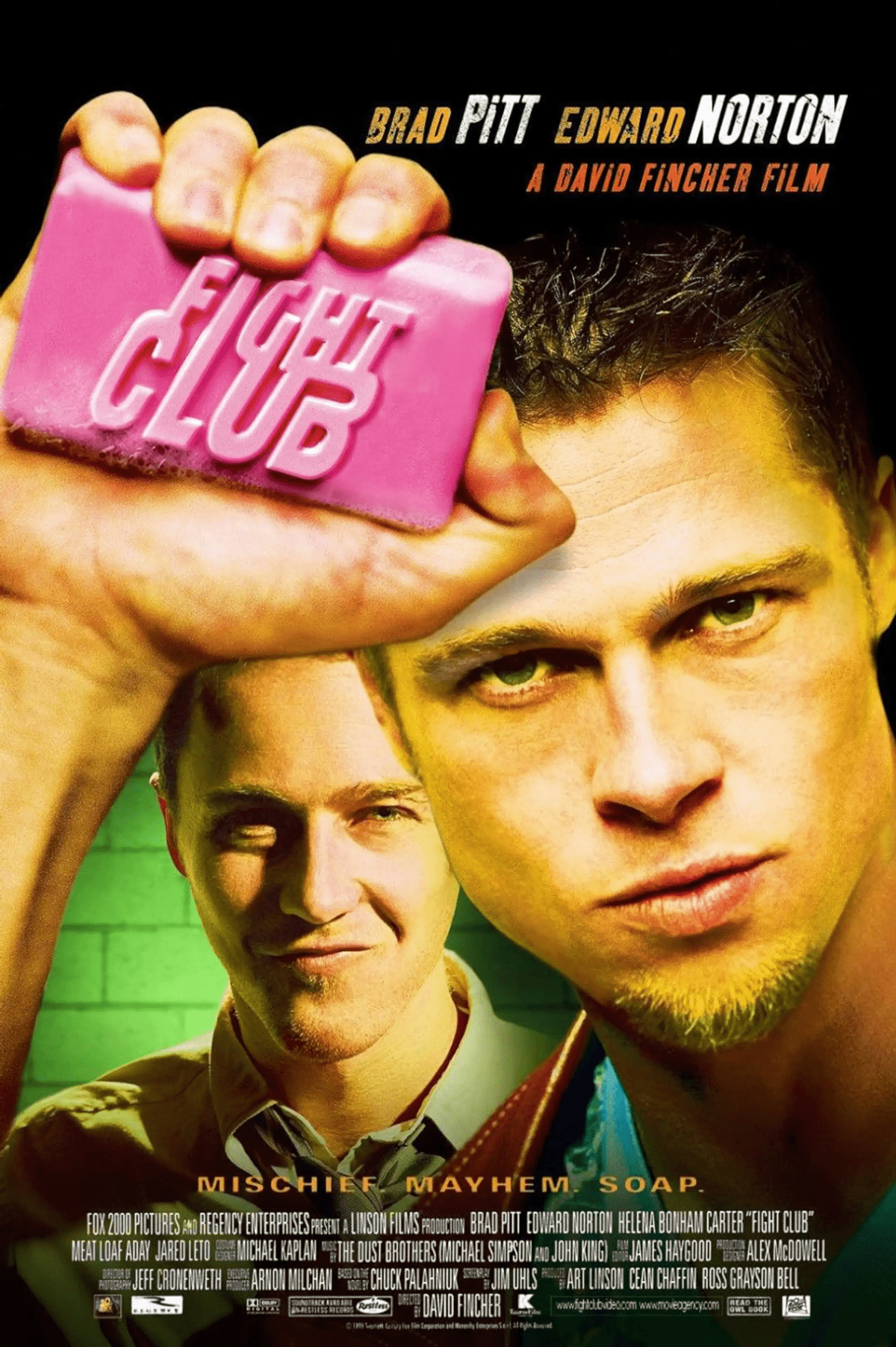
Fight Club is a 1999 Psychological Thriller / Black Comedy film directed by David Fincher and adapted by screenwriter Jim Uhls from the 1996 novel of the same name by Chuck Palahniuk.
The film's story follows the life of an unnamed man (Edward Norton) — named simply as "Narrator" in the credits and referred to as "Jack" in the script due to his recurring "I am Jack's ____" monologue — who has grown discontented with his life, which seems only to revolve around working at his dreary corporate job, indulging in endless bouts of meaningless consumerism, and going to support group meetings for diseases he doesn't have in a desperate attempt to feel any kind of emotion at all, all of which he does while struggling with chronic insomnia.
During a business flight, the man meets a charismatic free spirit named Tyler Durden (Brad Pitt), and they eventually start a "support group" — the titular "Fight Club" — where other unhappy, unfulfilled men get together and fight each other in bare-knuckle brawls as a form of "therapy." Fight Club eventually escalates as Tyler turns from the man's best friend into a Sensei for Scoundrels — and, eventually, into an Evil Reactionary.
A sequel simply titled Fight Club 2 was released in 2015-16 in comic book format, written by Palahniuk. Taking place ten years later, the Narrator (here given the name Sebastian) and Marla are married, have a child, and are living a stable if boring suburban life. Things are shaken up as Tyler Durden makes his return with even greater plans than the first time. Meanwhile, Palahniuk himself is also a character in it, writing the story as it unfolds. It gets very, very metatextual. This also received a sequel, Fight Club 3.
Previews: Trailer .
.
I am Jack's trope list:
- 555: Marla and Tyler's phone numbers begin with 555.
- Absurdly Exclusive Recruiting Standards: Exploited by Tyler when recruiting men into Project Mayhem. Applicants must wait on Tyler's porch for 3 days without food, shelter or encouragement to be accepted. In the meantime, Tyler keeps insisting that the organization won't let them join due to their high standards ("If the applicant is young, tell them they're too young. Old, 'too old,' fat, 'too fat.'") One prospective member is screamed at for being "too blonde." For the most part it just makes them more determined to follow Tyler.
- Actor Allusion: Played With: While this is another film where Edward Norton plays a character with a split personality, we don't learn this until near the end... and it's actually a case of a split personality here. Interestingly, he went on to play another one later, too.
- Adaptation Distillation: Sheds several of the book's subplots and changes the ending significantly. The author actually prefers the film to his own work.
- Adaptational Alternate Ending:
- In the book, the Narrator tries to destroy one building, but fails when Tyler botches the explosive mixture (which the book foreshadows in the opening chapter). The Narrator ends up in a mental institution — though he considers it Heaven — and some of its wardens are members of Project Mayhem, who patiently wait for Tyler to return from the depths of the Narrator's mind. The book also explicitly says the mental split happened the moment the Narrator fell in love with Marla — the Tyler psyche loved her, while his regular psyche hated her — while the movie only hinted at this. In the movie, the Narrator manages to regain his sanity, but eleven buildings end up annihilated by Tyler's explosives, with the Narrator and Marla holding hands while watching in awe. Nice big cock, roll credits. Chuck Palahniuk has gone on record saying he liked the movie's ending more than his.
- The Chinese edit of the film cuts to black just before the bombs go off and puts up a caption saying that the police successfully intervened, arrested everyone, and sent Tyler/the Narrator to a mental hospital. Palahniuk mocked this version of the film, but noted that it was ironically more faithful to the original book.
- Adaptational Heroism: While Tyler, like his book counterpart, is still obstinately a domestic terrorist whose main goal is to spread as much chaos as possible and bring society to its knees, the film has him adhering to a strong Thou Shalt Not Kill code, most notably arranging for the buildings he wants to blow up to be empty before he does the deed, whereas book Tyler was implied on more than one occasion to be a Serial Killer.
- Adventure Rebuff: Robert Paulson wants to join Project Mayhem, but is rebuffed by Tyler Durden several times. In fact, all potential initiates are systematically rebuffed several times before they're accepted.
- It's part of the requirement that the initiate has to refuse rejection in order to join. Those who walk away are not worthy.
- WE DO NOT TALK ABOUT PROJECT MAYHEM.
- Alternate Identity Amnesia: The protagonist doesn't remember any of his alter-ego activities.
- Anarchy Is Chaos: Subverted. Project Mayhem has elements of this ideology within it but is highly organized, with a purpose beyond simple havoc. It ultimately turns out they desire to bring down the capitalist system, a goal of most real anarchists. Tyler also appears to be anarcho-primitivist at one point, saying his great vision is of a future where humans abandoned civilization and have returned to living as hunter-gatherers.
- And Some Other Stuff: As noted above, frozen orange juice concentrate and gasoline don't really make homemade napalm. Several of the recipes were changed so that people wouldn't actually blow things up.
- Annoying Laugh: Tyler tells the Narrator when they first meet, "You have a sick desperation in your laugh".
- Arc Words: Too many to count, this trope being a core part of Palahniuk's writing style (Palahniuk referred to them as "choruses".) "On a long enough timeline the survival rate for everyone drops to zero," and "I know this because Tyler knows this" are two of the most well-known examples. There are also mentions of "space monkeys," and the "I am Jack's *insert characteristic here*," a reference to a series of articles in Reader's Digest that described internal organs in the first person, and "We have just lost cabin pressure."
- Arson, Murder, and Jaywalking: The tagline was "Mischief. Mayhem. Soap." This, however, is a subversion: the soap is made out of discarded fat from liposuctions. A straighter example are some of Project Mayhem's antics: among acts of threatening people at gunpoint, massive acts of arson and vandalism, and headlines like "Police Seize Excrement Canon" and "Performance Artist Molested", one simply reads "Power Outage At Local Mall".
- Artistic License – Medicine:
- The Doctor in the opening dismisses the Narrator's insomnia claims because "no one has ever died from insomnia''. As a doctor he should really know better.
- Tyler gives the Narrator a chemical burn and informs him that "water will react with it and make the effects worse" while "vinegar will neutralize the chemical", and so vinegar is applied to "cure" the burn. While Tyler's reasoning in and of itself is technically correct, it ignores two important things: water will also wash it away, and an acid neutralizing a base is an exothermic reaction (meaning it releases heat). In Real Life the vinegar would have neutralized the lye but also released a lot of heat, adding severe heat burns to his already damaged flesh and making the wound much worse, while the water would have flushed the lye from his flesh before it could actually worsen its effects.
- The Doctor in the opening dismisses the Narrator's insomnia claims because "no one has ever died from insomnia''. As a doctor he should really know better.
- Aside Glance: Tyler looks at the camera after Marla's rather disturbing pillow talk line "My God, I haven't been fucked like that since grade school".
- Ass-Kicking Pose: Tyler does several of these during his final fight with the Narrator and another one when the Narrator is on the phone with Marla for absolutely no reason except Brad Pitt being bored and wanting to try it out.
- Ate His Gun: In the film, this is actually Zig-Zagged. Following the "I am the one holding the gun" line, The Narrator puts his gun in his mouth, and shoots himself...through his cheek. It's here that Tyler is finally "killed", and it shows Tyler with his brains blown out the back of his head.
- Badass Long Robe: Tyler is commonly seen wearing a bathrobe and sunglasses, while generally being a badass extremist leader figure.
- Bad Guy Bar: Lou's Bar is where the first in-universe fight club appears. It's also implied that the owner, Lou, has ties to organized crime.
- The Bad Guys Are Cops: Once the Narrator realizes that Project Mayhem is planning a series of terrorist attacks, he attempts to go to the police, only to find out that several police officers are members of Project Mayhem, and have orders to castrate anyone who betrays the group.
- The Bad Guy Wins: Even though Tyler "dies", Project Mayhem still goes off as planned.
- Bald of Evil: Members of Project Mayhem shave their head as part of the initiation process. Tyler also appears with a shaved head after The Reveal.
- Bar Brawl: This is how the eponymous fight club starts. After drinking about three pitchers of beer, the Narrator and Tyler beat the crap out of each other. Eventually, a few others join in, and everything escalates from there.
- Battle Discretion Shot: The fight between the Narrator and Angel Face. According to the director's commentary, the original version was more directly graphic, but the censors boohooed it. The result that made it into the cinematic version fit this trope. The change, arguably, led to a more horrific scene because it used this trope.
- Battle Strip: No shirts, no shoes. Except for Bob, who is exempt from the rule without comment or debate for obvious reasons.
- Beauty Is Never Tarnished: Subverted and then lampshaded with the Narrator shooting himself through the cheek at the end, much to the shock of everyone that sees the wound left in its wake.
- Angel Face (played by the handsome Jared Leto) gets horrific facial wounds from the Narrator in a grim No-Holds-Barred Beatdown; even when he gets fixed up at a hospital, his face is still irreversibly damaged.
- Belligerent Sexual Tension: Marla and the Narrator.
- Better Living Through Evil: Tyler Durden helps the Narrator live a better life by abandoning materialism and consumerism. Too bad Tyler is his alter ego who uses Fight Club as a training program for a nihilistic assault on modern society. That, and Tyler wants the Narrator's personality to die completely so he can have his body permanently.
- Bird-Poop Gag: The members of Project Mayhem use bird seeds to draw a huge flock of pigeons to a Mercedes Benz dealership. The next day all the cars are covered in poop.
- Biting-the-Hand Humor: The film mocks most of its product placement (though one was intentional, as Edward Norton hates the New Beetle and intended to have a scene hitting it).
- Bittersweet Ending: Project Mayhem goes off without a hitch, meaning Tyler succeeds in destroying the world's credit data. However, the Narrator manages to "kill" Tyler and free himself from his influence, and now has a meaningful relationship with Marla and will presumably start living a better-balanced life.
- Bizarre and Improbable Ballistics: When the Narrator shoots himself through the cheek, the bullet can be inexplicably seen shooting off at 45 degrees. Fincher reasons that it might have bounced off his jaw, but the Narrator seems to be able to talk perfectly well in the following scene — perhaps a Magic Bullet?
- Black Comedy: The ultimate "Should I Be Laughing?" movie!
- Black Shirt: A group of black shirts start calling themselves Project Mayhem. One of the film's more obvious clues that these guys are not heroes is their literal black shirts and habit of chanting in unison while the Narrator is pleading with them to think for themselves.
- Blackmail: The Narrator attempts this on his boss, but when it doesn't seem to be working, decides to pull a Wounded Gazelle Gambit instead.
- Blood from the Mouth:
- Naturally shows up a few times, given all the people getting beat across the mouth. Tyler makes particularly disgusting use of the effect to intimidate a guy. Also turned on its head in the case of a bullet-hole in the cheek — does the blood still count if it's not actually coming out of the "mouth"?
- Inverted (literally) with the Narrator's line, "You can swallow a pint of blood before you get sick."
- Bloody Smile: During a team meeting, the protagonist gets a cheesy compliment from a co-worker and responds by giving him a sneering smile, showing blood in his mouth from the beating he took the night before.
- Boob-Based Gag: Bob is a rare male example, due to steroid abuse and the resulting drug therapy, in Palahniuk's typical humour in grotesque humans. We're introduced to him mashing the narrator against his chest as our narrator deadpans...This is Bob.
Bob had bitch tits. - Bookends: The film opens with Tyler holding a gun in the Narrator's mouth, asking if he has anything to say. The response is "I can't think of anything." We go back in time to find out How We Got Here, and when that scene becomes the present:
- Born in the Theatre: The pointing out of a cue mark (called, inaccurately, a cigarette burn). The movie also inserts a fake subliminal porn movie frame at the end.
- Tyler also appears at least five times in flickers of frames before he's properly introduced.
- During his "You Are Not Your Things" monologue, whether through fear or sheer force of personality, Tyler makes the film reel itself unstable, shaking about and showing the pinholes on the reel.
- Bowdlerise:
- Inverted. Marla's line from the book, "I want to have your abortion," is here changed to the significantly more offensive "I haven't been fucked like that since grade school." Fox wanted the original line changed, but David Fincher only did so under the condition that he did not have to change it more than once. Plus, he was only asked to change it, not make it less offensive.
- Played straight in the Chinese edit of the film, which ends not with Tyler's bombs detonating, but the film cutting to black with a block of text revealing that the police caught Project Mayhem, stopped the bombs from exploding, and arrested them all, with Tyler/the Narrator being sent to a psychiatric hospital and eventually released in 2012. Ironically, this makes it more similar to the ending of the original book.
- Break the Cutie: The fight between Angel Face and the narrator leaves Angel Face looking very untrue to his name.
- Breaking the Fourth Wall: Several times throughout the film, especially during scenes where the Narrator directly addresses the audience while talking about Tyler. For example, at one point the Narrator takes a time-out to explain Tyler's night jobs and juvenile terrorism.Narrator: He was the guerilla terrorist for the food service industry!
Tyler: (sighs) Do not watch! I cannot go while you watch.
Narrator: Apart from seasoning the lobster bisque, he farted on the lemon meringue, sneezed on braised endive, and as for the cream of mushroom soup, well...
Tyler: (chuckling) Go ahead. Tell 'em.
Narrator: You get the idea.
 - Briar Patching:
- Tyler's memetic rule, "You do not talk about Fight Club!" Of course, he does want them to talk about Fight Club and spread its message, but the idea of an exclusive club makes the movement more alluring to its members and more likely to be spread to their friends.
- Subverted when Tyler taunts the narrator about which wire to cut in the Wire Dilemma.
- Brick Joke: At one point in the film, the narrator discusses Tyler's stint splicing frames from porn films into kids' movies while working as a projectionist; to illustrate this, the camera briefly cuts to a close-up of a film strip showing several identical frames of a penis. At the end of the film, when the narrator and Marla are watching the buildings collapse, that exact frame briefly flashes on-screen.
- Broken Ace: Tyler, being the Narrator's subconscious conception of his ideal self, which he manifests as an alternate personality.
- Broken Record: "His name is Robert Paulson. His name is Robert Paulson."
- Bullet Time: The Narrator's dream of sleeping with Marla. Director Fincher was apparently embarrassed at the idea of directing a traditional sex scene, so he devised a more abstract way of presenting the material.
- Bungled Suicide: A strange example in that this is the only way to truly "kill" Tyler Durden; it's repeated the Narrator would have to kill himself to be rid of Tyler and his ideas. The narrator opts for a third option: shooting himself in a non-lethal way that resembles suicide. Tyler "dies" as a result.
- Call-Back: An easy one to miss on your first viewing is the opening scene when Tyler asks the Narrator if he wants to say anything to "mark the occasion". The narrator replies that he "can't think of anything." The film then goes back and works towards How We Got Here; when the scene plays out again, the line becomes "I still can't think of anything," which Tyler lampshades with "Ah, flashback humor."
- Camera Abuse: Not so much "camera" as "film" abuse, from the subliminal message insertions of Tyler Durden and artificial 'cigarette burn' marks, to when the film appears to jitter right off the spokes during Durden's "you're not your fuckin' khakis" monologue.
- Camping a Crapper: Tyler Durden and his mob corner a guy in a toilet cubicle and blackmail him by threatening to cut his testicles off.
- Canned Orders over Loudspeaker: Tyler Durden delivers some over a bullhorn to the first class of Project Mayhem:Listen up, maggots. You are not special. You are not a beautiful or unique snowflake. You're the same decaying organic matter as everything else. You are the all-singing, all-dancing crap of the world.
- Cardboard Box of Unemployment: Averted. When the Narrator blackmails his boss at the automotive company into letting him "work from home," he leaves the office with a shopping cart full of fax machines, phones, and computer paraphernalia. Not a cardboard box in sight, despite the office set having been painstakingly designed, built, and filmed to evoke a quintessential soul-sucking, 9-to-5, white-collar corporate headquarters.
- Cassandra Truth: Averted. The Narrator tries to confess his alter ego's crimes, and is believed, only to realize that everyone in the room is in on it.
- Cast Full of Pretty Boys: The film seems to do this on purpose. It gives the audience highly attractive men like Edward Norton, Brad Pitt and Jared Leto in varying states of undress, a ton of Ho Yay...and then has them violently beat the shit out of each other. If you're into that kinda thing you'll be in heaven.
- Cavalry Betrayal: Once he realises the full extent of Project Mayhem's plans the Narrator goes to the police and tells them the whole story, only to discover that the detectives he's talking are part of a Fight Club themselves, and they almost castrate him.
- Celebrity Paradox: Used to effect. When Marla and the Narrator are talking outside a movie theatre, the movie playing is Seven Years in Tibet, starring Brad Pitt, who also plays Tyler Durden in Fight Club. Given that this scene takes place after the Narrator discovers that Tyler is his split personality, the film serves as a subtle reminder that Tyler is invisibly present in this scene.
- Censor Decoy: A producer ordered Fincher to change the bit from the book in which Marla Singer declares, "I want to have your abortion." Fincher agreed on the condition that he only had to change it once, and the producer took the bait — but boy, did she regret it. The replacement line? "Oh my god, I haven't been fucked like that since grade school." The censor told Finch to change the now-worse line back to the original one, but since she agreed to only change it once, it was left in.
- Character Name Alias: All of the aliases used on name tags by the Narrator are the names of famous film characters, such as Taxi Driver (Travis) and Planet of the Apes (1968) (Cornelius).
- Chekhov's Gag: The cock that Tyler puts into family friendly films reappears at the end of the film.
- City with No Name: The film mentions several other cities, but never specifies where the Narrator lives. Clues in the novel and movie imply that the city is actually Wilmington, Delaware.
- Cluster F-Bomb:Narrator: God dammit! Fuck you. Fuck Fight Club, fuck Marla, I am sick of all your shit.
- Color-Coded Characters: Tyler dresses in reds and yellows. The Narrator dresses in blues and greys. Marla dresses in black.
- Combat Sadomasochist: Tyler Durden breaks into orgasmic laughter while being bludgeoned by Lou, all the while refusing to fight back.
- Coming of Age Story: One of the weirdest examples of this trope in cinematic history. It helps if you bear in mind that Fincher's biggest influence while making the film was The Graduate.
- The Commandments: The rules of Fight Club.
- You do not talk about Fight Club (and later, Project Mayhem).
- You do not talk about Fight Club.
- Someone yells "Stop," goes limp, taps out, the fight is over.
- Only two guys to a fight.
- One fight at a time.
- No belts, no shirts, no shoes.note
- Fights will go on as long as they have to.
- If this is your first night at Fight Club, you have to fight.
- Content Warnings: The DVD has another warning after the FBI/copyright notices that only flashes up for 7 seconds before segueing into a freaky animated sequence. If you freeze it, it tells you you're wasting your life freeze-framing DVDs to read it.
- Conveniently Empty Building: Justified. The Narrator is furious at Tyler Durden for the mass murder he's about to commit in Project Mayhem, which involves blowing up several office buildings. It's then explained that the buildings are completely empty, as it's the middle of the night, and all the people that would be working there at that time are members of their group. But they forget about the people on the streets (at night, but still), who would be hit by debris. Whoops!
- Cool People Rebel Against Authority: Tyler Durden's loud and brash anti-establishment way of thinking taps very well into the frustration and resentment of the working class and discontent white-collar middle class. While harmless at first (at least as harmless as the therapeutic punching of other people goes), as the movie goes on, Tyler is shown to be increasingly destructive, narcissistic, and mean-spirited. By the end of the movie, Tyler is, for all intents and purposes, the leader of a terrorist organization, plotting the downfall of modern civilization without any thought about how many people are truly fit to survive in the hunter-gatherer society that will live in the ruins.
- Corrupt Corporate Executive: The Narrator works for a major car company whose executives have him cover up anything that might be cause for a product recall.
- Cosy Catastrophe: Although not the end of the world, the ending fits this description in a sense. In fact, the entire point is to create this, to break everything down and start over new.Tyler Durden: In the world I see – you're stalking elk through the damp canyon forests around the ruins of Rockefeller Center. You'll wear leather clothes that will last you the rest of your life. You'll climb the wrist-thick kudzu vines that wrap the Sears Tower. And when you look down, you'll see tiny figures pounding corn, laying strips of venison on the empty car pool lane of some abandoned superhighway.
- Credits Gag:
- The DVD plays a very in-character gag on the FBI warning. At first it appears as normal, and then with some flickering and warping (the film's "Tyler has started fucking with something" visual cues), it is replaced with this:WARNING
If you are reading this then this warning is for you. Every word you read of this useless fine print is another second off your life. Don't you have better things to do? Is your life so empty that you honestly can't think of a better way to spend these moments? Or are you so impressed with authority that you give respect and credence to all who claim it? Do you read everything you're supposed to read? Do you think everything you're supposed to think? Buy what you're told you should want? Get out of your apartment. Meet a member of the opposite sex. Stop the excessive shopping and masturbation. Quit your job. Start a fight. Prove you're alive. If you don't claim your humanity you will become a statistic. You have been warned ...... Tyler - The Blu-Ray version of Fight Club takes it one step further — it starts off with the menu screen from Never Been Kissed before transitioning into the correct one.
- The DVD plays a very in-character gag on the FBI warning. At first it appears as normal, and then with some flickering and warping (the film's "Tyler has started fucking with something" visual cues), it is replaced with this:
- Creepy Monotone: The nameless Narrator sometimes slips into this, both in his narration and in his dialogue in the film.
- Cry into Chest: A major theme of the first 20 minutes is how random people in the support groups pair up to cry on one another. Of particular note is the Narrator being paired up with Bob, a former bodybuilder who has 'bitch tits' due to steroid abuse; it doesn't matter to the Narrator after discovering how good it feels to cry.
- Cut Himself Shaving: The Narrator is asked to explain his fighting injuries to a doctor. Tyler suggests that he "fell down some stairs." The Narrator agrees. The repetition makes a lot more sense when you learn that "Tyler" is an alternate personality. The doctor wouldn't have heard him speaking, because he isn't really there.
- Damn, It Feels Good to Be a Gangster!: The film made it look so cool to be in a fight club that it was pretty much inevitable that some people started their own.
- Dark Messiah: Tyler collected followers from the titular boxing club, promised them Better Living Through Evil, and used them to reset society to a freer, more primitive state. Besides that, he died for his cause, in the hopes of creating a legend.Narrator: Where would Jesus be if no one had written the gospels? ...You want to be a legend, Tyler, man, I'll make you a legend. I've been here from the beginning. I remember everything.
- The Dead Have Names: The Mechanic invokes this when the Narrator insists the Project Mayhem members recognize Bob's humanity and the weight of their actions. Yet, the Mechanic instead turns Bob's name — Robert Paulson — into a mournful chant, which later becomes a Memetic Mutation for other Fight Club/Project Mayhem cells.
- Deadpan Snarker: Tyler is the most noticeable one, although a few other characters get in on the act too.
- Deconstructed Character Archetype: Tyler is a Manic Pixie Dream Guy, a charismatic man who inspires the office-worker Narrator and other men to take control of their lives and rebel against society. However, over time, Tyler's methods grow more extreme, and his Fight Club eventually turns into a terrorist group that spreads mayhem and plans on blowing up buildings. The Plot Twist is that Tyler was just the Narrator's split personality all along, making Tyler a literal dream guy. After this revelation, the Narrator "kills" Tyler by shooting himself.
- Department of Redundancy Department: "The first rule of Fight Club is you do not talk about Fight Club. The second rule of Fight Club is you do not talk about Fight Club!"
- Destroy the Product Placement: It has a few instances:
- The Narrator's apartment is blown up in order to show him he doesn't need objects to survive. The furniture in said apartment came from IKEA (though in the movie the company where said furniture came from was called "Fürni").
- Project Mayhem members smash in the windows of a Volkswagen Beetle, break into a Mac store, and break a large spherical sculpture and send it rolling into a Starbucks shop.
- Disappeared Dad: The Narrator's dad left when he was only six years old.
- Disgusting Public Toilet: The bathroom in Tyler's house, complete with a revolting bathtub and water faucets that spew out brown water.
- Dissonant Laughter: When Lou brutally beats up Tyler Durden when they first meet, smashing open his mouth and nose, Tyler is... laughing his ass off."You don't know where I've been!"
- Does This Remind You of Anything?: The Ho Yay between Tyler and the narrator is very much intentional, to the point that Tyler comes across as the abusive husband in their relationship.
- Drives Like Crazy: Tyler. At one point he drives into incoming traffic and lets go of the steering wheel while simultaneously speeding up. In the same scene, no less! This, of course, causes him to crash the car.
- Dr. Jerk: The Narrator tries to get medical help for his insomnia and winds up with a doctor who doesn't even try to show him sympathy or kindness, refuses to write him any prescriptions and dismisses his pain by telling him to attend a cancer support group and learn what real pain is.
- Dude, Not Funny!: The Narrator gets pissed at Tyler after the latter cracks jokes right after threatening Raymond K Hessel.
- Easter Egg: Several, detailed here.
- Eerie Pale-Skinned Brunette: Marla.
- Empty Fridge, Empty Life: "How embarrassing: a house full of condiments and no food."
- "End Is Nigh" Ending: The film ends with the Narrator and Marla watching the destruction of the financial companies' buildings, which was intended to eliminate debt and 'reboot' society: the destruction of our consumer culture and the dawn of a new hunter/gatherer civilization.
- The Ending Changes Everything: The Narrator is Tyler Durden.
- Enemy Within: Whenever the Narrator fights Tyler.
- Escapism: Why the Fight Clubs are invented and what Tyler is for the Narrator.
- Establishing Character Moment: Marla sauntering into the testicular cancer support group evening with sunglasses on and a lit cigarette dangling from her lips.Marla: This is cancer, right?
- Eunuchs Are Evil: Inverted with Bob Paulson, who lost his testicles to cancer stemming from steroid abuse. Despite being duped into joining Fight Club and Project Mayhem, Bob is probably the nicest character in the whole movie, and he repeatedly demonstrates that he has plenty of figurative "balls."
- Even the Guys Want Him: The Narrator clearly has conflicting feelings about Angel Face, a Pretty Boy wildly known around Fight Club to be inhumanly beautiful among the usual crowd of macho men, and it's one reason he singles out and beats Angel Face to a pulp, remarking, "I felt like destroying something beautiful."
- Everyone Has Standards: One rule of Fight Club is that any two men in a fight (fairly brutal, bare-knuckle affairs) must fight for as long as possible — but as soon as they go limp or surrender, the fight ends, no questions asked. It's called "Fight Club", not "Beat Each Other To Death Club", after all. That's the main reason why the only crowd reaction to the Narrator's fight with Angel Face is genuine shock and disgust.
- The Narrator is appalled at a lot of the things Tyler does and visibly shows discomfort when he tags along, such as when he attempts to take Raymond K. Hessell as a "human sacrifice".
- Evil All Along: As it turns out, Tyler doesn't exactly have everyone's best interests at heart. While it's downplayed in the movie, as Tyler takes great pains to ensure no one is outright killed in the terrorist bombing, it's still going to be at the cost of a lot of peoples' livelihoods — which would normally be a good thing if Tyler wasn't running a Cult of Personality antithetical to his own brand of anarchism.
- Evil Feels Good: "I look like you want to look, I fuck like you want to fuck, I am smart, capable, and most importantly: I am free in every way that you are not."
- Evil Reactionary: Tyler believes modernity has robbed men of purpose and their manhood. Project Mayhem is ultimately about destroying the modern financial infrastructure in order to take society back to more agricultural, frontier ways.
- Evilutionary Biologist: Tyler Durden has the motivation, but not the methodology. He believes society and rampant consumerism are stagnating human development. Rather than combat this with mad science, however, he plans to force humanity to "evolve, and let the chips fall where they may" by crashing the global economy.
- Facial Horror: The Narrator punches Angel Face's... um, face so hard it's barely recognizably human, and most of his teeth are gone.
- Fake-Out Make-Out: Subverted: Tyler pulls Marla into a corner in a hallway to escape the paramedics, but instead of kissing her, he does a bit of an awkward dance to pass the time.
- Fan Disservice: Lots of half-naked, sweaty, bloodied men. One of whom is Bob. With "bitch tits".
- Fanservice: Lots of half-naked, sweaty, bloodied men. One of whom is Brad Pitt.
- Faux-To Guide: Tyler Durden's versions of the airline safety instructions card.
- Female Gaze: Related to the Fanservice in the form of Tyler Durden.
- Fight Clubbing: The Trope Namer and Trope Codifier. The eponymous Fight Club is for half-naked, sweaty men to beat each other bloody in order to release their repressed manhood.
- Fight Magnet: The members of Fight Club are all assigned this as "homework". Cue hilarious montage.
- First-Person Peripheral Narrator: Subverted: the film seems to be about Tyler Durden, and the Narrator is just telling his story. But it turns out they're the same person.
- Fist of Rage: An interesting inversion of this trope happens when the Narrator is being threatened by his boss. He looks down at his hand and is surprised to see it clenched into a shaking fist. Moments later, he unleashes a brutal beatdown ... on himself. But then, the twist in the end indicates that this is not the first time he has beat himself up either...
- Flat "What": After the Narrator explains to Marla Singer that Tyler Durden is a separate personality that he's only just been made aware of, she delivers one that manages to be both flat and epic at the same time.
- Another in response to "I want you to hit me as hard as you can."
- Foe Romance Subtext: Aside from the fact that they're basically the same person, there's a large amount of subtext between the Narrator and Tyler, as Tyler is the epitome of everything the Narrator wishes he were, compared to the Narrator's docile, repressed sexuality. The movie opens with Tyler shoving the barrel of a gun down the Narrator's throat, they live together, bathe together, spend their nights beating each other to a pulp while shirtless and covered in sweat, and let's not forget the chemical burn scene, in which Tyler kisses the Narrator's hand and holds him down while he burns him, and Marla's almost jealous reaction when she sees the scar ("Who did that to you? Guy or girl?"). There's also the Narrator's jealousy and subsequent brutal beat-down of Angel Face when he started to seem like Tyler's new favorite.
- How the Narrator specifically states "one" and not "ones", so either meaning Tyler or Marla specifically when he states "that old saying, how you always hurt the one you love? Well, it works both ways". Considering the context of that situation and the fact he only thought of Marla later, it seems pretty clear exactly who he meant...
- Foreshadowing:
- Tyler's presence is foreshadowed by his image getting spliced into several frames of footage at a few points before his actual introduction. It's been said that this is because the Narrator is still creating Tyler in his mind.
- When talking to his doctor, he mentions narcolepsy as he experienced dozing off and waking up somewhere else. Although the doctor possibly alludes to it as sleepwalking, it is much more likely Tyler had already manifested and was travelling around when he was sleeping.
- When the Narrator attempts to call Tyler after his apartment has exploded from a gas leak, Tyler doesn't answer the phone, but immediately calls the Narrator back. In a phone booth. Since Tyler isn't real, the Narrator's attempt to call him would fail, but imagining that Tyler calls him back afterwards is a lot easier.
- Many lines point to the twist, but might not become apparent until a second viewing. Especially obvious with lines such as, "I know this because Tyler knows this", "If you could wake up in a different time, in a different place, could you wake up as a different person?", "I already knew the story before he told it to me". When the Narrator fights himself in his boss' office, he muses, "For some reason, I was reminded of my first fight with Tyler." At one point Bob tells the Narrator of a rumor that Tyler never sleeps, forming a possible connection to the Narrator's insomnia. Another is when after mouthing off to his boss, he muses "Tyler's words coming out of my mouth".
- Marla interacts with either Tyler or the Narrator, never both at the same time. She always gives him strange looks when he talks or acts like there is a third person in the house. This is most notable when he tells her "Tyler's not here! Tyler's gone!"
- When Marla calls the Narrator at his office claiming to need him to check her for breast cancer, the Narrator muses that "[he's] neutral in her book." It's quite true, since Marla doesn't know the Narrator and Tyler are two personalities; she thought she was calling the latter and can't have any opinion on the former because she doesn't realize he exists.
- At one point, Tyler looks at a chiseled underwear model and sneers, "Is that what a real man looks like?" Tyler has the physique of an underwear model and is not a real man, being a split personality of the Narrator with an idealized appearance.
- The part where the Narrator explains Tyler's projectionist and waiter jobs to the audience. Specifically, how the Narrator and Tyler alternate explaining it.
- One internet ad has the Narrator saying the exact same lines that Tyler says in the actual film.
- When the Narrator and Tyler go out drinking after the apartment explosion, as Tyler's listing the things that concern him nowadays in a consumer-focused society, one of them is "some guy's name in my underwear". Exactly how it got there or why it'd concern him isn't stated, but it takes a new meaning upon rewatching. (Alternately, he's just complaining about the names of brands like Calvin Klein.)
- Following that is when Tyler tells the Narrator off for letting things like his furniture define him, Tyler mentions the sofa's Strinne green stripe pattern, a detail the Narrator only revealed to the audience.
- Another detail being when Tyler offers the Narrator a cigarette, he turns it down on account of how he doesn't smoke. The Narrator is seen smoking more and more as the film goes on; the first time at work his boss reprimands him that smoking isn't allowed and the second, one is off to the side as he threatens his boss, like "Tyler's words coming out of my mouth".
- The Fourth Wall Will Not Protect You: During the montage of Tyler recruiting members for Project Mayhem, he addresses the audience with a chilling speech about how they aren't special, and his presence is so commanding and intense that the music devolves into aimless, stuttering noise and the physical celluloid that the film is printed on starts shaking in the projector like it's going to explode.
- Freeze-Frame Bonus:
- In keeping with Tyler's habit of splicing porn frames into movies, Tyler himself, looking very impatient, flickers on screen in a few frames before his introduction proper. As does a frame of a pornstar's penis.
- If you check the "Bridgeworth Suites" hotel commercial the narrator watches, you'll realize it's the hotel where Tyler works; during the shot containing several rows of male waiters, he can be spotted at the far right of the front row.
- If you look carefully at the pay phone the Narrator uses to talk to Tyler, you'll notice that it's physically incapable of receiving incoming calls, meaning that it would be impossible for Tyler to call that pay phone to talk to him in the first place. The only plausible explanation is that Tyler never existed to begin with. The phone booth also shows that placing a call costs 35 cents, while the Narrator tries to call Tyler after putting in a single coin, meaning the attempted call went nowhere.
- When the Narrator first attends the support groups, there is a flyer for a 1997 film festival. Then, he mentions to Marla he's been going to the groups for over a year, and finally the film ends in 1999, when the film was released, after it's implied Fight Club has been going on for another year.
- Various business cards and postal codes place the story in the fictional Bradford, Delaware.
- In the first scene with the Narrator in his office, he is wearing a nametag, implying his first name (or at least one of them) is actually Neal.
-
 David Fincher has confirmed that, if you look hard enough, you can spot one or more Starbucks coffee cups in almost every scene.
 - Pausing when the Narrator writes a haiku about bees, you can see his email contacts are cast and crew members mentioned in the credits.
- In the "homework" scene, a priest is sprayed with water, and a car salesman is shoved. Later at the fight club, you can see the priest beating up the car salesman.
- Freudian Threat: The threat to cut off someone's balls happens a few times. This is, after all, a movie about men who are deeply insecure about their masculinity.
- Freudian Trio: Played with when it's revealed Tyler is literally the Narrator's id.
- Id: Tyler Durden
- Ego: Marla Singer
- Superego: the Narrator
- Friends with Benefits: What the Narrator thinks Tyler has with Marla.
- Full-Circle Revolution: There's no small irony that the fight clubbers end up exactly where they started from, as nameless cogs in a machine that uses and discards them. Now they just have some awesome scars, brushes, and broken bones to show off.
- Funny Background Event:
- The Narrator sighs as he sees his new acquaintance Tyler shimmy up to an expensive convertible and drives away. As the Narrator turns towards the camera in a fugue of jealousy and self-loathing, the car owner is seen frantically pursuing Tyler down the street.
- While the Narrator is on the phone with Marla, Tyler is in the other room messing with a pair of nunchucks and yelling at the top of his voice.
- When the Narrator first approaches Marla at the support group, there's another man who apparently had the same plan, but was a little slower off the mark. The resignation on his face as he turns away is hilarious.
- Future Primitive: Discussed in Tyler's vision for things to come:In the world I see, you are stalking elk through the damp canyon forests around the ruins of Rockefeller Center. You'll wear leather clothes that will last you the rest of your life. You'll climb the wrist-thick kudzu vines that wrap the Sears Tower. And when you look down, you'll see tiny figures pounding corn, laying strips of venison on the empty car pool lane of some abandoned superhighway.
- Gang Initiation Fight: Played With. To join the club, new members are expected to fight on their first day. However, subverted in that it really doesn't seem to matter whether they win. It's all about the fight itself.
- Genre-Busting: A social commentary/philosophical drama/black comedy/surreal-psychological mystery-thriller/crime action film in which the real fighting is only used as a way to highlight the message of the film. It has to be seen at least two times to be fully enjoyed.
- God Is Evil: The Narrator and Tyler Durden discuss this when Tyler tries to 'enlighten' the Narrator by means of burning his hand with lye.Tyler Durden: Our fathers were our models for God. If our fathers bailed, what does that tell you about God?
Narrator: No, no, I... don't...
Tyler Durden: Listen to me! You have to consider the possibility that God does not like you. He never wanted you. In all probability, He hates you. This is not the worst thing that can happen.
Narrator: It isn't?
Tyler Durden: We don't need Him! - Going Postal: The Narrator threatens his boss that this might be the consequence of pushing him too hard when his boss discovers the photocopied "Rules of Fight Club".
- Good Cop/Bad Cop: The Narrator and Tyler do this to the Project Mayhem applicants. Which becomes really weird after we find out Tyler is the Narrator.
- Good Old Fisticuffs: The solution to the stresses of modern-day society is a good round of pit-style fisticuffs.
- Groin Attack: "Anyone interferes with Project Mayhem, we gotta get his balls."
- Gut Punch: Bob's death.
- Handicapped Badass: Bob Paulson is originally introduced as a pathetic guy who had to be surgically castrated (forcing him to take hormonal supplements that give him "bitch tits") due to testicular cancer. By the time he gets killed, he has more than earned his place in Project Mayhem, as evidenced by the other members' chant:His name is Robert Paulson! His name is Robert Paulson! His name is Robert Paulson!
- Happy Place: The Narrator's happy place is a frozen cave occupied by his power animal — a talking penguin. He tries to enter it later to escape the pain of a chemical burn, but Tyler Durden pulls him out. Now, how would Tyler know about that?"Slide."
- Harmful to Minors: While working as a projectionist, Tyler splices frames from porn films into family-friendly movies — specifically ones that are being screened to children and their families. When the movie shows this in action, the camera briefly shows a little girl crying after being exposed to a split-second of what's implied to be graphic sex.
- He Had a Name: Invoked verbatim by the Narrator after the death of his friend Robert Paulson, when one of the members of Project Mayhem suggests disposing of "the body" by burying it in the garden. The Narrator's speech accidentally finishes turning Project Mayhem into a Martyrdom Culture: they reconcile it with Tyler's demand that the "Space Monkeys" go without names by concluding that Robert earned his name in death.Space Monkeys: (chanting in unison) His name is Robert Paulson. His name is Robert Paulson. His name is Robert Paulson.
- He Knows Too Much: Tyler tries to kill Marla because she knows too much about Project Mayhem and could compromise his plan to destroy the credit card companies' headquarters.
- He Who Fights Monsters: By the end, Tyler has shaped his group to be just as conformist as the consumerist society he's trying to overthrow, and in some cases, it's even worse.
- Hell-Bent for Leather: Tyler Durden wears red leather and goes as far as to say that in an ideal world a man will own just one set of clothes for his entire life, made of leather. He's supposed to be a subconscious representation of the repressed protagonist's idea of masculinity.
- Hit Me, Dammit!: "I want you to hit me as hard as you can!"
- Holding Hands: In the final scene, the Narrator takes Marla's hand as they watch several skyscrapers explode around them.
- Horrible Housing: The grungy, run-down house that the Narrator and Tyler move into.The Narrator: It looked like it was waiting to be torn down. Most of the windows were boarded up. None of the doors locked. The stairs were ready to collapse. I didn't know if he owned it or he was squatting. Neither would have surprised me. Nothing worked. The rusty plumbing leaked. Turning on a light meant another light in the house went out. There were no neighbors. Just warehouses and the paper mill. The fart smell of steam, the hamster cage smell of wood chips. At night, Tyler and I were alone for half a mile in every direction. When it rained, we had to kill the power. By the end of the first month, I didn't care about TV. I didn't mind the warm, stale refrigerator. The previous occupant had been a bit of a shut-in.
- Horrifying the Horror: Tyler Durden to the Mafia goons who disrupt a session of Fight Club, by letting himself get beaten up, only to tackle one of them and spit blood all over him while Laughing Mad.
- How We Got Here: The film starts with Tyler Durden holding a gun in the Narrator's mouth. The film plays with and Lampshades it: Tyler first asks the Narrator if he has anything to say, and he says he doesn't. When the film catches up with itself (after the Narrator states that "this is where we came in"), he asks the question again, and the Narrator replies he still can't think of anything, and Tyler quips, "Flashback humor."
- Huddle Shot: Used rather threateningly when Tyler Durden is delivering his We Are Everywhere threat.
- Human Resources: Tyler Durden collected human fat from the disposal bins behind a liposuction clinic, then used it to make expensive soap for rich ladies. Bonus points for fulfilling this trope, as the Narrator lampshades the idea that the same women who paid to get rid of the fat would now pay him to return it.Narrator: Tyler sold his soap to department stores at $20 a bar. Lord knows what they charged. It was beautiful. We were selling rich women their own fat asses back to them.
- Hypocrite: A major part of Tyler Durden's ranting diatribes against modern society is how it has turned people into unthinking drones who never question anything. After he turns Fight Club into Project Mayhem, the members become underlings whom he expects to follow his orders without questioning anything.
- Hypocritical Humour: In one scene, Tyler sneers at an advertisement featuring a ripped underwear model and asks, "Is that what a real man looks like?" Tyler himself is quite chiseled, but this only becomes hypocritical when you consider the fact that Tyler's appearance is the Narrator's ideal self, so yes, he does want to look like an underwear model purely for aesthetic reasons.
- Hypothetical Fight Debate: Related example when the two main characters are discussing which historical figure they'd like to get into a fistfight with and how they think they'd do. Tyler favors Abraham Lincoln for his reach and wiry strength. The Narrator picks Gandhi.
- Identity Breakdown:
- The big reveal that Tyler is the Split Personality idealized version of the Narrator, and thus Tyler has never existed as a separate person, leads the Narrator to have a Heroic BSoD and confront Tyler to try to stop Project Mayhem's terrorist plot of shutting down the global financial system. And in the end the Narrator resolves the breakdown by reasserting himself against Tyler and "kills" the Tyler personality.
- The existence of the Tyler personality also means that the Narrator had an Identity Breakdown before the start of the film due to the dissatisfaction and disempowerment he felt regarding his life. Tyler was the solution to that breakdown.
- If You Can Read This: The newspaper articles all have the same nonsense text, whether the headline is "Fountain Befouled" or "Feces Catapult Seized" or "Stolen Lab Monkey Found Shaved".
- I Just Want to Be Free/I Just Want to Be Special: Feeling trapped in his monotonous, materialistic lifestyle, the Narrator searches for a way to break out of the mold.
- I Just Want to Have Friends: Lacking any real friends, the Narrator joins self-help groups for diseases he doesn't have in order to make 'friends', who he only wants so he can get emotional catharsis from their pain and suffering, and then enters into a mutual relationship with Tyler.
- I'm Not Afraid of You: The Narrator to Tyler.
- Imaginary Friend: Tyler Durden is a split personality of the Narrator, and is in many ways his idealized self.
- The Immodest Orgasm: Courtesy of Marla.
- Implied Death Threat: When the Narrator's boss confronts him after the former left a copy of the rules of Fight Club in the copy machine, the Narrator warns that whoever wrote that paper is a very dangerous individual, one who could go on a killing spree if pushed.Narrator: ...this button-down, Oxford-cloth psycho might just snap, and then stalk from office to office with an Armalite AR-10 carbine gas-powered semi-automatic weapon, pumping round after round into colleagues and co-workers. This might be someone you've known for years. Someone very, very close to you.
- Important Haircut: The members are all shaved when they get recruited. Also, Tyler himself gets one before launching Project Mayhem.
- Impossibly Cool Clothes: Tyler's ability to actually pull off increasingly flamboyant, off-the-wall outfits attests to his "I'm everything you ever wanted to be" charisma.
- Inevitably Broken Rule: "The first rule of Fight Club is 'You do NOT talk about Fight Club!'" Guess what happens? See also Schmuck Bait and Reverse Psychology.
- The Insomniac: The Narrator's insomnia is what sparks the plot. In more ways than one, it would seem...
- Interface Screw:
- Tyler addresses the audience during one of his monologues and manages to shake the film. This scene is later reenacted with the Narrator.
- The DVD has Tyler vandalizing the opening FBI warning.
- Fincher gets in another meta-gag with the Blu-Ray release. When you initially boot it up, the menu for Never Been Kissed comes up for a few seconds.
- Ironic Echo: Related to Arc Words. One example that stands out in particular is when the group leader for the testicular cancer support group that the Narrator visits addresses the people in the room with the phrase "I look around this room and I see a lot of...", which Tyler steals while making his "Middle Children of History" speech later on in the film.
- Ironic Name: Angel Face. Once he fights the Narrator, let's just say he doesn't live up to the name anymore.
- I Surrender, Suckers!: Tyler's fight with Lou.
- I Was Quite a Looker: Bob used to be a bodybuilder...who took lots of steroids to help maintain his physique (back when that sort of thing was common). He then stopped doing both...and it shows.
- Jekyll & Hyde: Marla seems to feel this way about the Narrator: "You're Dr. Jekyll and Mr. Jackass." She is actually spot on.
- Journey to the Center of the Mind: Inverted in the opening credits. Fincher said he wanted to show the reaction of fear, all the way from one neuron in the brain firing off to sweat rolling down the Narrator's forehead.
- Jumping Off the Slippery Slope: One interpretation of the third act of both film and book.
- Kicking My Own Butt: The Narrator blackmails his boss into paying him for no work, and to seal the deal beats himself up in front of the boss, threatening to blame him for the beating if he doesn't comply, and of course to show how serious and nuts he is.
- Every fight the Narrator had with Tyler is this in reality.
- Laughing Mad: Tyler Durden's, several times but especially, and most disturbingly, during his fight with Lou. This laughter is also used at the beginning of the DVD menu.
- Leaning on the Fourth Wall: Done enough times to make the camera a supporting character. In at least one montage the Narrator directly addresses the camera to tell us about Tyler.
- At one point, the Narrator and Tyler address the camera to explain some of the finer details of how theater projectors work, such as the "cigarette burns" bit, complete with Tyler pausing what he's doing to point at one such marker showing up in the film itself.
- "Life Is Awesome" Speech: Tyler Durden drags a convenience store clerk out of his business and holds a gun on him, not to rob him, but to provide a strange sort of motivating force. Raymond K. Hessel, as he learns the clerk is named, gave up on his dream of being a veterinarian because of the difficulty involved. Tyler points the gun at him (which we later learn is empty), and tells Hessel that if he is not well on his way to becoming a veterinarian the next time Durden checks in on him, he will kill him. When the Narrator asks Durden why he did that, Tyler gives us this:Tyler Durden: Tomorrow will be the most beautiful day of Raymond K. Hessel’s life. His breakfast will taste better than any meal you and I have ever had.
- Little "No": The Narrator when he realizes that he and Tyler are the same person.
- Looks Like Cesare: Marla Singer — messy black hair, dark circles around her eyes, and pale skin.
- Loves My Alter Ego: A very odd version of this trope, since no one knows that Tyler is an alter ego. The Narrator is jealous that everyone, especially Marla, idolizes Tyler but ignores him. But to everyone else, there is no difference between Tyler and the Narrator, even though Marla does observe the mood difference between the two.
- Made of Iron: Lots of characters, but particularly Tyler and the Narrator. Doubly so for the Narrator, because Tyler is his Split Personality, meaning that whatever happens to Tyler happens to the Narrator as well.
- Madness Shared by Two: A major subversion. The Narrator moves into a decrepit house with Tyler Durden, and slowly begins buying into Tyler's radical ideas about fighting, masculinity, and the need to destroy society. As his life spins out of control and is swallowed by Tyler's Project Mayhem terrorist group, the Narrator learns the mind-blowing truth: Tyler is his own split personality and never existed at all. All of this came from his own head.
- Magic Countdown: It takes about five minutes from the point where Tyler says "60 seconds" before the bombs actually go off. No countdown is shown or mentioned during that time, though.
- Manic Pixie Dream Guy: Tyler is a charismatic, unhinged man who inspires the office-worker Narrator and other men to take control of their lives and rebel against society. In the climax, Tyler reveals that he is actually the Narrator's Split Personality, meaning that Tyler is literally a dream guy.
- Manipulative Bastard: Tyler easily dupes dozens of people into joining Fight Club and later Project Mayhem.
- Marshmallow Hell: This is Bob.◊ Bob had bitch tits.
- Masquerade: If you're not allowed to talk about Fight Club, you might never know who is in on it and who isn't. This is especially true for the book, in which the Narrator mentions that nobody knows whether a prank pulled in public was pulled by Project Mayhem or not, because the first rule is you do not ask questions. This is lampshaded in both the book and movie when police officers the Narrator is counting on to save him from castration appear to be part of Project Mayhem.
- Maybe Magic, Maybe Mundane: Tyler Durden, the handsome man played by Brad Pitt, does not exist. There is only Tyler Durden who also the narrator and has a split personality. That being said, there are a few moments in the film that make you question what's really going on. Such as when "Tyler" can interact with physical objects like doors and weapons, or when the Narrator and "Tyler" are "fighting" and the Narrator is being physically dragged by something around the parking garage.
- Meaningful Echo: A lot of them, too many to cite. Possibly as much as ten percent of the script.
- Medium Awareness: Lots of deliberate film artifacts, including "cigarette burns" and sprocket holes. And, of course, a nice big cock.
- Memetic Mutation: Played darkly within the In-Universe example, "His name is Robert Paulson", when the Narrator first realizes that no matter how much he tries, any members of Project Mayhem not present at the birth of a rule will just become the Misaimed Fandom of the mutated meaning.
- Mental Story: In large part, but a lot of interesting stuff happens in reality, too.
- Mind Screw: The movie is weird from the start, but after a certain point, everything gets thrown out the window.
- Missing Time: The plane sequences.
- Mr. Exposition: The Narrator provides details on his life, Tyler's background, and other plot-important details through, well, his narration.
- Mr. Fanservice: Most conversations about how attractive Brad Pitt is will mention this film.
- My Master, Right or Wrong: This is how all members of Project Mayhem come to view Tyler and the Narrator, as the recruitment process involves having the willpower to stand outside the house and be verbally and physically berated for three straight days to prove their loyalty. Ironically, this ends up backfiring on the Narrator once he realizes Tyler is his split personality, as Tyler had instructed all members of Mayhem to castrate him should he ever try to stop the plan. Despite this, they do have a genuine concern for his wellbeing, as upon the Narrator shooting himself in the mouth to kill Tyler, the first they do upon seeing him is rush to his aid and search for medical equipment.
- Narrator All Along: Tyler is the Narrator's split personality.
- Necktie Leash: Following the booty call, when Tyler stands in front of Marla's door, she pulls him in by the jacket (since he doesn't wear a necktie).
- Never Trust a Trailer: The trailer focused on the fighting elements instead of the psychological elements.
- No Communities Were Harmed: The Narrator's hometown is never given, but clues suggest that it is Wilmington, Delaware. Other cities are mentioned by name as locations of satellite Fight Clubs.
- No-Holds-Barred Beatdown:
- The "fights" in the film are usually sloppy brawls or lopsided beat-downs, particularly the Narrator vs Angel Face, and Tyler vs the Narrator.
- Lou beating the shit out of Tyler, who refuses to defend himself until Lou turns his back.
- No Name Given: Edward Norton's character is known in the script only as the Narrator, and is never given a name in the film.
- No Product Safety Standards: The Narrator discusses how the automaker he works for chooses to enact a product recall (or not).Woman beside the Narrator on a plane: What car company did you say you worked for?!
Narrator: *Beat* A major one. - Not What It Looks Like: Invoked by the Narrator who beats himself up at his boss' office so when the security guards arrive it looks like he was battered by his boss.
- Ominous Visual Glitch: Tyler shows up in a glitchy Freeze-Frame Bonus for Subliminal Seduction before being officially introduced as a character. Tyler can also break the fourth wall and point out "cigarette burns" in the film.
- Once More, with Clarity: Towards the end of the film, the Narrator figures out Tyler Durden exists as a hallucinatory manifestation of his id. Once this happens, the film shows previous scenes involving both the narrator and Tyler — without Tyler in them.
- One Dialogue, Two Conversations: A variation of this occurs in the scene in which Marla comes into the kitchen of the Narrator and Tyler's house and he asks her what she gets out of her relationship with Tyler. She thinks he is asking about her relationship with him because she thinks he is Tyler. She then asks him what he gets out of his relationship with her, and he thinks that she is asking about his relationship with Tyler.
- Only a Flesh Wound: Near the end of the movie, the Narrator shoots himself through the cheek, but seems to come out of it fine, except for the (plot-important) mental shock.
- Only Known by Their Nickname: Jared Leto's character is credited as "Angel Face". And of course the nameless Narrator has become known as "Jack" to fans, after one of the movie's most memorable running gags.
- Ooh, Me Accent's Slipping: Helena Bonham Carter's English accent comes through at times, most obviously in the scene in which the narrator explains that he actually quite likes her.
- Operation: [Blank]: Project Mayhem is named after the group's goal of creating chaos severe enough to force a societal reset.
- Painting the Medium: Many scenes, especially the "Let me tell you about Tyler Durden" scene. Also: "Ah, flashback humor."
- Percussive Therapy: Many of the people who come to Fight Club are people who are unsatisfied with their life, so they work out their feelings by beating the crap out of each other.
- Pet the Dog: Bob, not understanding Project Mayhem's Secret Test of Character, picks up his bags and leaves dejectedly when Tyler insults him. The Narrator pities the poor guy and stops him to explain that it's all part of the initiation process.
- Pimped-Out Dress: Marla compares a bridesmaid's dress to a condom.
- Police Are Useless: The police aren't very good at investigating and stopping Project Mayhem. Justified; Project Mayhem infiltrated and intimidated the police in order to continue operating.
- Pretty Boy: Angel Face. It's part of the reason the Narrator brutally beats him at Fight Club.
- Product Placement:
- The film subverts this by showing numerous name-brand products and companies — while holding them up as examples of the failure of modern society. One notable scene involves the Narrator's apartment morphing into the not-IKEA "Fürni" catalog page he ordered his furniture from. In the DVD commentary, the filmmakers wondered what 7-UP thought about their glowing logo providing a silhouette for Tyler's gun. Hell, the Narrator himself says it outright: "When deep space exploration ramps up, it'll be the corporations that name everything. The IBM stellar sphere, the Microsoft galaxy. Planet Starbucks."
- To shoot a scene where Project Mayhem destroy a Starbucks shop with a dislodged street sculpture, the producers needed permission to use the Starbucks logo. According to the DVD Commentary, they tried to use it anywhere they could manage when they received permission — but were then forbidden to use the logo for the destroyed coffee shop.
- The film subverts this by showing numerous name-brand products and companies — while holding them up as examples of the failure of modern society. One notable scene involves the Narrator's apartment morphing into the not-IKEA "Fürni" catalog page he ordered his furniture from. In the
- Rated M for Manly: The story of Fight Club imparts the idea of society neutering male nature and discouraging traditionally male impulses and activities by labeling them shameful. The Fight Clubs (before Project Mayhem) exist as a way for the characters to subvert society's expectations by allowing them to release their impulses in secret (the dialogue makes sure to emphasize the Club's male-exclusive status). On the other hand, by the end the audience has seen how damaging all this is and how Fight Club is just another form of conformity.
- Red Oni, Blue Oni: Tyler is impulsive and rash, whereas the Narrator is a calm and cool corporate drone. Their different personalities are, of course, all mixed-up in the heat of the fight, and then we find out that they're actually not so different.
- Rehearsing a Conversation: The audience is shown an instance of the narrator rehearsing his confrontation with Marla in his head, before he attempts to do so. She shuts him down by telling him she could see him rehearsing it beforehand.
- Removing the Rival: The motivation for the Narrator to beat the crap out of Angel Face even after he says "stop". It leaves Tyler unimpressed.
- The Reveal: Twice. The first is when Tyler blurts out his role in the destruction of the Narrator's apartment. The second is the Tomato in the Mirror surprise below.
- Reverse Psychology: Tyler actually wants you to tell as many people as you can about Fight Club — and he knows that the best way to get you to do this is by emphasizing how secret it is. See Schmuck Bait.
- Rewatch Bonus: A huge part of the popularity and enduring appeal of the film. The second time you watch the film, you'll wonder how you didn't realize that Tyler is not real, seeing moments that you may have handwaved as coincidences the first time round, such as Tyler and the Narrator owning the same type of suitcase, or even as continuity errors such as the Narrator being pulled from the driver's seat after the car crash. In fact the film has so many examples that it has its own page — suffice it to say that when you finish it, you will watch it again almost immediately. You'll also be amazed at how much your perception of Marla changes the second time around — her actions seem far less irrational once you have the whole picture. You'll also try to spot all the single frame shots of Tyler that appear before he actually shows up in-character.
- Rule #1: There are eight rules, though people only remember the first two (which are the same rule) due to Memetic Mutation.
- Rummage Sale Reject: Tyler's outfits are retro as well as rummage sale chic, emphasizing his cool detachment from the culture of modern society. His clothes range from 70s-style leather jackets to kitschy bathrobes.
- Say My Name: The Narrator accidentally does this when trying to confirm that Marla just called him "Tyler".
- Schmuck Bait: The famous first two rules of Fight Club are actually specifically designed to be disobeyed, since Tyler's goal from the beginning is to grow his movement. It also fits in perfectly with his lawbreaking nature.
- Second-Person Narration: The "You wake up at SeaTac" scene.
- Sensei for Scoundrels: The trope was originally titled The Tyler Durden, which still exists as a redirect.
- Sensitive Guy and Manly Man: The Narrator and Tyler at first appear to be this to a certain extent, then we realize fairly soon that they are not so different in terms of their attitude toward society and life in general, and this is before we find out that Tyler is actually the Narrator's split personality.
- Sexier Alter Ego: Tyler, no doubt.
- Shirtless Scene: The sixth rule of Fight Club says "no shirts, no shoes". Bob averts this rule without comment. Guess why?◊ (It also saved money on makeup effects.)
- Shoo Out the Clowns: Bob, the testicular cancer survivor, is rather dark comic relief. He gets fatally shot before the third act, when things get even darker.
- Shout-Out: After threatening him at gunpoint, Tyler tells Raymond K. Hessel to leave. As he's running away, Tyler shouts "Run, Forrest, run!"
- Marla's excuse for being at the support meetings for diseases and maladies she doesn't actually have ("it's cheaper than a movie and there's free coffee") is a possible shout-out to Margarets Museum, a film Helena Bonham Carter did earlier in the decade where co-star Kate Nelligan gives a similar excuse about attending funerals ("it's cheaper than bingo and there's free food").
- The car crash dilemma of "recall vs. out-of-court settlement" the Narrator explains to a passenger on an airplane is the same that Dr. George Getchell explains to Maggie Ward about the Meridian in Class Action.
- At about an hour into the film, Marla begins singing a portion of the theme to Valley of the Dolls.
- The film can be roughly summarized as a frustrated insomniac attempting to find his way out of unhappiness and resorting to violence as a solution. Now where have we seen this one before?
- The subliminal flashes of penises that Tyler cuts into movies are likely a nod to the beginning of Ingmar Bergman's Persona (1966), a film with comparable themes of identity, professional disillusionment, and split personalities.
- Single Serving Friend: The Trope Namer. The Narrator refers to people he meets on planes as Single-Serving Friends: "Between takeoff and landing we have our time together. That's it." He's seen explaining his company's recall procedures to one such friend.
- Ironically subverted by the man the Narrator calls "by far the most interesting Single-Serving Friend I've ever met": Tyler Durden. Though they part ways after their flight, the Narrator soon finds his life inexplicably (and inescapably) entwined with Tyler's.
- Sliding Scale of Idealism Versus Cynicism: Fight Club is easily one of the most cynical movies ever made. It's almost relentless in its gloom and doom.
- The Snack Is More Interesting: When the Narrator calls Tyler over the payphone, Tyler is noisily eating potato chips.
- The Snark Knight: The Narrator and Tyler, Tyler moreso, since he is literally the Narrator's uninhibited id.
- The Social Darwinist: Tyler wants to destroy modern capitalism and indeed civilization entirely, as he believes that it makes people weak. By ending it, mankind will be forced to evolve or die.
- Soul-Crushing Desk Job: The Narrator works in a corporate job that he finds extremely unfulfilling and meaningless.
- Split Personality: The film eventually reveals that Tyler is an alter of the Narrator.
- Straw Nihilist: Tyler sounds like one at first glance, but it soon becomes apparent that he's anything but a true nihilist.Tyler Durden: Listen up, maggots. You are not special. You are not a beautiful or unique snowflake. You're the same decaying organic matter as everything else.
- Subliminal Seduction:
- Tyler inserts single frames of pornography into children's films — and later threatens to reveal this to the public unless the boss of the projectionists' union pays him off.
- Tyler shows up this way in a few scenes before his first proper scene, generally as a way to trip out the audience.
- Sure, Let's Go with That: One of the potential recruits for Project Mayhem has bright yellow hair. When the Drill Sergeant Nasty-equivalent starts cutting the recruits down, he rips into the blond's hair color, as he can't find anything else to riff on.Recruiter: You are too fucking old, fatty. And you! You're too fucking... blond!
- Tag Line:
- How much can you know about yourself if you've never been in a fight?
- When you wake up in a different place at a different time, can you wake up as a different person?
- Losing all hope is freedom.
- Mischief. Mayhem. Soap.
- Works great even on blood stains.
- Take That!: When members of the Fight Club take powerful magnets to erase a bunch of video cassettes at a rental store, it shows them doing it to a whole shelf of Alien³. Hard to take that as a coincidence given how miserable Fincher was directing the movie and how detail-oriented he is.
- Take This Job and Shove It: The Narrator pulls a Wounded Gazelle Gambit on his boss as his own way of getting revenge.
- There Is No Rule Six: Whenever Tyler is introducing new members, he always makes sure to emphasize that the first and second rules of Fight Club are that they do not talk about it. The indoctrination goes to the point that when the confused Narrator asks random members what they are doing, they answer that they aren't supposed to talk about it and think he is testing them.Tyler Durden: The first rule of Fight Club is you do not talk about Fight Club. The second rule of Fight Club is: you DO NOT talk about Fight Club.
- "They're Not Real" Reveal: Turns out, Tyler was never there to begin with. It was all in the Narrator's head.
- This Is Reality:
- Tyler invokes this trope to remind the Narrator that he doesn't exist after the Narrator tries to shoot him. After the Narrator keeps firing, Tyler just gets exasperated and knocks the gun away.
Tyler: Whoa! WHOA! (collects himself) Okay! You are now firing your gun at your imaginary friend... NEAR FOUR HUNDRED GALLONS OF NITROGLYCERIN!!- Another example is when Bob and other members of Project Mayhem wearing ski masks blow up a corporate art piece to destroy a coffee shop. They flee, only to end up being chased by the police, and Bob gets shot in the head and dies. Lampshaded by the Narrator:
The Narrator:You morons! You were running around in ski masks trying to blow stuff up, what did you think was going to happen?! - Through the Eyes of Madness: Because we all invent alternative selves and then rename ourselves to get out of crappy jobs.
- Tomato in the Mirror: When the Narrator realizes Tyler is his alter ego.
- Trailers Always Lie: Most of the trailers made the film look like a straight-up fight movie, which didn't help it at the box office.
- Trailers Always Spoil: Bob's corpse is seen briefly.
- Training from Hell: Downplayed. To be accepted into Project Mayhem, you have to stand outside a house for three days, without food, shelter, or encouragement, and endure physical and verbal abuse the whole time.
- The Trickster: Tyler. His hobbies include putting various bodily waste products in people's food and splicing single frames of porn into children's films.
- Tropaholics Anonymous: The Narrator goes to support groups for people with terminal diseases (even though he doesn't have one), because he finds that witnessing their misery allows him to sleep. It stops working when he encounters Marla, who does the same thing. Of course, it's more obvious that she's a fraud when she attends a support group for a condition that is impossible for her to have had: testicular cancer.
- Übermensch: Tyler. Charismatic? Check. Atheistic? Check. Has agenda intended to tear down the existing establishment (mindless consumerism coupled with a society where masculinity cannot be expressed openly) with a new paradigm after rejecting all previous moral codes and overcoming the inherent nihilism? Check. Has a Last Man equivalent (and in the Narrator, no less)? Check.
- The Unfettered: Tyler Durden."I look like you want to look, I fuck like you want to fuck, and most importantly, I am free in all the ways that you are not."
- Unreliable Narrator: The Narrator has a split personality, and we see through his perspective, seeing Tyler Durden as a separate person. We're occasionally given glimpses of what was really going on in past scenes, such as the Narrator burning his own unrestrained hand and dropping a beer bottle in an attempt to pass it to Durden.
- The Narrator's interactions with Marla Singer portray her as almost cartoonishly deranged until near the end of the movie, where she confirms the Narrator is Tyler Durden himself. Tyler got all the fun times with Marla, and only allowed the Narrator to remember a very little bit; every time Marla was obnoxious, the Narrator got the full brunt of it without knowing anything else about her personality.
- Unusual Hiring Practices: Played With. In order to join "Project Mayhem", candidates have to pass a test where they are left standing on the front porch of the Paper Street House for 3 days without food or shelter, enduring constant criticism and told to leave. If they last this long, they are allowed to stay at the house and train, becoming the "Space Monkeys". Other requirements are various articles of black clothing and enough money for a possible burial.
- (doubles for source material Fight Club)
- Violence Is Disturbing: Considering that the film is a negative representation of cynical attitudes with a terrorist organization wreaking havoc, this is to be expected. And the actual violent content itself in the film has still been criticized long after the film's release.
- Vomit Indiscretion Shot: A quick one while Tyler negotiates with Lou.
- Watch the World Die: At the end, the Narrator and Marla watch as all the buildings around them collapse.Narrator: You met me at a very strange time in my life.
- We All Die Someday: "On a long enough timeline, the survival rate for everyone drops to zero."
- Also, when the Narrator calls out Marla for not being terminally ill, he clarifies that he doesn't mean this in the "Tibetan Buddhist, Sylvia Plath, we're all dying" sense.
- We Are Everywhere: Tyler Durden delivers one to the public official who planned to investigate Fight Club:Tyler Durden: Hi. You're going to call off your rigorous investigation. You're going to publicly state that there is no underground group, or we are going to take your balls. […] The people you are after are the people you depend on; we cook your meals, we connect your calls, we guard you while you sleep. Do not fuck with us.''
- We Have Become Complacent: One of Tyler's critiques of consumerism is that it suppresses humanity's natural instincts, breeding complacency and stalling evolution. Project Mayhem is created to bring humanity back to square one and start over for this very purpose.Tyler Durden: I say let the chips fall where they may. Let's evolve!
- Western Terrorists: Project Mayhem aims to destroy capitalism and bring full-throated masculinity back into society. To judge by Tyler's speech, he wants all of modern civilization gone too, back into a hunter-gatherer mode of life. Initially they start with minor thefts and vandalism, then escalate into bombing (empty) buildings holding credit records to wipe out debt.
- Wham Line:
- "Why do you think I blew up your condo?"
- "You're Mr. Durden."
- And then later doubled down with: "You fuck me, then snub me. You love me, you hate me. You show me your sensitive side, then you turn into a total asshole! Is that a pretty accurate description of our relationship, Tyler?"
- Whole-Plot Reference: The novel is one to The Great Gatsby, and most of those elements remain in the film.
- Where the Hell Is Springfield?: The Narrator's hometown is never given. Most of the clues imply that it's Wilmington, Delaware, or somewhere in the immediate vicinity, though others point away from that city (such as Marla's pill bottle, which has a Los Angeles address on the label).
- Wire Dilemma: "Oh, heavens, no, not the green one — anything but the green one!" The green wire is usually the ground wire. That's exactly what someone would choose for an important function in a circuit if they wanted to deceive.
- Wounded Gazelle Gambit: "I am Jack's smirking revenge"... as he beats himself up in his boss's office.
- You Are Too Late: Project Mayhem's plan to destroy a series of office buildings works, and the Narrator is too late to stop it. Although it's an odd case, as he was also the one trying to do it.
- You Cannot Kill an Idea: The plans to blow up corporate buildings.
- You Have Outlived Your Usefulness: All but said in relation to Tyler and the Narrator and how Tyler "dies".
- Your Mind Makes It Real: Outright stated a couple of times, with the Narrator's evolution into Tyler.

