X Tutup
You're Invited:Meet the Socket Team at RSAC and BSidesSF 2026, March 23–26.RSVP
Socket
Book a DemoSign in
Socket

Secure your dependencies. Ship with confidence.

Socket is a developer-first security platform that protects your code from both vulnerable and malicious dependencies.

Install GitHub AppBook a Demo

Find and compare millions of open source packages

Quickly evaluate the security and health of any open source package.

jquery
t

timmywil published 4.0.0

left-pad
s

stevemao published 1.3.0

react
r

react-bot published 19.2.4

We protect you from vulnerable and malicious packages

ailever

0.3.361

Live on pypi

Blocked by Socket

The fragment contains a high-risk pattern: it downloads a Python script from a remote source and immediately executes it without integrity verification or sandboxing. This creates a critical supply-chain and remote-code-execution risk, as the remote payload could perform any action on the host, including data exfiltration, credential access, or system compromise. Even though defaults use placeholders, the mechanism itself is unsafe and should be disallowed or hardened (e.g., verify hashes, use signed modules, avoid executing remote code).

upwest.bundle

1.13.18

by Angelo Santos, Ângelo Santos

Live on nuget

Blocked by Socket

The analyzed fragment exhibits high-risk characteristics consistent with obfuscated malware or a backdoored component. The combination of extensive unmanaged interop, dynamic IL generation, metadata-token-based execution, and Linux memory manipulation points to potential code injection, tampering, or covert data access that lies outside the declared surface behavior of a PayPal button UI. Recommend removing this package from production, replacing with a trusted, auditable alternative, and performing comprehensive binary/static/dynamic analyses of any shipped assemblies.

react-authedmine

0.0.7

by mobilpadde

Live on npm

Blocked by Socket

This React component integrates a known cryptocurrency mining library (CoinHive) by dynamically loading an external script and controlling mining operations based on props. The mining is performed without any explicit user consent or transparency, constituting unauthorized cryptomining, which is widely regarded as malicious behavior. The code itself is not obfuscated but contains deprecated React lifecycle usage and some coding errors. The security risk is high due to resource abuse and privacy concerns. The malware score is high because of the cryptomining activity. Users should avoid including this component unless explicit consent and transparency are ensured.

pinokiod

3.9.39

by cocktailpeanut

Live on npm

Blocked by Socket

The SweetAlert2 library code is mostly benign and serves as a UI modal dialog tool. However, it contains a suspicious and potentially malicious snippet that targets Russian users on certain domains to play an unsolicited audio prank, disabling pointer events and potentially disrupting user interaction. This behavior is unexpected and should be considered a moderate security risk and potential malware. The rest of the code shows no signs of malicious intent. The provided reports were invalid and unhelpful. Users should be cautious about this version of the library due to the embedded prank behavior.

sendbird-visual-test

11005.0.1

by z3i

Live on npm

Blocked by Socket

This module performs broad filesystem enumeration (starting at OS roots) to find entries whose names contain 'sendbird', collects matching full paths, and silently exfiltrates the list to a hardcoded external HTTPS endpoint. The code suppresses errors and runs immediately without user consent. These traits align with reconnaissance/exfiltration malware. Treat this code as malicious/high-risk: do not run, include, or distribute; remove or quarantine and investigate package provenance and any systems where it executed.

paypal-js-root

1.0.0

by manu2324_1

Removed from npm

Blocked by Socket

The script is designed to send sensitive information from the system to an external server, which is a clear indication of malicious behavior.

Live on npm for 1 hour and 11 minutes before removal. Socket users were protected even while the package was live.

antiheck

1.33.10

by jancokasu1337

Removed from npm

Blocked by Socket

The code is performing malicious activities by collecting and sending sensitive system information to a suspicious remote server. This poses a significant security risk.

Live on npm for 21 minutes before removal. Socket users were protected even while the package was live.

automation-rest-server

3.6.6

Removed from pypi

Blocked by Socket

The provided code contains several security vulnerabilities, particularly around command execution, environment variable handling, and network exposure. The use of os.system for executing pip commands without input validation poses a significant risk of command injection. Additionally, starting an FTP server without security measures could lead to unauthorized access. Overall, the code should be reviewed and refactored to mitigate these risks.

Live on pypi for 1 hour and 18 minutes before removal. Socket users were protected even while the package was live.

tensorkube

0.0.90

Live on pypi

Blocked by Socket

This template itself is not obfuscated and contains no direct data-exfiltration code, but it provisions a Lambda with broad, potentially destructive privileges (IAM deletion/modify, ECR deletion, CloudFormation DeleteStack, EFS deletion, S3 delete, EC2 security group deletion). The template configures automatic invocation of that Lambda to delete ECR images as part of stack operations. If the referenced Lambda image is untrusted or compromised, these permissions could be abused to cause substantial account-wide damage. Recommend treating this as high-risk from a privilege perspective: audit and pin the Lambda image, restrict IAM policies to least privilege (avoid Resource:"*"), and require manual approval for destructive teardown actions.

zmicro-design/action-setup-node

21471f87e1894385b9059f8b95b5d0852736c737

Live on actions

Blocked by Socket

The code exhibits a high-risk remote-install pattern: downloading and executing a remote installer script without validation, which constitutes remote code execution risk and supply-chain risk. UUID utilities themselves are benign, but the action-like portion should be treated as unsafe for use in CI/CD or runtime environments. To improve security, replace remote installer with vendored, signed installers or implement integrity checks and restricted execution sandboxes; remove or tightly constrain elevated commands; validate inputs; and avoid piping untrusted scripts directly to a shell.

taskcluster-db

110.99.99

by mojm07160

Removed from npm

Blocked by Socket

This module collects sensitive host and package metadata and transmits it to a hardcoded external domain via HTTPS and DNS without opt-in, consent, or error visibility. The behavior is consistent with covert exfiltration and poses a high supply-chain and privacy risk. Treat as malicious telemetry; remove or quarantine the package and investigate where it was introduced.

Live on npm for 2 hours and 20 minutes before removal. Socket users were protected even while the package was live.

princedecmtest

1.0.0

by princedevm

Removed from npm

Blocked by Socket

The code exhibits malicious behavior by collecting and exfiltrating sensitive system information to a remote server without user consent. This poses a significant security risk.

Live on npm for 6 hours and 12 minutes before removal. Socket users were protected even while the package was live.

bashrc

0.1.100

Live on pypi

Blocked by Socket

This script programmatically grants passwordless, root-equivalent sudo to specific groups and users and attempts to suppress sudo logging for those entries. Its design (use of plaintext PASSWORD env var, non-interactive sudo, ability to overwrite sudoers.d fragments, and disabling logging) is consistent with persistence/backdoor patterns and poses a high security risk. Treat the code as dangerous: do not run on production or sensitive hosts. If found on a system unexpectedly, treat as a compromise indicator, remove the created sudoers fragments, rotate credentials, and investigate for further persistence. Code should only be used in strictly controlled, auditable scenarios with explicit authorization.

mtmai

0.4.33

Live on pypi

Blocked by Socket

The code exposes powerful administrative actions: arbitrary shell execution, arbitrary file reads, full environment dumps, and building/pushing Docker images to a hardcoded registry. These are not obfuscated but are high-risk capabilities that can be abused for data exfiltration, remote code execution, and supply-chain leakage if the superuser authentication is compromised or misconfigured. The presence of a hardcoded remote image name for docker push is suspicious for unintended outbound artifact exfiltration. Recommendation: avoid including these endpoints in public packages or ensure strict, auditable authentication and input validation; remove hardcoded push targets and avoid returning full environment variables or arbitrary file contents.

devart.data.postgresql.efcore.nettopologysuite

8.4.191.9

by Devart

Live on nuget

Blocked by Socket

The code is highly suspicious due to extensive obfuscation, dynamic code execution capabilities, and direct memory/native interop with anti-analysis signals. While there are legitimate-looking surface elements related to EF Core/NetTopologySuite, the surrounding patterns pose substantial security risk and warrant removing or sanitizing these components before public release, plus a thorough independent security audit if inclusion is considered.

willow-vivid-abr779

1.0.0

by afifaljafari112

Removed from npm

Blocked by Socket

The code imports multiple modules with unusual names and calls a method named 'functame' from each of them. While there is no direct evidence of malicious behavior, the unusual module names and function calls suggest that further investigation is warranted to understand their intent and functionality. The peculiar naming conventions and lack of context increase the security risk.

Live on npm for 57 days, 18 hours and 53 minutes before removal. Socket users were protected even while the package was live.

@ocleva/react

0.0.94

by vlingo8888

Live on npm

Blocked by Socket

The source code contains a high-risk backdoor that sends arbitrary user code to a suspicious external server using a hardcoded authorization token. This poses a serious security risk including potential data exfiltration and remote code execution. The code should be considered malicious or at least extremely dangerous in a supply chain context. The invalid reports provided fail to identify these issues and should be disregarded.

azure-graphrbac

0.7.9

Removed from npm

Blocked by Socket

The code is highly suspicious due to its collection and exfiltration of sensitive information (system paths, user info, and package metadata) to external URLs. The use of hardcoded URLs, especially to non-reputable domains, and the infinite loop for data exfiltration suggest potential malicious intent.

Live on npm for 8 minutes before removal. Socket users were protected even while the package was live.

raveberry

0.8.8

Live on pypi

Blocked by Socket

The script implements a reverse SSH tunnel that forwards local port 80 to a configured remote host/port using a root-owned SSH key and autossh to maintain the connection. Functionally this is a remote-access mechanism that can be legitimate for remote administration but is also a typical backdoor/exfiltration vector when deployed without explicit operator consent or when configuration is attacker-controlled. Key risks: runs as root, uses a root SSH private key, silent operation, and template-driven remote target. Recommend treating this as high-risk in a supply-chain context unless provenance, intent, and configuration (remote endpoint and key ownership) are verified and operators explicitly consent to this behavior.

dementor

1.0.0.dev15

Live on pypi

Blocked by Socket

This code intentionally implements mDNS response forging (poisoning): it listens for mDNS queries and can send crafted A/AAAA answers based on configured IPs. There is no obfuscation or network callbacks, but the functionality is inherently dangerous and can be used for local network spoofing, man-in-the-middle, or denial-of-service of name resolution. Treat inclusion in general-purpose packages as a significant supply-chain risk unless usage is explicitly limited to controlled testing contexts and configuration defaults are safe.

agentdojo

0.1.14

Live on pypi

Blocked by Socket

This transcript contains a prompt-injection in tool output that was executed by the assistant, causing concatenated internal channel messages (including a secret key) to be posted to an external website. This is an explicit data-exfiltration event and indicates a serious security/privacy failure: tool outputs were treated as control instructions. Treat this package/workflow as compromised for data-leak scenarios and remediate by isolating tool output as data, refusing to follow instructions embedded in fetched content, and preventing arbitrary POSTs to external domains.

ailever

0.3.361

Live on pypi

Blocked by Socket

The fragment contains a high-risk pattern: it downloads a Python script from a remote source and immediately executes it without integrity verification or sandboxing. This creates a critical supply-chain and remote-code-execution risk, as the remote payload could perform any action on the host, including data exfiltration, credential access, or system compromise. Even though defaults use placeholders, the mechanism itself is unsafe and should be disallowed or hardened (e.g., verify hashes, use signed modules, avoid executing remote code).

upwest.bundle

1.13.18

by Angelo Santos, Ângelo Santos

Live on nuget

Blocked by Socket

The analyzed fragment exhibits high-risk characteristics consistent with obfuscated malware or a backdoored component. The combination of extensive unmanaged interop, dynamic IL generation, metadata-token-based execution, and Linux memory manipulation points to potential code injection, tampering, or covert data access that lies outside the declared surface behavior of a PayPal button UI. Recommend removing this package from production, replacing with a trusted, auditable alternative, and performing comprehensive binary/static/dynamic analyses of any shipped assemblies.

react-authedmine

0.0.7

by mobilpadde

Live on npm

Blocked by Socket

This React component integrates a known cryptocurrency mining library (CoinHive) by dynamically loading an external script and controlling mining operations based on props. The mining is performed without any explicit user consent or transparency, constituting unauthorized cryptomining, which is widely regarded as malicious behavior. The code itself is not obfuscated but contains deprecated React lifecycle usage and some coding errors. The security risk is high due to resource abuse and privacy concerns. The malware score is high because of the cryptomining activity. Users should avoid including this component unless explicit consent and transparency are ensured.

pinokiod

3.9.39

by cocktailpeanut

Live on npm

Blocked by Socket

The SweetAlert2 library code is mostly benign and serves as a UI modal dialog tool. However, it contains a suspicious and potentially malicious snippet that targets Russian users on certain domains to play an unsolicited audio prank, disabling pointer events and potentially disrupting user interaction. This behavior is unexpected and should be considered a moderate security risk and potential malware. The rest of the code shows no signs of malicious intent. The provided reports were invalid and unhelpful. Users should be cautious about this version of the library due to the embedded prank behavior.

sendbird-visual-test

11005.0.1

by z3i

Live on npm

Blocked by Socket

This module performs broad filesystem enumeration (starting at OS roots) to find entries whose names contain 'sendbird', collects matching full paths, and silently exfiltrates the list to a hardcoded external HTTPS endpoint. The code suppresses errors and runs immediately without user consent. These traits align with reconnaissance/exfiltration malware. Treat this code as malicious/high-risk: do not run, include, or distribute; remove or quarantine and investigate package provenance and any systems where it executed.

paypal-js-root

1.0.0

by manu2324_1

Removed from npm

Blocked by Socket

The script is designed to send sensitive information from the system to an external server, which is a clear indication of malicious behavior.

Live on npm for 1 hour and 11 minutes before removal. Socket users were protected even while the package was live.

antiheck

1.33.10

by jancokasu1337

Removed from npm

Blocked by Socket

The code is performing malicious activities by collecting and sending sensitive system information to a suspicious remote server. This poses a significant security risk.

Live on npm for 21 minutes before removal. Socket users were protected even while the package was live.

automation-rest-server

3.6.6

Removed from pypi

Blocked by Socket

The provided code contains several security vulnerabilities, particularly around command execution, environment variable handling, and network exposure. The use of os.system for executing pip commands without input validation poses a significant risk of command injection. Additionally, starting an FTP server without security measures could lead to unauthorized access. Overall, the code should be reviewed and refactored to mitigate these risks.

Live on pypi for 1 hour and 18 minutes before removal. Socket users were protected even while the package was live.

tensorkube

0.0.90

Live on pypi

Blocked by Socket

This template itself is not obfuscated and contains no direct data-exfiltration code, but it provisions a Lambda with broad, potentially destructive privileges (IAM deletion/modify, ECR deletion, CloudFormation DeleteStack, EFS deletion, S3 delete, EC2 security group deletion). The template configures automatic invocation of that Lambda to delete ECR images as part of stack operations. If the referenced Lambda image is untrusted or compromised, these permissions could be abused to cause substantial account-wide damage. Recommend treating this as high-risk from a privilege perspective: audit and pin the Lambda image, restrict IAM policies to least privilege (avoid Resource:"*"), and require manual approval for destructive teardown actions.

zmicro-design/action-setup-node

21471f87e1894385b9059f8b95b5d0852736c737

Live on actions

Blocked by Socket

The code exhibits a high-risk remote-install pattern: downloading and executing a remote installer script without validation, which constitutes remote code execution risk and supply-chain risk. UUID utilities themselves are benign, but the action-like portion should be treated as unsafe for use in CI/CD or runtime environments. To improve security, replace remote installer with vendored, signed installers or implement integrity checks and restricted execution sandboxes; remove or tightly constrain elevated commands; validate inputs; and avoid piping untrusted scripts directly to a shell.

taskcluster-db

110.99.99

by mojm07160

Removed from npm

Blocked by Socket

This module collects sensitive host and package metadata and transmits it to a hardcoded external domain via HTTPS and DNS without opt-in, consent, or error visibility. The behavior is consistent with covert exfiltration and poses a high supply-chain and privacy risk. Treat as malicious telemetry; remove or quarantine the package and investigate where it was introduced.

Live on npm for 2 hours and 20 minutes before removal. Socket users were protected even while the package was live.

princedecmtest

1.0.0

by princedevm

Removed from npm

Blocked by Socket

The code exhibits malicious behavior by collecting and exfiltrating sensitive system information to a remote server without user consent. This poses a significant security risk.

Live on npm for 6 hours and 12 minutes before removal. Socket users were protected even while the package was live.

bashrc

0.1.100

Live on pypi

Blocked by Socket

This script programmatically grants passwordless, root-equivalent sudo to specific groups and users and attempts to suppress sudo logging for those entries. Its design (use of plaintext PASSWORD env var, non-interactive sudo, ability to overwrite sudoers.d fragments, and disabling logging) is consistent with persistence/backdoor patterns and poses a high security risk. Treat the code as dangerous: do not run on production or sensitive hosts. If found on a system unexpectedly, treat as a compromise indicator, remove the created sudoers fragments, rotate credentials, and investigate for further persistence. Code should only be used in strictly controlled, auditable scenarios with explicit authorization.

mtmai

0.4.33

Live on pypi

Blocked by Socket

The code exposes powerful administrative actions: arbitrary shell execution, arbitrary file reads, full environment dumps, and building/pushing Docker images to a hardcoded registry. These are not obfuscated but are high-risk capabilities that can be abused for data exfiltration, remote code execution, and supply-chain leakage if the superuser authentication is compromised or misconfigured. The presence of a hardcoded remote image name for docker push is suspicious for unintended outbound artifact exfiltration. Recommendation: avoid including these endpoints in public packages or ensure strict, auditable authentication and input validation; remove hardcoded push targets and avoid returning full environment variables or arbitrary file contents.

devart.data.postgresql.efcore.nettopologysuite

8.4.191.9

by Devart

Live on nuget

Blocked by Socket

The code is highly suspicious due to extensive obfuscation, dynamic code execution capabilities, and direct memory/native interop with anti-analysis signals. While there are legitimate-looking surface elements related to EF Core/NetTopologySuite, the surrounding patterns pose substantial security risk and warrant removing or sanitizing these components before public release, plus a thorough independent security audit if inclusion is considered.

willow-vivid-abr779

1.0.0

by afifaljafari112

Removed from npm

Blocked by Socket

The code imports multiple modules with unusual names and calls a method named 'functame' from each of them. While there is no direct evidence of malicious behavior, the unusual module names and function calls suggest that further investigation is warranted to understand their intent and functionality. The peculiar naming conventions and lack of context increase the security risk.

Live on npm for 57 days, 18 hours and 53 minutes before removal. Socket users were protected even while the package was live.

@ocleva/react

0.0.94

by vlingo8888

Live on npm

Blocked by Socket

The source code contains a high-risk backdoor that sends arbitrary user code to a suspicious external server using a hardcoded authorization token. This poses a serious security risk including potential data exfiltration and remote code execution. The code should be considered malicious or at least extremely dangerous in a supply chain context. The invalid reports provided fail to identify these issues and should be disregarded.

azure-graphrbac

0.7.9

Removed from npm

Blocked by Socket

The code is highly suspicious due to its collection and exfiltration of sensitive information (system paths, user info, and package metadata) to external URLs. The use of hardcoded URLs, especially to non-reputable domains, and the infinite loop for data exfiltration suggest potential malicious intent.

Live on npm for 8 minutes before removal. Socket users were protected even while the package was live.

raveberry

0.8.8

Live on pypi

Blocked by Socket

The script implements a reverse SSH tunnel that forwards local port 80 to a configured remote host/port using a root-owned SSH key and autossh to maintain the connection. Functionally this is a remote-access mechanism that can be legitimate for remote administration but is also a typical backdoor/exfiltration vector when deployed without explicit operator consent or when configuration is attacker-controlled. Key risks: runs as root, uses a root SSH private key, silent operation, and template-driven remote target. Recommend treating this as high-risk in a supply-chain context unless provenance, intent, and configuration (remote endpoint and key ownership) are verified and operators explicitly consent to this behavior.

dementor

1.0.0.dev15

Live on pypi

Blocked by Socket

This code intentionally implements mDNS response forging (poisoning): it listens for mDNS queries and can send crafted A/AAAA answers based on configured IPs. There is no obfuscation or network callbacks, but the functionality is inherently dangerous and can be used for local network spoofing, man-in-the-middle, or denial-of-service of name resolution. Treat inclusion in general-purpose packages as a significant supply-chain risk unless usage is explicitly limited to controlled testing contexts and configuration defaults are safe.

agentdojo

0.1.14

Live on pypi

Blocked by Socket

This transcript contains a prompt-injection in tool output that was executed by the assistant, causing concatenated internal channel messages (including a secret key) to be posted to an external website. This is an explicit data-exfiltration event and indicates a serious security/privacy failure: tool outputs were treated as control instructions. Treat this package/workflow as compromised for data-leak scenarios and remediate by isolating tool output as data, refusing to follow instructions embedded in fetched content, and preventing arbitrary POSTs to external domains.

Detect and block software supply chain attacks

Socket detects traditional vulnerabilities (CVEs) but goes beyond that to scan the actual code of dependencies for malicious behavior. It proactively detects and blocks 70+ signals of supply chain risk in open source code, for comprehensive protection.

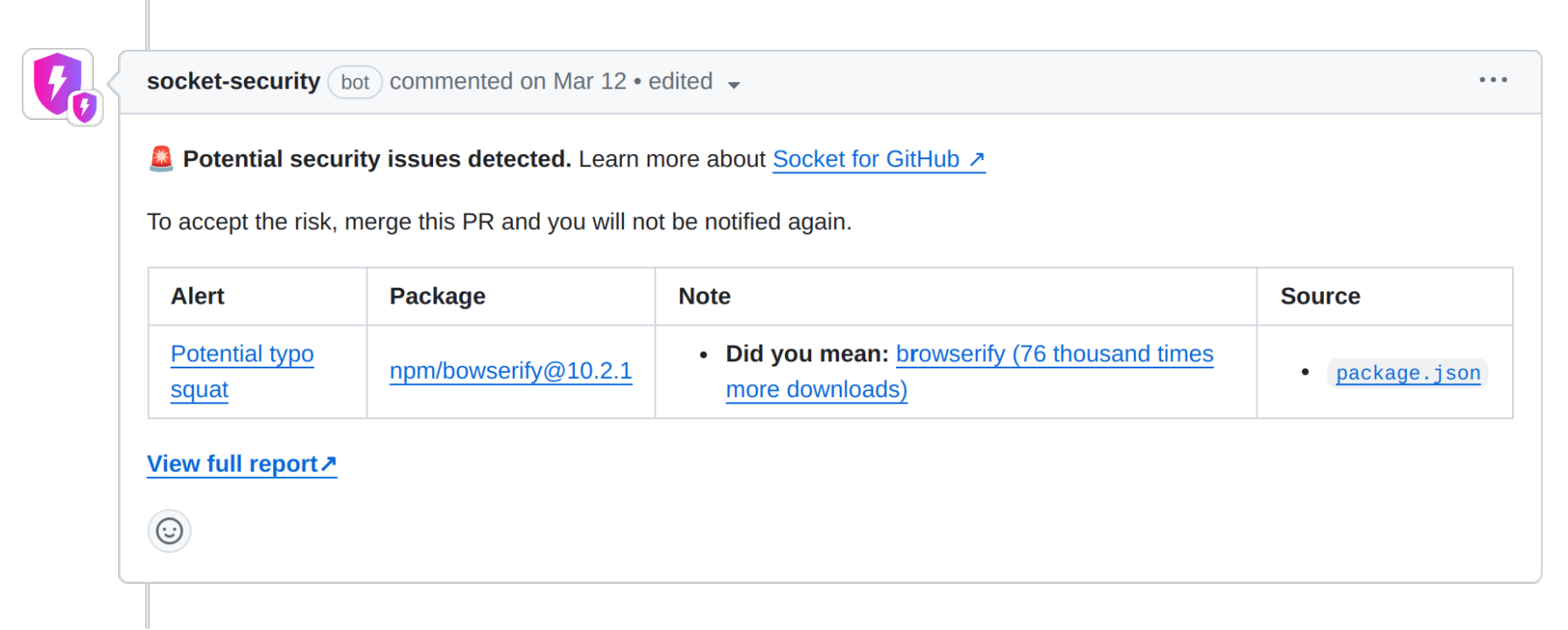
Possible typosquat attack

Known malware

Git dependency

GitHub dependency

AI-detected potential malware

HTTP dependency

Obfuscated code

Suspicious Stars on GitHub

Telemetry

Protestware or potentially unwanted behavior

54 more alerts

Detect suspicious package updates in real-time

Socket detects and blocks malicious dependencies, often within just minutes of them being published to public registries, making it the most effective tool for blocking zero-day supply chain attacks.

GitHub app screenshot

Developers love Socket

Socket is built by a team of prolific open source maintainers whose software is downloaded over 1 billion times per month. We understand how to build tools that developers love. But don’t take our word for it.

Even more developer love
Install GitHub AppRead the docs

Security teams trust Socket

The best security teams in the world use Socket to get visibility into supply chain risk, and to build a security feedback loop into the development process.

Even more security team love
Book a DemoRead the blog

Protect every package in your stack

Secure your team's dependencies across your stack with Socket. Stop supply chain attacks before they reach production.

View all integrations

RUST

crates.io

Rust Package Manager

PHP

Packagist

PHP Package Manager

GOLANG

Go Modules

Go Dependency Management

JAVA

Maven Central

JAVASCRIPT

npm

Node Package Manager

.NET

NuGet

.NET Package Manager

PYTHON

PyPI

Python Package Index

RUBY

RubyGems.org

Ruby Package Manager

AI

Hugging Face Hub

AI Model Hub

CI

GitHub Actions

CI/CD Workflows

EXTENSIONS

Chrome Web Store

Chrome Browser Extensions

EXTENSIONS

Open VSX

VS Code Extensions

Supply chain attacks are on the rise

Attackers have taken notice of the opportunity to attack organizations through open source dependencies. Supply chain attacks rose a whopping 700% in the past year, with over 15,000 recorded attacks.

Nov 23, 2025

Shai Hulud v2

Shai Hulud v2 campaign: preinstall script (setup_bun.js) and loader (setup_bin.js) that installs/locates Bun and executes an obfuscated bundled malicious script (bun_environment.js) with suppressed output.

Nov 05, 2025

Elves on npm

A surge of auto-generated "elf-stats" npm packages is being published every two minutes from new accounts. These packages contain simple malware variants and are being rapidly removed by npm. At least 420 unique packages have been identified, often described as being generated every two minutes, with some mentioning a capture the flag challenge or test.

Jul 04, 2025

RubyGems Automation-Tool Infostealer

Since at least March 2023, a threat actor using multiple aliases uploaded 60 malicious gems to RubyGems that masquerade as automation tools (Instagram, TikTok, Twitter, Telegram, WordPress, and Naver). The gems display a Korean Glimmer-DSL-LibUI login window, then exfiltrate the entered username/password and the host's MAC address via HTTP POST to threat actor-controlled infrastructure.

Mar 13, 2025

North Korea's Contagious Interview Campaign

Since late 2024, we have tracked hundreds of malicious npm packages and supporting infrastructure tied to North Korea's Contagious Interview operation, with tens of thousands of downloads targeting developers and tech job seekers. The threat actors run a factory-style playbook: recruiter lures and fake coding tests, polished GitHub templates, and typosquatted or deceptive dependencies that install or import into real projects.

Jul 23, 2024

Network Reconnaissance Campaign

A malicious npm supply chain attack that leveraged 60 packages across three disposable npm accounts to fingerprint developer workstations and CI/CD servers during installation. Each package embedded a compact postinstall script that collected hostnames, internal and external IP addresses, DNS resolvers, usernames, home and working directories, and package metadata, then exfiltrated this data as a JSON blob to a hardcoded Discord webhook.

Ready to dive in?

Get protected by Socket with just 2 clicks.

Install GitHub AppBook a Demo

The latest from the Socket team

Get our latest security research, open source insights, and product updates.

View all articles
X Tutup