# 动态规划
## 背景
先从一道题目开始~
如题 [triangle](https://leetcode-cn.com/problems/triangle/)
> 给定一个三角形,找出自顶向下的最小路径和。每一步只能移动到下一行中相邻的结点上。
例如,给定三角形:
```text
[
[2],
[3,4],
[6,5,7],
[4,1,8,3]
]
```
自顶向下的最小路径和为 11(即,2 + 3 + 5 + 1 = 11)。
使用 DFS(遍历 或者 分治法)
遍历
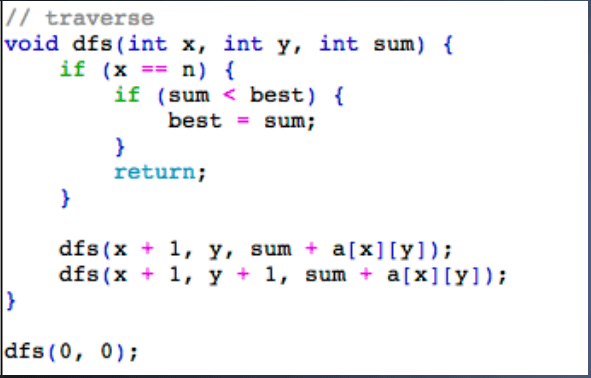
分治法
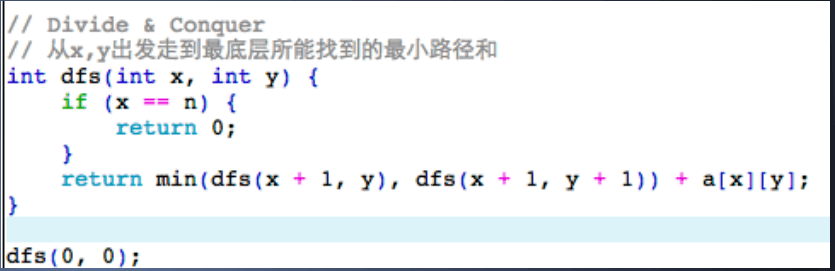
优化 DFS,缓存已经被计算的值(称为:记忆化搜索 本质上:动态规划)
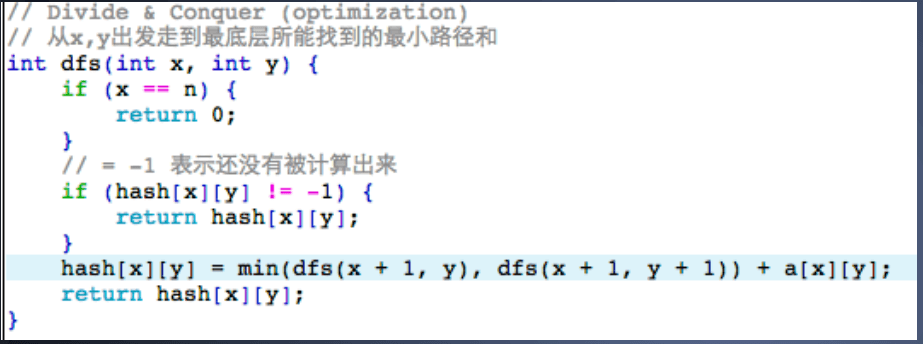
动态规划就是把大问题变成小问题,并解决了小问题重复计算的方法称为动态规划
动态规划和 DFS 区别
- 二叉树 子问题是没有交集,所以大部分二叉树都用递归或者分治法,即 DFS,就可以解决
- 像 triangle 这种是有重复走的情况,**子问题是有交集**,所以可以用动态规划来解决
动态规划,自底向上
```Python
class Solution:
def minimumTotal(self, triangle: List[List[int]]) -> int:
if len(triangle) == 0:
return 0
dp = triangle[-1].copy()
for i in range(-2, -len(triangle) - 1, -1):
for j in range(len(triangle[i])):
dp[j] = triangle[i][j] + min(dp[j], dp[j + 1])
return dp[0]
```
动态规划,自顶向下
```Python
class Solution:
def minimumTotal(self, triangle: List[List[int]]) -> int:
if len(triangle) == 0:
return 0
dp = triangle[0]
for row in triangle[1:]:
dp_new = [row[0] + dp[0]]
for i in range(len(dp) - 1):
dp_new.append(row[i+1] + min(dp[i], dp[i+1]))
dp_new.append(row[-1] + dp[-1])
dp = dp_new
return min(dp)
```
```Python
class Solution:
def minimumTotal(self, triangle: List[List[int]]) -> int:
result = triangle
count = 0
for line in result:
line[0] += count
count = line[0]
for i in range(1, len(triangle)):
for j in range(1, len(triangle[i])):
if j >= len(triangle[i-1]):
result[i][j] += result[i-1][j-1]
else:
result[i][j] += min(result[i-1][j-1], result[i-1][j])
return min(result[-1])
```
## 递归和动规关系
递归是一种程序的实现方式:函数的自我调用
```go
Function(x) {
...
Funciton(x-1);
...
}
```
动态规划:是一种解决问题的思想,大规模问题的结果,是由小规模问题的结果运算得来的。动态规划可用递归来实现(Memorization Search)
## 使用场景
满足两个条件
- 满足以下条件之一
- 求最大/最小值(Maximum/Minimum )
- 求是否可行(Yes/No )
- 求可行个数(Count(\*) )
- 满足不能排序或者交换(Can not sort / swap )
如题:[longest-consecutive-sequence](https://leetcode-cn.com/problems/longest-consecutive-sequence/) 位置可以交换,所以不用动态规划
## 四点要素
1. **状态 State**
- 灵感,创造力,存储小规模问题的结果
2. 方程 Function
- 状态之间的联系,怎么通过小的状态,来算大的状态
3. 初始化 Intialization
- 最极限的小状态是什么, 起点
4. 答案 Answer
- 最大的那个状态是什么,终点
## 常见四种类型
1. Matrix DP (10%)
1. Sequence (40%)
1. Two Sequences DP (40%)
1. Backpack (10%)
> 注意点
>
> - 贪心算法大多题目靠背答案,所以如果能用动态规划就尽量用动规,不用贪心算法
## 1、矩阵类型(10%)
### [minimum-path-sum](https://leetcode-cn.com/problems/minimum-path-sum/)
> 给定一个包含非负整数的 *m* x *n* 网格,请找出一条从左上角到右下角的路径,使得路径上的数字总和为最小。
思路:动态规划
1. state: f(x, y) 从起点走到 (x, y) 的最短路径
2. function: f(x, y) = min(f(x - 1, y), f(x, y - 1]) + A(x, y)
3. intialize: f(0, 0) = A(0, 0)、f(i, 0) = sum(0,0 -> i,0)、 f(0, i) = sum(0,0 -> 0,i)
4. answer: f(n - 1, m - 1)
5. 2D DP -> 1D DP
```Python
class Solution:
def minPathSum(self, grid: List[List[int]]) -> int:
m, n = len(grid), len(grid[0])
dp = [0] * n
dp[0] = grid[0][0]
for i in range(1, n):
dp[i] = dp[i-1] + grid[0][i]
for i in range(1, m):
dp[0] += grid[i][0]
for j in range(1, n):
dp[j] = grid[i][j] + min(dp[j-1], dp[j])
return dp[-1]
```
```Python
class Solution:
def minPathSum(self, grid: List[List[int]]) -> int:
m = len(grid)
n = len(grid[0])
result = grid
for i in range(1, m):
result[i][0] += result[i-1][0]
for j in range(1, n):
result[0][j] += result[0][j-1]
for i in range(1, m):
for j in range(1, n):
result[i][j] += min(result[i-1][j], result[i][j-1])
return result[-1][-1]
```
### [unique-paths](https://leetcode-cn.com/problems/unique-paths/)
> 一个机器人位于一个 m x n 网格的左上角 (起始点在下图中标记为“Start” )。
> 机器人每次只能向下或者向右移动一步。机器人试图达到网格的右下角(在下图中标记为“Finish”)。
> 问总共有多少条不同的路径?
```Python
class Solution:
def uniquePaths(self, m: int, n: int) -> int:
if m < n:
m, n = n, m
dp = [1] * n
for i in range(1, m):
for j in range(1, n):
dp[j] += dp[j - 1]
return dp[-1]
```
```Python
class Solution:
def uniquePaths(self, m: int, n: int) -> int:
result = [[1] * n for _ in range(m)]
for i in range(1, m):
for j in range(1, n):
result[i][j] = result[i-1][j] + result[i][j-1]
return result[-1][-1]
```
### [unique-paths-ii](https://leetcode-cn.com/problems/unique-paths-ii/)
> 一个机器人位于一个 m x n 网格的左上角 (起始点在下图中标记为“Start” )。
> 机器人每次只能向下或者向右移动一步。机器人试图达到网格的右下角(在下图中标记为“Finish”)。
> 问总共有多少条不同的路径?
> 现在考虑网格中有障碍物。那么从左上角到右下角将会有多少条不同的路径?
```Python
class Solution:
def uniquePathsWithObstacles(self, G: List[List[int]]) -> int:
m, n = len(G), len(G[0])
dp = [1] if G[0][0] == 0 else [0]
for i in range(1, n):
new = dp[i-1] if G[0][i] == 0 else 0
dp.append(new)
for i in range(1, m):
dp[0] = 0 if G[i][0] == 1 else dp[0]
for j in range(1, n):
dp[j] = dp[j-1] + dp[j] if G[i][j] == 0 else 0
return dp[-1]
```
```Python
class Solution:
def uniquePathsWithObstacles(self, obstacleGrid: List[List[int]]) -> int:
if obstacleGrid[0][0]:
return 0
m = len(obstacleGrid)
n = len(obstacleGrid[0])
result = [[0] * n for _ in range(m)]
result[0][0] = 1
for i in range(1, m):
if not obstacleGrid[i][0]:
result[i][0] = result[i-1][0]
for j in range(1, n):
if not obstacleGrid[0][j]:
result[0][j] = result[0][j-1]
for i in range(1, m):
for j in range(1, n):
if obstacleGrid[i][j]:
result[i][j] = 0
else:
result[i][j] = result[i-1][j] + result[i][j-1]
return result[-1][-1]
```
## 2、序列类型(40%)
### [climbing-stairs](https://leetcode-cn.com/problems/climbing-stairs/)
> 假设你正在爬楼梯。需要 *n* 阶你才能到达楼顶。
```Python
class Solution:
def climbStairs(self, n: int) -> int:
if n < 2: return n
step1, step2 = 2, 1
for _ in range(n - 2):
step1, step2 = step1 + step2, step1
return step1
```
```Python
class Solution:
def climbStairs(self, n: int) -> int:
if n == 1:
return n
result = [1] * n
result[1] = 2
for i in range(2, n):
result[i] = result[i-1] + result[i-2]
return result[-1]
```
### [jump-game](https://leetcode-cn.com/problems/jump-game/)
> 给定一个非负整数数组,你最初位于数组的第一个位置。
> 数组中的每个元素代表你在该位置可以跳跃的最大长度。
> 判断你是否能够到达最后一个位置。
解法:直接DP无法得到O(n)的解,考虑间接DP
- tail to head
```Python
class Solution:
def canJump(self, nums: List[int]) -> bool:
left = len(nums) - 1 # most left index that can reach the last index
for i in range(len(nums) - 2, -1, -1):
left = i if i + nums[i] >= left else left # DP
return left == 0
```
- head to tail
```Python
class Solution:
def canJump(self, nums: List[int]) -> bool:
max_pos = nums[0] # furthest index can reach
for i in range(1, len(nums)):
if max_pos < i:
return False
max_pos = max(max_pos, i + nums[i]) # DP
return True
```
```Python
class Solution:
def canJump(self, nums: List[int]) -> bool:
max_jump = 0
length = len(nums)
for i in range(length):
if max_jump >= i:
max_jump = max(max_jump, i + nums[i])
if max_jump >= length - 1:
return True
return False
```
### [jump-game-ii](https://leetcode-cn.com/problems/jump-game-ii/)
> 给定一个非负整数数组,你最初位于数组的第一个位置。
> 数组中的每个元素代表你在该位置可以跳跃的最大长度。
> 你的目标是使用最少的跳跃次数到达数组的最后一个位置。
```Python
class Solution:
def jump(self, nums: List[int]) -> int:
cur_max = 0
step_max = 0
step = 0
for i in range(len(nums)):
if cur_max < i: # can't reach i, don't have to consider in this problem
return float('inf')
if step_max < i: # can't reach i in current number of steps
step += 1
step_max = cur_max
cur_max = max(cur_max, i + nums[i]) # DP
return min_step
```
```Python
class Solution:
def jump(self, nums: List[int]) -> int:
max_jump, step, end = 0, 0, 0
for i in range(len(nums)-1):
max_jump = max(max_jump, i+nums[i])
if i == end:
step += 1
end = max_jump
return step
```
### [palindrome-partitioning-ii](https://leetcode-cn.com/problems/palindrome-partitioning-ii/)
> 给定一个字符串 _s_,将 _s_ 分割成一些子串,使每个子串都是回文串。
> 返回符合要求的最少分割次数。
- Why is hard
仅目标DP, 判断回文时间复杂度高 -> 目标DP + 回文二维DP, 回文DP空间复杂度高 -> 一点trick, 回文DP空间复杂度降为线性
```Python
class Solution:
def minCut(self, s: str) -> int:
dp_min = [0] * len(s)
dp_pal = [True] * len(s)
def isPal(i, j):
dp_pal[i] = (s[i] == s[j] and dp_pal[i+1])
return dp_pal[i]
for j in range(1, len(s)):
min_cut = dp_min[j - 1] + 1
if isPal(0, j):
min_cut = 0
for i in range(1, j):
if isPal(i, j):
min_cut = min(min_cut, dp_min[i - 1] + 1)
dp_min[j] = min_cut
return dp_min[-1]
```
```Python
class Solution:
def minCut(self, s: str) -> int:
n = len(s)
if n < 2:
return 0
result = [n] * n
result[0] = 0
for i in range(1, n):
if s[:i+1] == s[:i+1][::-1]:
result[i] = 0
continue
for j in range(i):
if s[j+1:i+1] == s[j+1:i+1][::-1]:
result[i] = min(result[i], result[j]+1)
return result[-1]
```
### [longest-increasing-subsequence](https://leetcode-cn.com/problems/longest-increasing-subsequence/)
> 给定一个无序的整数数组,找到其中最长上升子序列的长度。
子序列 是由数组派生而来的序列,删除(或不删除)数组中的元素而不改变其余元素的顺序。例如,[3,6,2,7] 是数组 [0,3,1,6,2,2,7] 的子序列。
示例 1:
输入:nums = [10,9,2,5,3,7,101,18]
输出:4
解释:最长递增子序列是 [2,3,7,101],因此长度为 4
示例 2:
输入:nums = [0,1,0,3,2,3]
输出:4
示例 3:
输入:nums = [7,7,7,7,7,7,7]
输出:1
- DP(i) 等于以第i个数结尾的最长上升子序列的长度,容易想但不是最优
```Python
class Solution:
def lengthOfLIS(self, nums: List[int]) -> int:
if len(nums) == 0: return 0
dp_max = [1] * len(nums)
for j in range(1, len(nums)):
for i in range(j):
if nums[j] > nums[i]:
dp_max[j] = max(dp_max[j], dp_max[i] + 1)
return max(dp_max)
```
- 最优算法使用 greedy + binary search,比较tricky
```Python
class Solution:
def lengthOfLIS(self, nums: List[int]) -> int:
if len(nums) == 0: return 0
seq = [nums[0]]
for i in range(1, len(nums)):
ins = bisect.bisect_left(seq, nums[i])
if ins == len(seq):
seq.append(nums[i])
else:
seq[ins] = nums[i]
return len(seq)
```
```Python
class Solution:
def lengthOfLIS(self, nums: List[int]) -> int:
result = [nums[0]]
length = len(nums)
for i in range(1, length):
if nums[i] > result[-1]:
result.append(nums[i])
continue
if nums[i] < result[-1]:
for j in range(len(result)):
if nums[i] <= result[j]:
result[j] = nums[i]
break
return len(result)
```
### [word-break](https://leetcode-cn.com/problems/word-break/)
> 给定一个**非空**字符串 *s* 和一个包含**非空**单词列表的字典 *wordDict*,判定 *s* 是否可以被空格拆分为一个或多个在字典中出现的单词。
```Python
class Solution:
def wordBreak(self, s: str, wordDict: List[str]) -> bool:
dp = [False] * (len(s) + 1)
dp[-1] = True
for j in range(len(s)):
for i in range(j+1):
if dp[i - 1] and s[i:j+1] in wordDict:
dp[j] = True
break
return dp[len(s) - 1]
```
```Python
class Solution:
def wordBreak(self, s: str, wordDict: List[str]) -> bool:
length = len(s)
result = [False] * length
for i in range(length):
if s[:i+1] in wordDict:
result[i] = True
continue
for j in range(i+1):
if result[j] and s[j+1:i+1] in wordDict:
result[i] = True
break
return result[-1]
```
小结
常见处理方式是给 0 位置占位,这样处理问题时一视同仁,初始化则在原来基础上 length+1,返回结果 f[n]
- 状态可以为前 i 个
- 初始化 length+1
- 取值 index=i-1
- 返回值:f[n]或者 f[m][n]
## Two Sequences DP(40%)
### [longest-common-subsequence](https://leetcode-cn.com/problems/longest-common-subsequence/)
> 给定两个字符串 text1 和 text2,返回这两个字符串的最长公共子序列。
> 一个字符串的 子序列 是指这样一个新的字符串:它是由原字符串在不改变字符的相对顺序的情况下删除某些字符(也可以不删除任何字符)后组成的新字符串。
> 例如,"ace" 是 "abcde" 的子序列,但 "aec" 不是 "abcde" 的子序列。两个字符串的「公共子序列」是这两个字符串所共同拥有的子序列。
- 二维DP若只与当前行和上一行有关,可将空间复杂度降到线性
```Python
class Solution:
def longestCommonSubsequence(self, t1: str, t2: str) -> int:
if t1 == '' or t2 == '':
return 0
if len(t1) < len(t2):
t1, t2 = t2, t1
dp = [int(t2[0] == t1[0])] * len(t2) # previous row
dp_new = [0] * len(t2) # current row
for j in range(1, len(t2)):
dp[j] = 1 if t2[j] == t1[0] else dp[j - 1]
for i in range(1, len(t1)):
dp_new[0] = 1 if dp[0] == 1 or t2[0] == t1[i] else 0
for j in range(1, len(t2)):
if t2[j] != t1[i]:
dp_new[j] = max(dp[j], dp_new[j - 1])
else:
dp_new[j] = dp[j - 1] + 1
dp, dp_new = dp_new, dp
return dp[-1]
```
```Python
class Solution:
def longestCommonSubsequence(self, text1: str, text2: str) -> int:
m = len(text1) + 1
n = len(text2) + 1
result = [[0]*n for _ in range(m)]
for i in range(1, m):
for j in range(1, n):
if text1[i-1] == text2[j-1]:
result[i][j] = result[i-1][j-1] + 1
else:
result[i][j] = max(result[i-1][j], result[i][j-1])
return result[-1][-1]
```
### [edit-distance](https://leetcode-cn.com/problems/edit-distance/)
> 给你两个单词 word1 和 word2,请你计算出将 word1 转换成 word2 所使用的最少操作数
> 你可以对一个单词进行如下三种操作:
> 插入一个字符
> 删除一个字符
> 替换一个字符
思路:和上题很类似,相等则不需要操作,否则取删除、插入、替换最小操作次数的值+1
```Python
class Solution:
def minDistance(self, w1: str, w2: str) -> int:
if w1 == '': return len(w2)
if w2 == '': return len(w1)
m, n = len(w1), len(w2)
if m < n:
w1, w2, m, n = w2, w1, n, m
dp = [int(w1[0] != w2[0])] * n
dp_new = [0] * n
for j in range(1, n):
dp[j] = dp[j - 1] + int(w2[j] != w1[0] or dp[j - 1] != j)
for i in range(1, m):
dp_new[0] = dp[0] + int(w2[0] != w1[i] or dp[0] != i)
for j in range(1, n):
dp_new[j] = min(dp[j - 1] + int(w2[j] != w1[i]), dp[j] + 1, dp_new[j - 1] + 1)
dp, dp_new = dp_new, dp
return dp[-1]
```
```Python
class Solution:
def minDistance(self, word1: str, word2: str) -> int:
m = len(word1)
n = len(word2)
if not m*n:
return m+n
m, n = m + 1, n + 1
result = [[0]*n for _ in range(m)]
for i in range(m):
result[i][0] = i
for j in range(n):
result[0][j] = j
for i in range(1, m):
for j in range(1, n):
if word1[i-1] == word2[j-1]:
result[i][j] = result[i-1][j-1]
else:
result[i][j] = min(result[i-1][j-1], result[i-1][j], result[i][j-1]) + 1
return result[-1][-1]
```
说明
> 另外一种做法:MAXLEN(a,b)-LCS(a,b)
## 零钱和背包(10%)
### [coin-change](https://leetcode-cn.com/problems/coin-change/)
> 给定不同面额的硬币 coins 和一个总金额 amount。编写一个函数来计算可以凑成总金额所需的最少的硬币个数。如果没有任何一种硬币组合能组成总金额,返回 -1。
思路:和其他 DP 不太一样,i 表示钱或者容量
```Python
class Solution:
def coinChange(self, coins: List[int], amount: int) -> int:
dp = [0] * (amount + 1)
for i in range(1, len(dp)):
dp[i] = float('inf')
for coin in coins:
if i >= coin and dp[i - coin] + 1 < dp[i]:
dp[i] = dp[i - coin] + 1
return -1 if dp[amount] == float('inf') else dp[amount]
```
```Python
class Solution:
def coinChange(self, coins: List[int], amount: int) -> int:
result = [float("inf")] * (amount+1)
result[0] = 0
for i in range(1, amount+1):
for j in range(len(coins)):
if i >= coins[j]:
result[i] = min(result[i], result[i-coins[j]]+1)
if result[-1] == float("inf"):
return -1
return result[-1]
```
### [backpack](https://www.lintcode.com/problem/backpack/description)
> 在 n 个物品中挑选若干物品装入背包,最多能装多满?假设背包的大小为 m,每个物品的大小为 A[i]
```Python
class Solution:
def backPack(self, m, A):
n = len(A)
dp = [0] * (m + 1)
dp_new = [0] * (m + 1)
for i in range(n):
for j in range(1, m + 1):
use_Ai = 0 if j - A[i] < 0 else dp[j - A[i]] + A[i]
dp_new[j] = max(dp[j], use_Ai)
dp, dp_new = dp_new, dp
return dp[-1]
```
```Python
def backPack(weight, value, bagweight):
# 二维数组
dp = [[0] * (bagweight + 1) for _ in range(len(weight))]
# 初始化
for j in range(weight[0], bagweight + 1):
dp[0][j] = value[0]
# weight数组的大小就是物品个数
for i in range(1, len(weight)): # 遍历物品
for j in range(bagweight + 1): # 遍历背包容量
if j < weight[i]:
dp[i][j] = dp[i - 1][j]
else:
dp[i][j] = max(dp[i - 1][j], dp[i - 1][j - weight[i]] + value[i])
return dp[len(weight) - 1][bagweight]
if __name__ == "__main__":
weight = [1, 3, 4]
value = [15, 20, 30]
bagweight = 4
result = backPack(weight, value, bagweight)
print(result)
```
### [backpack-ii](https://www.lintcode.com/problem/backpack-ii/description)
> 有 `n` 个物品和一个大小为 `m` 的背包. 给定数组 `A` 表示每个物品的大小和数组 `V` 表示每个物品的价值.
> 问最多能装入背包的总价值是多大?
思路:dp(i, j) 为前 i 个物品,装入 j 背包的最大价值
```Python
class Solution:
def backPackII(self, m, A, V):
n = len(A)
dp = [0] * (m + 1)
dp_new = [0] * (m + 1)
for i in range(n):
for j in range(1, m + 1):
use_Ai = 0 if j - A[i] < 0 else dp[j - A[i]] + V[i] # previous problem is a special case of this problem that V(i) = A(i)
dp_new[j] = max(dp[j], use_Ai)
dp, dp_new = dp_new, dp
return dp[-1]
```
```Python
```
## 补充
### [maximum-product-subarray](https://leetcode-cn.com/problems/maximum-product-subarray/)
> 最大乘积子串
处理负数情况稍微有点复杂,注意需要同时 DP 正数乘积和负数乘积
```Python
class Solution:
def maxProduct(self, nums: List[int]) -> int:
max_product = float('-inf')
dp_pos, dp_neg = 0, 0
for num in nums:
if num > 0:
dp_pos, dp_neg = max(num, num * dp_pos), dp_neg * num
else:
dp_pos, dp_neg = dp_neg * num, min(num, dp_pos * num)
if dp_pos != 0:
max_product = max(max_product, dp_pos)
elif dp_neg != 0:
max_product = max(max_product, dp_neg)
else:
max_product = max(max_product, 0)
return max_product
```
```Python
```
### [decode-ways](https://leetcode-cn.com/problems/decode-ways/)
> 1 到 26 分别对应 a 到 z,给定输入数字串,问总共有多少种译码方法
常规 DP 题,注意处理edge case即可
```Python
class Solution:
def numDecodings(self, s: str) -> int:
def valid_2(i):
if i < 1:
return 0
num = int(s[i-1:i+1])
return int(num > 9 and num < 27)
dp_1, dp_2 = 1, 0
for i in range(len(s)):
dp_1, dp_2 = dp_1 * int(s[i] != '0') + dp_2 * valid_2(i), dp_1
return dp_1
```
```Python
```
### [best-time-to-buy-and-sell-stock-with-cooldown](https://leetcode-cn.com/problems/best-time-to-buy-and-sell-stock-with-cooldown/)
> 给定股票每天的价格,每天可以买入卖出,买入后必须卖出才可以进行下一次购买,卖出后一天不可以购买,问可以获得的最大利润
经典的维特比译码类问题,找到状态空间和状态转移关系即可
```Python
class Solution:
def maxProfit(self, prices: List[int]) -> int:
buy, buy_then_nothing, sell, sell_then_nothing = float('-inf'), float('-inf'), float('-inf'), 0
for p in prices:
buy, buy_then_nothing, sell, sell_then_nothing = sell_then_nothing - p, max(buy, buy_then_nothing), max(buy, buy_then_nothing) + p, max(sell, sell_then_nothing)
return max(buy, buy_then_nothing, sell, sell_then_nothing)
```
```Python
class Solution:
def maxProfit(self, prices: List[int]) -> int:
n = len(prices)
if n < 2:
return 0
buy = [0] * n
sell = [0] * n
sell_s = [0] * n
buy[0] = -prices[0]
for i in range(1, n):
buy[i] = max(buy[i-1], sell[i-1] - prices[i])
sell_s[i] = buy[i-1] + prices[i]
sell[i] = max(sell_s[i-1], sell[i-1])
return max(sell[-1], sell_s[-1])
```
### [word-break-ii](https://leetcode-cn.com/problems/word-break-ii/)
> 给定字符串和可选的单词列表,求字符串所有的分割方式
思路:此题 DP 解法容易想但并不是好做法,因为和 word-break 不同,此题需要返回所有可行分割而不是找到一组就可以。这里使用 个人推荐 backtrack with memoization。
```Python
class Solution:
def wordBreak(self, s: str, wordDict: List[str]) -> List[str]:
n = len(s)
result = []
mem = collections.defaultdict(list)
wordDict = set(wordDict)
def backtrack(first=0, route=[]):
if first == n:
result.append(' '.join(route))
return True
if first not in mem:
for next_first in range(first + 1, n + 1):
if s[first:next_first] in wordDict:
route.append(s[first:next_first])
if backtrack(next_first, route):
mem[first].append(next_first)
route.pop()
if len(mem[first]) > 0:
return True
elif len(mem[first]) > 0:
for next_first in mem[first]:
route.append(s[first:next_first])
backtrack(next_first)
route.pop()
return True
return False
backtrack()
return result
```
```Python
```
### [burst-balloons](https://leetcode-cn.com/problems/burst-balloons/)
> n 个气球排成一行,每个气球上有一个分数,每次戳爆一个气球得分为该气球分数和相邻两气球分数的乘积,求最大得分
此题主要难点是构造 DP 的状态,过程为逆着气球戳爆的顺序
```Python
class Solution:
def maxCoins(self, nums: List[int]) -> int:
n = len(nums)
nums.append(1)
dp = [[0] * (n + 1) for _ in range(n + 1)]
for dist in range(2, n + 2):
for left in range(-1, n - dist + 1):
right = left + dist
max_coin = float('-inf')
left_right = nums[left] * nums[right]
for j in range(left + 1, right):
max_coin = max(max_coin, left_right * nums[j] + dp[left][j] + dp[j][right])
dp[left][right] = max_coin
nums.pop()
return dp[-1][n]
```
### [best-time-to-buy-and-sell-stock](https://leetcode-cn.com/problems/best-time-to-buy-and-sell-stock/)
121. 买卖股票的最佳时机
给定一个数组 prices ,它的第 i 个元素 prices[i] 表示一支给定股票第 i 天的价格。
只能选择 某一天 买入这只股票,并选择在 未来的某一个不同的日子 卖出该股票。设计一个算法来计算你所能获取的最大利润。
返回可以从这笔交易中获取的最大利润。如果你不能获取任何利润,返回 0 。
```Python
class Solution:
def maxProfit(self, prices: List[int]) -> int:
buy = float("inf")
sell = 0
for day in prices:
buy = min(buy, day)
sell = max(sell, day - buy)
return sell
```
### [best-time-to-buy-and-sell-stock-ii](https://leetcode-cn.com/problems/best-time-to-buy-and-sell-stock-ii/)
122. 买卖股票的最佳时机 II
给定一个数组 prices ,其中 prices[i] 是一支给定股票第 i 天的价格。
设计一个算法来计算你所能获取的最大利润。你可以尽可能地完成更多的交易(多次买卖一支股票)。
注意:你不能同时参与多笔交易(你必须在再次购买前出售掉之前的股票)。
```Python
class Solution(object):
def maxProfit(self, prices):
"""
:type prices: List[int]
:rtype: int
"""
length = len(prices)
dp = [[0,0] for _ in range(length)]
dp[0][0] = 0
dp[0][1] = -prices[0]
for i in range(1, length):
dp[i][0] = max(dp[i-1][0],dp[i-1][1] + prices[i])
dp[i][1] = max(dp[i-1][0]-prices[i],dp[i-1][1])
return max(dp[-1][0],dp[-1][1])
```
```Python
class Solution:
def maxProfit(self, prices: List[int]) -> int:
profit = 0
for i in range(1, len(prices)):
tmp = prices[i] - prices[i - 1]
if tmp > 0: profit += tmp
return profit
```
### [best-time-to-buy-and-sell-stock-iii](https://leetcode-cn.com/problems/best-time-to-buy-and-sell-stock-iii/)
123. 买卖股票的最佳时机 III
给定一个数组,它的第 i 个元素是一支给定的股票在第 i 天的价格。
设计一个算法来计算你所能获取的最大利润。你最多可以完成 两笔 交易。
注意:你不能同时参与多笔交易(你必须在再次购买前出售掉之前的股票)。
```Python
class Solution:
def maxProfit(self, prices: List[int]) -> int:
n = len(prices)
buy1 = buy2 = -prices[0]
sell1 = sell2 = 0
for i in range(1, n):
buy1 = max(buy1, -prices[i])
sell1 = max(sell1, buy1 + prices[i])
buy2 = max(buy2, sell1 - prices[i])
sell2 = max(sell2, buy2 + prices[i])
return sell2
```
### [best-time-to-buy-and-sell-stock-iv](https://leetcode-cn.com/problems/best-time-to-buy-and-sell-stock-iv/)
188. 买卖股票的最佳时机 IV
给定一个整数数组 prices ,它的第 i 个元素 prices[i] 是一支给定的股票在第 i 天的价格。
设计一个算法来计算你所能获取的最大利润。你最多可以完成 k 笔交易。
注意:你不能同时参与多笔交易(你必须在再次购买前出售掉之前的股票)。
```Python
class Solution:
def maxProfit(self, k: int, prices: List[int]) -> int:
days = len(prices)
profit = 0
if days < 2:
return profit
if k >= days:
for day in range(1, days):
if prices[day] > prices[day-1]:
profit += (prices[day] - prices[day-1])
return profit
buy = [float("-inf")]* (k+1)
sell = [0]* (k+1)
for i in range(days):
for j in range(1, k+1):
buy[j] = max(buy[j], sell[j-1]-prices[i])
sell[j] = max(sell[j], buy[j]+prices[i])
return sell[-1]
```
### [best-time-to-buy-and-sell-stock-with-transaction-fee](https://leetcode-cn.com/problems/best-time-to-buy-and-sell-stock-with-transaction-fee/)
给定一个整数数组 prices,其中第 i 个元素代表了第 i 天的股票价格 ;整数 fee 代表了交易股票的手续费用。
你可以无限次地完成交易,但是你每笔交易都需要付手续费。如果你已经购买了一个股票,在卖出它之前你就不能再继续购买股票了。
返回获得利润的最大值。
注意:这里的一笔交易指买入持有并卖出股票的整个过程,每笔交易你只需要为支付一次手续费。
```Python
class Solution:
def maxProfit(self, prices: List[int], fee: int) -> int:
n = len(prices)
dp = [[0, -prices[0]]] + [[0, 0] for _ in range(n - 1)]
for i in range(1, n):
dp[i][0] = max(dp[i - 1][0], dp[i - 1][1] + prices[i] - fee)
dp[i][1] = max(dp[i - 1][1], dp[i - 1][0] - prices[i])
return dp[n - 1][0]
```
### [best-time-to-buy-and-sell-stock-with-cooldown](https://leetcode-cn.com/problems/best-time-to-buy-and-sell-stock-with-cooldown/)
309. 最佳买卖股票时机含冷冻期
给定一个整数数组,其中第 i 个元素代表了第 i 天的股票价格 。
设计一个算法计算出最大利润。在满足以下约束条件下,你可以尽可能地完成更多的交易(多次买卖一支股票):
你不能同时参与多笔交易(你必须在再次购买前出售掉之前的股票)。
卖出股票后,你无法在第二天买入股票 (即冷冻期为 1 天)。
```Python
class Solution:
def maxProfit(self, prices: List[int]) -> int:
n = len(prices)
if n < 2:
return 0
buy = [0] * n
sell = [0] * n
sell_s = [0] * n
buy[0] = -prices[0]
for i in range(1, n):
buy[i] = max(buy[i-1], sell[i-1] - prices[i])
sell_s[i] = buy[i-1] + prices[i]
sell[i] = max(sell_s[i-1], sell[i-1])
return max(sell[-1], sell_s[-1])
```
## 练习
Matrix DP (10%)
- [ ] [triangle](https://leetcode-cn.com/problems/triangle/)
- [ ] [minimum-path-sum](https://leetcode-cn.com/problems/minimum-path-sum/)
- [ ] [unique-paths](https://leetcode-cn.com/problems/unique-paths/)
- [ ] [unique-paths-ii](https://leetcode-cn.com/problems/unique-paths-ii/)
Sequence (40%)
- [ ] [climbing-stairs](https://leetcode-cn.com/problems/climbing-stairs/)
- [ ] [jump-game](https://leetcode-cn.com/problems/jump-game/)
- [ ] [jump-game-ii](https://leetcode-cn.com/problems/jump-game-ii/)
- [ ] [palindrome-partitioning-ii](https://leetcode-cn.com/problems/palindrome-partitioning-ii/)
- [ ] [longest-increasing-subsequence](https://leetcode-cn.com/problems/longest-increasing-subsequence/)
- [ ] [word-break](https://leetcode-cn.com/problems/word-break/)
Two Sequences DP (40%)
- [ ] [longest-common-subsequence](https://leetcode-cn.com/problems/longest-common-subsequence/)
- [ ] [edit-distance](https://leetcode-cn.com/problems/edit-distance/)
Backpack & Coin Change (10%)
- [ ] [coin-change](https://leetcode-cn.com/problems/coin-change/)
- [ ] [backpack](https://www.lintcode.com/problem/backpack/description)
- [ ] [backpack-ii](https://www.lintcode.com/problem/backpack-ii/description)
Others
- [ ] [maximum-product-subarray](https://leetcode-cn.com/problems/maximum-product-subarray/)
- [ ] [decode-ways](https://leetcode-cn.com/problems/decode-ways/)
- [ ] [best-time-to-buy-and-sell-stock-with-cooldown](https://leetcode-cn.com/problems/best-time-to-buy-and-sell-stock-with-cooldown/)
- [ ] [word-break-ii](https://leetcode-cn.com/problems/word-break-ii/)
- [ ] [burst-balloons](https://leetcode-cn.com/problems/burst-balloons/)