



Note
Go to the end to download the full example code.
Transfer Learning for Computer Vision Tutorial#
Created On: Mar 24, 2017 | Last Updated: Jan 27, 2025 | Last Verified: Nov 05, 2024
Author: Sasank Chilamkurthy
In this tutorial, you will learn how to train a convolutional neural network for image classification using transfer learning. You can read more about the transfer learning at cs231n notes
Quoting these notes,
In practice, very few people train an entire Convolutional Network from scratch (with random initialization), because it is relatively rare to have a dataset of sufficient size. Instead, it is common to pretrain a ConvNet on a very large dataset (e.g. ImageNet, which contains 1.2 million images with 1000 categories), and then use the ConvNet either as an initialization or a fixed feature extractor for the task of interest.
These two major transfer learning scenarios look as follows:
Finetuning the ConvNet: Instead of random initialization, we initialize the network with a pretrained network, like the one that is trained on imagenet 1000 dataset. Rest of the training looks as usual.
ConvNet as fixed feature extractor: Here, we will freeze the weights for all of the network except that of the final fully connected layer. This last fully connected layer is replaced with a new one with random weights and only this layer is trained.
# License: BSD
# Author: Sasank Chilamkurthy

import torch
import torch.nn as nn
import torch.optim as optim
from torch.optim import lr_scheduler
import torch.backends.cudnn as cudnn
import numpy as np
import torchvision
from torchvision import datasets, models, transforms
import matplotlib.pyplot as plt
import time
import os
from PIL import Image
from tempfile import TemporaryDirectory

cudnn.benchmark = True
plt.ion()   # interactive mode
<contextlib.ExitStack object at 0x7f6e6440f310>
Load Data#
We will use torchvision and torch.utils.data packages for loading the data.
The problem we’re going to solve today is to train a model to classify ants and bees. We have about 120 training images each for ants and bees. There are 75 validation images for each class. Usually, this is a very small dataset to generalize upon, if trained from scratch. Since we are using transfer learning, we should be able to generalize reasonably well.
This dataset is a very small subset of imagenet.
Note
Download the data from here and extract it to the current directory.
# Data augmentation and normalization for training
# Just normalization for validation
data_transforms = {
    'train': transforms.Compose([
        transforms.RandomResizedCrop(224),
        transforms.RandomHorizontalFlip(),
        transforms.ToTensor(),
        transforms.Normalize([0.485, 0.456, 0.406], [0.229, 0.224, 0.225])
    ]),
    'val': transforms.Compose([
        transforms.Resize(256),
        transforms.CenterCrop(224),
        transforms.ToTensor(),
        transforms.Normalize([0.485, 0.456, 0.406], [0.229, 0.224, 0.225])
    ]),
}

data_dir = 'data/hymenoptera_data'
image_datasets = {x: datasets.ImageFolder(os.path.join(data_dir, x),
                                          data_transforms[x])
                  for x in ['train', 'val']}
dataloaders = {x: torch.utils.data.DataLoader(image_datasets[x], batch_size=4,
                                             shuffle=True, num_workers=4)
              for x in ['train', 'val']}
dataset_sizes = {x: len(image_datasets[x]) for x in ['train', 'val']}
class_names = image_datasets['train'].classes

# We want to be able to train our model on an `accelerator <https://pytorch.org/docs/stable/torch.html#accelerators>`__
# such as CUDA, MPS, MTIA, or XPU. If the current accelerator is available, we will use it. Otherwise, we use the CPU.

device = torch.accelerator.current_accelerator().type if torch.accelerator.is_available() else "cpu"
print(f"Using {device} device")
Using cuda device
Visualize a few images#
Let’s visualize a few training images so as to understand the data augmentations.
def imshow(inp, title=None):
    """Display image for Tensor."""
    inp = inp.numpy().transpose((1, 2, 0))
    mean = np.array([0.485, 0.456, 0.406])
    std = np.array([0.229, 0.224, 0.225])
    inp = std * inp + mean
    inp = np.clip(inp, 0, 1)
    plt.imshow(inp)
    if title is not None:
        plt.title(title)
    plt.pause(0.001)  # pause a bit so that plots are updated


# Get a batch of training data
inputs, classes = next(iter(dataloaders['train']))

# Make a grid from batch
out = torchvision.utils.make_grid(inputs)

imshow(out, title=[class_names[x] for x in classes])
![['bees', 'ants', 'bees', 'bees']](https://docs.PyTorch.org/tutorials/_images/sphx_glr_transfer_learning_tutorial_001.png)
Training the model#
Now, let’s write a general function to train a model. Here, we will illustrate:
Scheduling the learning rate
Saving the best model
In the following, parameter scheduler is an LR scheduler object from
torch.optim.lr_scheduler.
def train_model(model, criterion, optimizer, scheduler, num_epochs=25):
    since = time.time()

    # Create a temporary directory to save training checkpoints
    with TemporaryDirectory() as tempdir:
        best_model_params_path = os.path.join(tempdir, 'best_model_params.pt')

        torch.save(model.state_dict(), best_model_params_path)
        best_acc = 0.0

        for epoch in range(num_epochs):
            print(f'Epoch {epoch}/{num_epochs - 1}')
            print('-' * 10)

            # Each epoch has a training and validation phase
            for phase in ['train', 'val']:
                if phase == 'train':
                    model.train()  # Set model to training mode
                else:
                    model.eval()   # Set model to evaluate mode

                running_loss = 0.0
                running_corrects = 0

                # Iterate over data.
                for inputs, labels in dataloaders[phase]:
                    inputs = inputs.to(device)
                    labels = labels.to(device)

                    # zero the parameter gradients
                    optimizer.zero_grad()

                    # forward
                    # track history if only in train
                    with torch.set_grad_enabled(phase == 'train'):
                        outputs = model(inputs)
                        _, preds = torch.max(outputs, 1)
                        loss = criterion(outputs, labels)

                        # backward + optimize only if in training phase
                        if phase == 'train':
                            loss.backward()
                            optimizer.step()

                    # statistics
                    running_loss += loss.item() * inputs.size(0)
                    running_corrects += torch.sum(preds == labels.data)
                if phase == 'train':
                    scheduler.step()

                epoch_loss = running_loss / dataset_sizes[phase]
                epoch_acc = running_corrects.double() / dataset_sizes[phase]

                print(f'{phase} Loss: {epoch_loss:.4f} Acc: {epoch_acc:.4f}')

                # deep copy the model
                if phase == 'val' and epoch_acc > best_acc:
                    best_acc = epoch_acc
                    torch.save(model.state_dict(), best_model_params_path)

            print()

        time_elapsed = time.time() - since
        print(f'Training complete in {time_elapsed // 60:.0f}m {time_elapsed % 60:.0f}s')
        print(f'Best val Acc: {best_acc:4f}')

        # load best model weights
        model.load_state_dict(torch.load(best_model_params_path, weights_only=True))
    return model
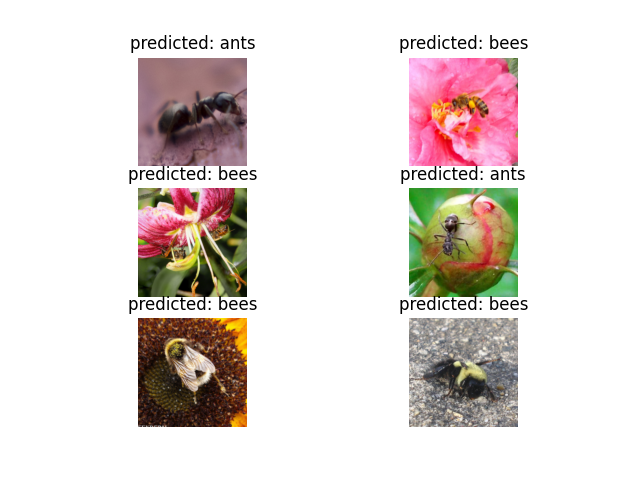
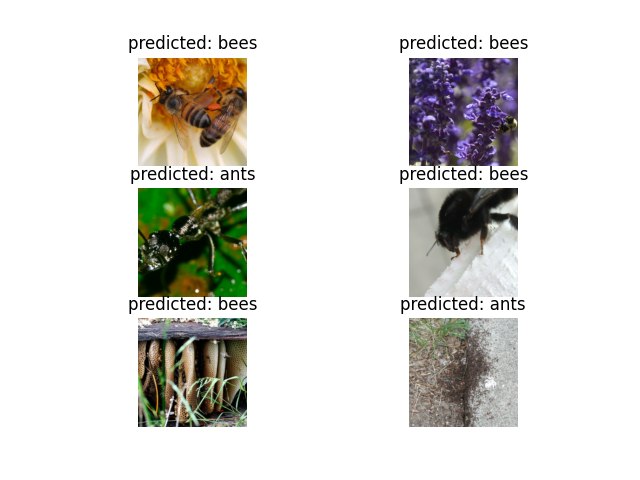
Visualizing the model predictions#
Generic function to display predictions for a few images
def visualize_model(model, num_images=6):
    was_training = model.training
    model.eval()
    images_so_far = 0
    fig = plt.figure()

    with torch.no_grad():
        for i, (inputs, labels) in enumerate(dataloaders['val']):
            inputs = inputs.to(device)
            labels = labels.to(device)

            outputs = model(inputs)
            _, preds = torch.max(outputs, 1)

            for j in range(inputs.size()[0]):
                images_so_far += 1
                ax = plt.subplot(num_images//2, 2, images_so_far)
                ax.axis('off')
                ax.set_title(f'predicted: {class_names[preds[j]]}')
                imshow(inputs.cpu().data[j])

                if images_so_far == num_images:
                    model.train(mode=was_training)
                    return
        model.train(mode=was_training)
Finetuning the ConvNet#
Load a pretrained model and reset final fully connected layer.
model_ft = models.resnet18(weights='IMAGENET1K_V1')
num_ftrs = model_ft.fc.in_features
# Here the size of each output sample is set to 2.
# Alternatively, it can be generalized to ``nn.Linear(num_ftrs, len(class_names))``.
model_ft.fc = nn.Linear(num_ftrs, 2)

model_ft = model_ft.to(device)

criterion = nn.CrossEntropyLoss()

# Observe that all parameters are being optimized
optimizer_ft = optim.SGD(model_ft.parameters(), lr=0.001, momentum=0.9)

# Decay LR by a factor of 0.1 every 7 epochs
exp_lr_scheduler = lr_scheduler.StepLR(optimizer_ft, step_size=7, gamma=0.1)
Downloading: "https://download.pytorch.org/models/resnet18-f37072fd.pth" to /var/lib/ci-user/.cache/torch/hub/checkpoints/resnet18-f37072fd.pth

  0%|          | 0.00/44.7M [00:00<?, ?B/s]
 90%|█████████ | 40.4M/44.7M [00:00<00:00, 423MB/s]
100%|██████████| 44.7M/44.7M [00:00<00:00, 424MB/s]
Train and evaluate#
It should take around 15-25 min on CPU. On GPU though, it takes less than a minute.
model_ft = train_model(model_ft, criterion, optimizer_ft, exp_lr_scheduler,
                       num_epochs=25)
Epoch 0/24
----------
train Loss: 0.6085 Acc: 0.6721
val Loss: 0.2226 Acc: 0.9281

Epoch 1/24
----------
train Loss: 0.4554 Acc: 0.7746
val Loss: 0.2066 Acc: 0.9020

Epoch 2/24
----------
train Loss: 0.5615 Acc: 0.7787
val Loss: 0.8024 Acc: 0.7582

Epoch 3/24
----------
train Loss: 0.4984 Acc: 0.8115
val Loss: 0.5729 Acc: 0.7843

Epoch 4/24
----------
train Loss: 0.6573 Acc: 0.7582
val Loss: 0.2342 Acc: 0.9085

Epoch 5/24
----------
train Loss: 0.3285 Acc: 0.8607
val Loss: 0.2177 Acc: 0.9085

Epoch 6/24
----------
train Loss: 0.5555 Acc: 0.7951
val Loss: 0.3437 Acc: 0.8170

Epoch 7/24
----------
train Loss: 0.3223 Acc: 0.8607
val Loss: 0.1905 Acc: 0.9412

Epoch 8/24
----------
train Loss: 0.3460 Acc: 0.8402
val Loss: 0.1901 Acc: 0.9412

Epoch 9/24
----------
train Loss: 0.2787 Acc: 0.8607
val Loss: 0.1823 Acc: 0.9608

Epoch 10/24
----------
train Loss: 0.3544 Acc: 0.8484
val Loss: 0.1826 Acc: 0.9412

Epoch 11/24
----------
train Loss: 0.3980 Acc: 0.8115
val Loss: 0.1820 Acc: 0.9477

Epoch 12/24
----------
train Loss: 0.3580 Acc: 0.8402
val Loss: 0.1848 Acc: 0.9412

Epoch 13/24
----------
train Loss: 0.2958 Acc: 0.8484
val Loss: 0.1901 Acc: 0.9346

Epoch 14/24
----------
train Loss: 0.2842 Acc: 0.8525
val Loss: 0.2579 Acc: 0.9020

Epoch 15/24
----------
train Loss: 0.2924 Acc: 0.8689
val Loss: 0.1932 Acc: 0.9346

Epoch 16/24
----------
train Loss: 0.2418 Acc: 0.9016
val Loss: 0.1728 Acc: 0.9477

Epoch 17/24
----------
train Loss: 0.2387 Acc: 0.9016
val Loss: 0.1935 Acc: 0.9281

Epoch 18/24
----------
train Loss: 0.3746 Acc: 0.8197
val Loss: 0.1820 Acc: 0.9346

Epoch 19/24
----------
train Loss: 0.2482 Acc: 0.9057
val Loss: 0.1935 Acc: 0.9412

Epoch 20/24
----------
train Loss: 0.2973 Acc: 0.8689
val Loss: 0.1822 Acc: 0.9412

Epoch 21/24
----------
train Loss: 0.2424 Acc: 0.9016
val Loss: 0.1849 Acc: 0.9477

Epoch 22/24
----------
train Loss: 0.2385 Acc: 0.9098
val Loss: 0.1981 Acc: 0.9412

Epoch 23/24
----------
train Loss: 0.2251 Acc: 0.9180
val Loss: 0.1862 Acc: 0.9281

Epoch 24/24
----------
train Loss: 0.2910 Acc: 0.8811
val Loss: 0.1969 Acc: 0.9346

Training complete in 0m 37s
Best val Acc: 0.960784
visualize_model(model_ft)
ConvNet as fixed feature extractor#
Here, we need to freeze all the network except the final layer. We need
to set requires_grad = False to freeze the parameters so that the
gradients are not computed in backward().
You can read more about this in the documentation here.
model_conv = torchvision.models.resnet18(weights='IMAGENET1K_V1')
for param in model_conv.parameters():
    param.requires_grad = False

# Parameters of newly constructed modules have requires_grad=True by default
num_ftrs = model_conv.fc.in_features
model_conv.fc = nn.Linear(num_ftrs, 2)

model_conv = model_conv.to(device)

criterion = nn.CrossEntropyLoss()

# Observe that only parameters of final layer are being optimized as
# opposed to before.
optimizer_conv = optim.SGD(model_conv.fc.parameters(), lr=0.001, momentum=0.9)

# Decay LR by a factor of 0.1 every 7 epochs
exp_lr_scheduler = lr_scheduler.StepLR(optimizer_conv, step_size=7, gamma=0.1)
Train and evaluate#
On CPU this will take about half the time compared to previous scenario. This is expected as gradients don’t need to be computed for most of the network. However, forward does need to be computed.
model_conv = train_model(model_conv, criterion, optimizer_conv,
                         exp_lr_scheduler, num_epochs=25)
Epoch 0/24
----------
train Loss: 0.6880 Acc: 0.6230
val Loss: 0.2614 Acc: 0.9085

Epoch 1/24
----------
train Loss: 0.5453 Acc: 0.7377
val Loss: 0.2634 Acc: 0.8824

Epoch 2/24
----------
train Loss: 0.4910 Acc: 0.7746
val Loss: 0.3151 Acc: 0.8627

Epoch 3/24
----------
train Loss: 0.6182 Acc: 0.7500
val Loss: 0.3836 Acc: 0.8497

Epoch 4/24
----------
train Loss: 0.5353 Acc: 0.7951
val Loss: 0.1782 Acc: 0.9216

Epoch 5/24
----------
train Loss: 0.3773 Acc: 0.8279
val Loss: 0.2087 Acc: 0.9150

Epoch 6/24
----------
train Loss: 0.4413 Acc: 0.7869
val Loss: 0.1787 Acc: 0.9346

Epoch 7/24
----------
train Loss: 0.3208 Acc: 0.8648
val Loss: 0.1836 Acc: 0.9412

Epoch 8/24
----------
train Loss: 0.3875 Acc: 0.8402
val Loss: 0.1728 Acc: 0.9477

Epoch 9/24
----------
train Loss: 0.3393 Acc: 0.8484
val Loss: 0.1720 Acc: 0.9542

Epoch 10/24
----------
train Loss: 0.3104 Acc: 0.8730
val Loss: 0.1724 Acc: 0.9477

Epoch 11/24
----------
train Loss: 0.3305 Acc: 0.8443
val Loss: 0.1864 Acc: 0.9412

Epoch 12/24
----------
train Loss: 0.3414 Acc: 0.8689
val Loss: 0.1564 Acc: 0.9477

Epoch 13/24
----------
train Loss: 0.4895 Acc: 0.7787
val Loss: 0.1815 Acc: 0.9412

Epoch 14/24
----------
train Loss: 0.4183 Acc: 0.8197
val Loss: 0.1533 Acc: 0.9477

Epoch 15/24
----------
train Loss: 0.3389 Acc: 0.8607
val Loss: 0.1702 Acc: 0.9346

Epoch 16/24
----------
train Loss: 0.3447 Acc: 0.8402
val Loss: 0.1710 Acc: 0.9542

Epoch 17/24
----------
train Loss: 0.2947 Acc: 0.8689
val Loss: 0.1662 Acc: 0.9477

Epoch 18/24
----------
train Loss: 0.3481 Acc: 0.8279
val Loss: 0.1735 Acc: 0.9477

Epoch 19/24
----------
train Loss: 0.3982 Acc: 0.8279
val Loss: 0.1740 Acc: 0.9412

Epoch 20/24
----------
train Loss: 0.3415 Acc: 0.8279
val Loss: 0.2340 Acc: 0.9085

Epoch 21/24
----------
train Loss: 0.3535 Acc: 0.8443
val Loss: 0.1854 Acc: 0.9477

Epoch 22/24
----------
train Loss: 0.2956 Acc: 0.8607
val Loss: 0.1720 Acc: 0.9477

Epoch 23/24
----------
train Loss: 0.4191 Acc: 0.8320
val Loss: 0.1600 Acc: 0.9542

Epoch 24/24
----------
train Loss: 0.3633 Acc: 0.8320
val Loss: 0.1864 Acc: 0.9477

Training complete in 0m 28s
Best val Acc: 0.954248
visualize_model(model_conv)

plt.ioff()
plt.show()
Inference on custom images#
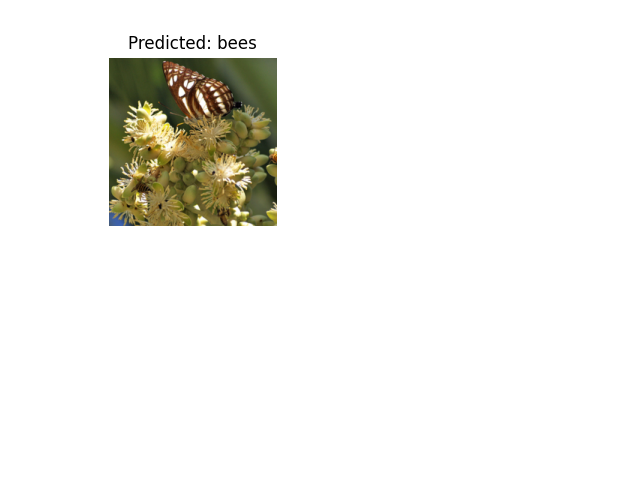
Use the trained model to make predictions on custom images and visualize the predicted class labels along with the images.
def visualize_model_predictions(model,img_path):
    was_training = model.training
    model.eval()

    img = Image.open(img_path)
    img = data_transforms['val'](img)
    img = img.unsqueeze(0)
    img = img.to(device)

    with torch.no_grad():
        outputs = model(img)
        _, preds = torch.max(outputs, 1)

        ax = plt.subplot(2,2,1)
        ax.axis('off')
        ax.set_title(f'Predicted: {class_names[preds[0]]}')
        imshow(img.cpu().data[0])

        model.train(mode=was_training)
visualize_model_predictions(
    model_conv,
    img_path='data/hymenoptera_data/val/bees/72100438_73de9f17af.jpg'
)

plt.ioff()
plt.show()
Further Learning#
If you would like to learn more about the applications of transfer learning, checkout our Quantized Transfer Learning for Computer Vision Tutorial.
Total running time of the script: (1 minutes 7.831 seconds)